


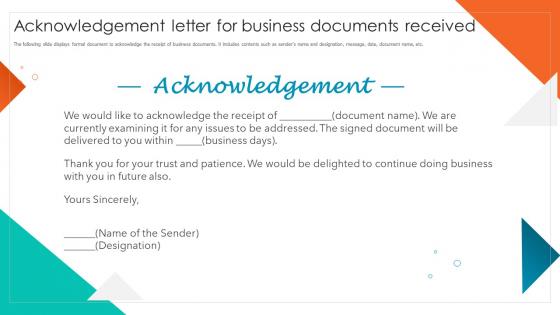
Acknowledgement Letter For Business Documents Received




Try Before you Buy Download Free Sample Product
 Impress Your
 Audience
 100%
100% Editable
 Save Hours
 of Time


The following slide displays formal document to acknowledge the receipt of business documents. It includes contents such as senders name and designation, message, date, document name, etc.
People who downloaded this PowerPoint presentation also viewed the following :
Acknowledgement Letter For Business Documents Received with all 6 slides:
Use our Acknowledgement Letter For Business Documents Received to effectively help you save your valuable time. They are readymade to fit into any presentation structure.





FAQs for Acknowledgement Letter For
You need five things in a good acknowledgment letter: mention exactly what you got, when you received it, what happens next (with timing), your contact info, and the right tone. The tone thing is honestly where most people mess up - don't be too formal but also don't gush all over them. Be specific too! Instead of "your application," say "your marketing coordinator application." Always give them a timeline, even if it's just "we'll get back to you in two weeks." People hate being left hanging, and it shows you actually respect their time.
Look, acknowledgment letters are honestly one of those small things that make a huge difference. People remember who takes time to say thanks - it builds real trust and shows you're not just taking their help for granted. I've seen it strengthen so many work relationships over time. When someone puts in effort or shares their expertise, a formal note demonstrates you actually noticed and care. It sounds cheesy but it creates goodwill that pays off later. You'll get better collaboration, people will be more willing to help again, and your network grows stronger. Maybe start with whoever helped you on that recent project?
Look, you want to hit that sweet spot between professional and actually human. Nobody wants to read some corporate robot response - like seriously, who needs "we are in receipt of" when "thanks for" does the job? Just be genuinely grateful without the crazy enthusiasm. Keep it straightforward and warm, kind of like talking to a coworker you actually like. Don't overthink the language. Oh, and definitely wrap up with what happens next so they're not left wondering if their email disappeared into the void.
Honestly, it's all about what industry you're in. Legal stuff has to be super formal with exact wording - kinda boring but whatever. Tech companies? They can be way more chill about it. Healthcare and finance need all those compliance disclaimers (ugh), but creative agencies get to make theirs actually look cool and branded. Government sticks to their standard templates like always. Startups usually just send quick, personal notes. My advice? Find samples from your specific field and copy their vibe. Don't just grab some random template online - it'll probably sound off for what you need.
Honestly, most people mess up by being way too vague - like just saying "got your letter, thanks!" which tells them absolutely nothing. You've gotta be specific about dates, amounts, reference numbers, whatever applies. Skip the super formal robot language too. Oh, and don't promise stuff you can't actually deliver or give them some crazy timeline that'll bite you later. Send it quickly though - waiting weeks makes the whole thing pointless. I'd keep it short but make sure you cover everything important. Double-check the recipient's right and your facts are straight before you send it off.
Honestly, acknowledgment letters are kind of underrated but they work. Customers just want to know you actually got their message and care about whatever's bugging them. It buys you time to figure things out without them wondering if their email disappeared into the void. I've seen people stay loyal to companies even during problems just because they felt heard, you know? Don't overthink it though - just be specific about what they told you and give them a realistic timeline for your response. Something like "got your complaint about the broken widget, we'll get back to you by Friday" does the trick.
Honestly, acknowledgment letters are clutch when you need to cover your ass or just buy time. Send them for job apps, complaints, big purchases - basically anything formal where someone needs proof you got their message. Legal stuff and insurance claims especially. If there's a deadline but you can't respond right away? Fire off an acknowledgment. Shows you're not ignoring them even though you need more time to think. I learned this the hard way after missing some important work email once. When you're unsure, just acknowledge it.
Skip the boring "thanks for your help" stuff - that's so generic. Get specific about what they actually did. Like, mention the exact project or that clever idea they pitched in the meeting. I always throw in something that proves I was actually listening, you know? Maybe reference how they handled that messy situation or a random conversation you had. Personal details make all the difference. Their unique strengths, the impact they made on the team. People want to feel like you see them as a real person, not just some checkbox you're ticking off.
Acknowledgment letters are basically receipts for project stuff. When you hand off tasks or share critical info, they confirm people actually got what you sent and understand what they're supposed to do. Super useful for getting sign-offs on milestones too. Honestly, they're lifesavers when dealing with vendors or clients who love to develop sudden amnesia about their commitments. Send them for any big decisions or handoffs - trust me, you'll be glad you did when someone tries to backtrack later. They're your proof that everyone was on the same page.
Okay so templates are honestly a game-changer for acknowledgment letters. Instead of writing from scratch every time, you just swap in the specifics - names, dates, whatever you're acknowledging. Saves me so much time when I'm drowning in other stuff. They also help you stay consistent and not forget the basics like proper greetings or follow-up steps. Just don't make them sound like robots wrote them, you know? I'd start with maybe 2-3 templates for your most common situations. Trust me, you'll thank yourself later.
Yeah, they can carry legal weight depending on what you're acknowledging. Confirming you got documents or admitting fault creates a paper trail courts might use later. Basically "we both agree this went down" type proof - which honestly saves everyone headaches when disputes pop up. Just be careful with your wording so you don't accidentally admit to stuff you didn't mean to. My cousin learned that the hard way in a fender bender situation. Read through it twice before hitting send, especially if there's any chance of legal drama down the line.
Definitely ditch those boring "thanks for applying" emails. I always use their actual name and mention something specific from what they sent - shows you actually read it instead of just hitting copy-paste. Nobody remembers generic form letters anyway. Throw in some personality and tell them when they'll hear back so they're not sitting there wondering. Oh, and maybe share something cool about working there or why you're pumped about their application. You want them thinking "wow, these people actually care" not "great, another robot response." Makes a huge difference.
Oh man, this is so important! Different cultures have completely different expectations for acknowledgment letters. Japanese business culture wants super formal language with lots of gratitude expressed throughout. Germans? They actually prefer short and direct - no fluff. Americans usually go warm but keep it brief. I totally messed this up once by sending a casual "thanks!" to a Japanese client - awkward doesn't even cover it. Middle Eastern cultures often include religious blessings, and Latin cultures expect more personal relationship stuff woven in. Before you write yours, just do a quick search on their culture's business norms. Trust me, it's worth the five minutes to avoid looking clueless.
Honestly, acknowledgment letters can make or break donor relationships at nonprofits. Send them for donations, volunteer work, all that stuff - partly for tax receipts but mostly to keep people engaged. Quick turnaround matters way more than you'd think. Personal touches work wonders too, like mentioning exactly what their $50 bought or how many meals it provided. I'd set up templates for different donation amounts to save time, but don't make them sound robotic. One organization I know doubled their repeat donors just by fixing these letters. People want to feel appreciated, not like they're just another name in your database.
Oh these are the fun ones to write! Academic acknowledgment letters cover stuff like scholarships, dean's list, graduation honors, research grants, competition wins. You want to be specific about what they actually accomplished and why it's a big deal. Like if it's dean's list, mention the GPA cutoff. Scholarship? Talk about how competitive it was. I always keep a basic template but then personalize each one - makes it way less repetitive. Honestly beats writing rejection letters any day. The key is being formal enough but still showing you're genuinely excited for them.
-
Very unique and reliable designs.
-
Wonderful templates design to use in business meetings.