


Acknowledgement template with short briefing and table of contents





Try Before you Buy Download Free Sample Product
 Impress Your
 Audience
 100%
100% Editable
 Save Hours
 of Time


Our Acknowledgement Template With Short Briefing And Table Of Contents ensure you are never hard put. They are created to facilitate your efforts.
People who downloaded this PowerPoint presentation also viewed the following :
Content of this Powerpoint Presentation
Description:
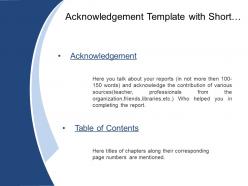
This image is a slide from a presentation, titled "Acknowledgement Template with Short..." indicating that it may be part of a series for guiding on how to draft acknowledgements in reports or documents. The slide is divided into two primary sections:
1. Acknowledgement:
This bullet point instructs the presenter to talk about their reports and acknowledge the contributions of various sources such as teachers, professionals from organizations, friends, and libraries in no more than 100-150 words. It stresses the importance of giving credit to those who assisted in the completion of the report.
2. Table of Contents:
This section is meant to guide on how to present the titles of chapters in a report along with their corresponding page numbers. This is a fundamental component of any structured document, providing an overview of the content and easy navigation for the reader.
Use Cases:
The industries where such slides can be useful span across any field where structured reporting and formal documentation presentations are required.
1. Academia:
Use: Teaching students how to write and present reports.
Presenter: Professor or Academic Instructor.
Audience: Students.
2. Scientific Research:
Use: Presenting research findings and acknowledging contributions.
Presenter: Researcher or Scientist.
Audience: Peers or Funding Committee.
3. Publishing:
Use: Guiding authors on manuscript preparation.
Presenter: Editor or Publishing Consultant.
Audience: Authors or Aspiring Writers.
4. Business:
Use: Compiling business reports or proposals.
Presenter: Business Analyst or Consultant.
Audience: Management or Stakeholders.
5. Healthcare:
Use: Documenting medical research or clinical study findings.
Presenter: Medical Researcher or Clinician.
Audience: Medical Professionals or Regulatory Bodies.
6. Non-Profit Organizations:
Use: Reporting on project outcomes and acknowledging donors or volunteers.
Presenter: Project Manager or Director.
Audience: Donors, Volunteers, or Board Members.
7. Legal:
Use: Preparing case reports or legal briefs.
Presenter: Lawyer or Paralegal.
Audience: Legal Professionals or Clients.
Acknowledgement template with short briefing and table of contents with all 5 slides:
Handle the cliff hanger with our Acknowledgement Template With Short Briefing And Table Of Contents. Impress folks with your calm demeanor.
FAQs for Acknowledgement template with short briefing and
So basically throw in a clear subject line that mentions what you're acknowledging, plus the date you got their message. Give them a quick summary so they know you actually read it - not just some lazy "thanks, got it" text. I'm terrible with timing stuff but definitely give them a realistic heads up on when you'll get back to them. Your contact info helps if they need to bug you again. Oh, and match whatever tone you normally use with them. The whole point is being specific enough that it's obvious you paid attention to what they sent.
Honestly, templates are lifesavers for this stuff. They stop you from having that horrible moment where you realize you forgot to thank your boss or whoever gave you data. Creates a systematic way to hit everyone - team members, stakeholders, sources, all that. Saves tons of time too since you're not panicking last minute trying to remember people. Audiences definitely pick up on the professionalism when you nail the acknowledgements. Oh, and here's the thing - make one template now that you can tweak for different presentations. Trust me, you'll be so glad you did this prep work later.
Honestly, any industry dealing with sensitive stuff benefits big time - healthcare, legal, financial services. They've got compliance rules up the wazoo, so templates are a lifesaver. Customer service teams swear by them too since response times drop like crazy. One company I heard about cut their drafting time by 70% after getting their templates sorted. Government and schools use them everywhere for consistency, which makes total sense when you think about it. The trick is finding templates that actually fit your industry's vibe and rules, then teaching people how to tweak them without going overboard.
So basically it's all about reading the room. Formal presentations? You gotta do the whole thing - full names, titles, funding sources, the works. Think academic conferences where people actually care about proper protocol. But informal stuff? Just keep it chill. "Thanks to my team" or "Sarah saved my butt with those late-night ideas" totally works. I honestly think people overthink this part. Match what your audience expects and you're good. Don't accidentally forget someone important though - that's always awkward regardless of the setting.
Honestly, the worst thing you can do is copy-paste without changing anything - people spot that fake stuff immediately. Be specific about what you're actually acknowledging instead of keeping it super vague. Also, don't suddenly sound like a corporate robot if that's not how you normally talk, it's just weird. Oh, and if they're waiting for next steps or timing info, definitely include that. I learned this the hard way when my boss kept asking for updates I never mentioned. Bottom line: make it personal, be clear about what you got, and write like yourself.
Yeah, this stuff is trickier than people think! Different cultures have totally different expectations - some places you HAVE to list the senior people first or you'll offend someone. Others just go alphabetically or by who contributed what. The formality thing varies wildly too. Like, what sounds polite in Japan might come across as weirdly stiff in Australia, you know? I'd definitely look up the cultural norms first, and honestly? Find someone from that culture to double-check your draft. Language nuances can make or break these things. Trust me, I've watched acknowledgements bomb because nobody thought about this beforehand.
Yeah, visuals definitely help! Photos of your team or partner logos make it way more personal than just text. I mean, people connect with faces, right? Keep it simple though - I've seen presentations where they went crazy with graphics and it just looked messy. Match whatever style you're already using in the rest of your slides. Honestly, sometimes just a clean "Thank You" with a team photo beats all the fancy stuff. Don't let the visuals steal the show from your actual message of gratitude.
Oh totally! Skip the boring "thanks for your support" stuff - nobody cares about that. Get specific instead. Like "your late-night brainstorming sessions saved this project" or "you caught the errors that would've embarrassed us all." Way better, right? I always use phrases like "because of you" or "your insight led to..." since they show actual impact. Corporate speak just makes people zone out tbh. The key is being personal and concrete - mention real moments when you can. That's what makes acknowledgements actually hit different instead of sounding like every other thank you note ever written.
Honestly, just ditch the boring generic stuff and make it actually about them. Swap "Dear colleagues" for whatever they'd actually respond to - like "Hey team" or whatever fits. The spots that matter most? Your opening, the actual thing you're thanking them for (be specific!), and how you wrap up. Those template things always sound so robotic anyway. Oh, and definitely think about who you're writing to - formal boss vs casual coworker makes a huge difference. I'd pick like 3-4 sections that feel super cookie-cutter and rewrite those with real details about what actually happened. Makes it way more genuine.
Dude, acknowledging your audience right off the bat actually works. Like, people will literally put their phones down and pay attention when you start with something real they're dealing with. I've watched speakers completely flip a room just by saying "I know you're all thinking about the budget cuts" or whatever's actually on their minds. Response rates go up, people stick around longer - the whole thing. But skip the generic "thanks for coming" garbage. That does nothing. Make it specific to what they're going through. It's honestly one of those simple tricks that feels almost unfair how well it works.
Digital presentations give you way more room to get creative - slide animations, clickable profile links, maybe even video thank-yous if you're going all out. In-person is different though. You want shorter, snappier acknowledgments and actually engage with people - point them out, have them stand up. With digital formats, people read at their own speed so you can add more detail. Live presentations need to keep moving or you'll lose everyone. Oh, and definitely test your tech stuff beforehand! Nothing's more awkward than a dead link right when you're trying to wrap up nicely.
So basically, academic acknowledgments are way longer and more formal than corporate ones. You'd thank your advisor, committee members, funding sources, family - honestly it's like Oscar speech territory. Corporate presentations? Keep it short and sweet. Just focus on your immediate team, stakeholders, maybe data sources. The whole vibe is different - academia celebrates this long research journey while corporate stuff is more about who helped with that specific deck. I'd say stick to core contributors for work presentations and save the emotional thank-yous for thesis defense day.
Honestly, just make it genuine - mention specific people and actually say WHY you're thanking them instead of just listing names. Practice saying everyone's names beforehand too (trust me, you don't want to butcher your manager's name up there lol). Look at people when you mention them if they're in the audience. Oh and keep it short! Nobody wants to sit through a 5-minute thank-you marathon. The key is sounding like you actually mean it - let the emotion come through your voice. Start your list early so you don't have that "oh crap I forgot someone" moment later.
Yeah, definitely update those acknowledgements when your project shifts. I keep a running list of people who've helped - saves me from that panic when deadlines hit and I'm trying to remember everyone. Add new collaborators, funding sources, whoever. People get genuinely hurt if they feel overlooked after putting in real work. Honestly, outdated acknowledgements can mess up relationships faster than you'd think. I check mine every few months or after big milestones. Way more important than keeping LinkedIn current, though that's probably not saying much.
Depends what you're going for really. Word and Google Docs are the obvious picks for basic stuff with merge fields. Canva's where it's at if you want something that actually looks good though - way better than my design skills anyway. Adobe InDesign works great for print materials. Oh, and if you're doing tons of digital ones, Mailchimp or Constant Contact might save you time. Honestly? Just start with whatever you already know how to use. You can always switch later if it's not cutting it.
-
Innovative and Colorful designs.
-
Excellent products for quick understanding.