


Acknowledgement Letter For Information Received By Customer




Try Before you Buy Download Free Sample Product
 Impress Your
 Audience
 100%
100% Editable
 Save Hours
 of Time


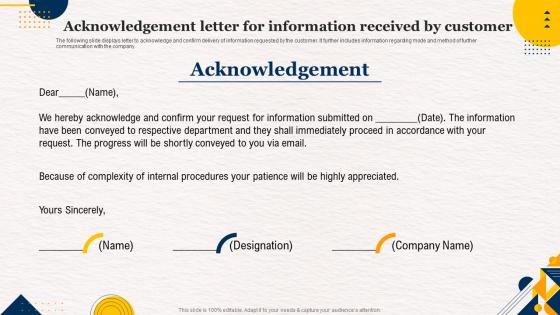
The following slide displays letter to acknowledge and confirm delivery of information requested by the customer. It further includes information regarding mode and method of further communication with the company.
People who downloaded this PowerPoint presentation also viewed the following :
Acknowledgement Letter For Information Received By Customer with all 6 slides:
Use our Acknowledgement Letter For Information Received By Customer to effectively help you save your valuable time. They are readymade to fit into any presentation structure.






FAQs for Acknowledgement Letter For Information
Effective acknowledgement letters include a clear subject line, prompt response timing, specific reference to what's being acknowledged, sincere appreciation language, and professional contact information. These elements work together by establishing credibility, demonstrating professionalism, and maintaining positive stakeholder relationships, with many organizations finding that well-crafted acknowledgements enhance customer satisfaction and strengthen business communications.
Acknowledgement letters enhance professional communication by confirming receipt of important documents, demonstrating responsiveness and reliability, and creating clear paper trails for accountability. These formal confirmations streamline business processes by reducing follow-up inquiries, building trust between parties, and ensuring all stakeholders remain informed, ultimately delivering improved operational efficiency and stronger professional relationships across organizations.
Acknowledgement letters confirm receipt of documents, applications, or communications and outline next steps, while thank-you letters express gratitude for gifts, services, or opportunities received. While acknowledgement letters focus on formal business processes like job applications or insurance claims, thank-you letters emphasize personal appreciation, with many organizations finding that combining both approaches enhances customer relationships and professional communication.
Acknowledgement letters should be sent within 24-48 hours after receiving important business communications, proposals, complaints, applications, or payments to maintain professional relationships and operational transparency. This prompt response demonstrates organizational efficiency, builds client trust, and ensures clear communication flow, with many companies finding that timely acknowledgements significantly enhance customer satisfaction and reduce follow-up inquiries.
Professional acknowledgement letters require formal, respectful language for business contexts, while personal acknowledgements can adopt warmer, more conversational tones with emotional expressions of gratitude. The tone should match your relationship with the recipient, with corporate communications maintaining structured courtesy and individual thank-you letters allowing greater personalization, ultimately ensuring your message resonates appropriately and strengthens professional relationships.
Acknowledgement letters establish formal records of receipt, agreement, or understanding between parties, creating verifiable documentation that can support contract enforcement, dispute resolution, and compliance verification. These letters provide timestamped evidence of communications, deliveries, or contractual obligations, with many legal professionals finding that proper acknowledgement documentation significantly strengthens case positions and minimizes ambiguities in business relationships.
Common mistakes include being too generic, omitting specific details about what is being acknowledged, using overly formal or impersonal language, failing to include next steps or timelines, and neglecting to proofread for errors. These oversights can undermine professional relationships and create confusion, with many organizations finding that personalized, detailed acknowledgements enhance stakeholder trust and streamline communication processes.
Yes, specific templates streamline acknowledgment letter creation, including donation receipts, job application confirmations, complaint responses, meeting attendance verifications, and document receipt acknowledgments. These standardized formats help organizations maintain consistent professional communication while ensuring all necessary details are included, ultimately enhancing operational efficiency and improving stakeholder relationships across various business contexts.
Personalization in acknowledgement letters significantly enhances recipient perception by demonstrating genuine attention, respect for individual contributions, and organizational thoughtfulness through specific details, customized messaging, and relevant context. This approach strengthens professional relationships, increases recipient satisfaction, and builds lasting trust, with many organizations finding that personalized acknowledgements improve employee engagement, client loyalty, and overall brand reputation more effectively than generic communications.
**INPUT**: What is the appropriate length for an acknowledgement letter? **OUTPUT**: Acknowledgement letters should typically be one page or 200-400 words, maintaining conciseness while covering essential elements like gratitude expression, specific reference details, and next steps. This strategic length enables professional communication that respects recipients' time while delivering comprehensive information, with many organizations finding that brief, focused correspondence enhances relationships and streamlines business processes. *Word count: 56 words*
Acknowledging contributions through acknowledgement letters significantly boosts team morale by fostering recognition, validation, and appreciation among team members. These personalized communications enhance employee engagement, strengthen workplace relationships, and increase job satisfaction, with many organizations finding that formal recognition programs reduce turnover while improving productivity and overall team cohesion.
Digital acknowledgement letters are preferable when speed, cost efficiency, environmental sustainability, and tracking capabilities are priorities, particularly in high-volume business operations, remote work environments, and customer service scenarios. Many organizations find that digital formats enable instant delivery, automated record-keeping, and seamless integration with existing systems, while significantly reducing printing costs and supporting increasingly paperless business practices.
The design of an acknowledgement letter significantly influences its effectiveness by enhancing readability, reinforcing brand professionalism, and creating positive recipient impressions through clear formatting, strategic use of whitespace, and consistent visual hierarchy. Well-designed letters with clean layouts, appropriate fonts, and organized content structure streamline communication flow while building trust, with many organizations finding that thoughtful design elements ultimately deliver stronger relationships and improved business correspondence outcomes.
Acknowledgement letters in project management serve as formal documentation confirming receipt of deliverables, milestone completions, change requests, and stakeholder communications, ensuring transparency and accountability throughout project lifecycles. These communications streamline coordination between teams, clients, and vendors by establishing clear records of accepted work and agreements, ultimately reducing disputes and enhancing project efficiency across industries.
Following up after sending an acknowledgement letter includes setting clear timeline expectations, maintaining consistent communication channels, providing regular progress updates, and ensuring all promised actions are completed punctually. These practices streamline ongoing relationships by demonstrating reliability, building trust, and enhancing professional credibility, with many organizations finding that systematic follow-up ultimately delivers stronger partnerships and improved stakeholder confidence.
-
Placing an order on SlideTeam is very simple and convenient, saves you a lot of your time.
-
This design is not only aesthetically pleasing but it has many uses making the cost worthwhile. The graphics look stunning, and you can edit them as per your needs.