

Activation Function In A Neural Network Training Ppt




Try Before you Buy Download Free Sample Product
 Impress Your
 Audience
 100%
100% Editable
 Save Hours
 of Time


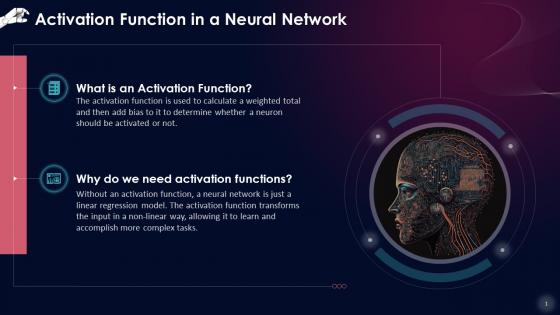
This slide gives an introduction to activation function in a neural network and discusses its importance. The activation function is used to calculate a weighted total and then add bias to it to determine whether a neuron should be activated or not.
People who downloaded this PowerPoint presentation also viewed the following :
Activation Function In A Neural Network Training Ppt with all 17 slides:
Use our Activation Function In A Neural Network Training Ppt to effectively help you save your valuable time. They are readymade to fit into any presentation structure.












FAQs for Activation Function In A Neural
Think of activation functions as the on/off switches for neurons - they decide what gets passed along based on the input they receive. Your network would just be boring linear math without them, honestly. They're what give neural networks the ability to learn weird, complex stuff in your data. ReLU is usually my go-to since it's straightforward and trains fast. Sigmoid and tanh are other popular options, but they each behave differently during training. I'd say start with ReLU - you can always experiment later if you need something specific.
So activation functions are what decide which neurons actually "fire" and send info forward through your network. Without them you'd just have a boring linear model that can't learn complex patterns. The tricky part is they all create different gradients during backpropagation, so some help your weights update faster than others. ReLU is super popular because it speeds up training, but honestly it can kill off neurons permanently. Sigmoid causes vanishing gradients which is annoying. I'd say just try a few different ones and see what clicks with your specific problem - there's no magic formula really.
So linear functions just multiply your input by some constant - super basic stuff like f(x) = 2x. Non-linear ones actually create curves and interesting shapes. Here's the thing though - linear functions are pretty much pointless in deep learning. You could stack a million linear layers and it'd still just be fancy linear regression lol. Non-linear functions like ReLU or sigmoid let your network actually learn complex patterns. Without them, adding more layers does literally nothing since everything collapses into one boring linear transformation. ReLU's usually your best bet to start with - works great and isn't complicated.
So sigmoid basically takes any number and squashes it between 0 and 1 - super handy for binary classification since you can treat the output like a probability. It's got this smooth S-curve that you can differentiate everywhere, which is nice. But here's where it gets annoying: the gradients vanish when inputs are really big or small, so training becomes painfully slow. Also not zero-centered, which messes with gradient updates. Most folks just use ReLU now unless they specifically need that 0-1 range for their output layer. Way less headache honestly.
ReLU's honestly your best bet for deep networks - it solves those annoying vanishing gradient issues that sigmoid and tanh create. The math is dead simple too: just max(0,x). Works amazing for CNNs and image stuff. Multiple hidden layers? ReLU's got you covered since gradients actually flow during backprop. Plus the sparsity helps with learning features, which is pretty cool. Only downside is dying ReLUs if you crank the learning rate too high - learned that one the hard way. Leaky ReLU fixes that though.
So tanh is zero-centered, which is pretty nice - your outputs go from -1 to 1 instead of sigmoid's 0 to 1 range. Makes gradient flow way smoother during backprop. You'll still hit vanishing gradients with deep networks though, just not as brutally as sigmoid does it. The saturation thing is still annoying when inputs get big. Honestly? If you're doing shallow stuff or really need those zero-centered outputs, tanh's solid. But deep networks - nah, just go ReLU. Way less headache.
Oh man, activation functions are such a game changer for training speed. ReLU is usually your best bet - gradients stay strong even when you go deep, unlike sigmoid which just dies out in later layers. Super annoying when that happens btw. Sigmoid gets saturated and your gradients become basically useless, so training just crawls. ReLU can have its own issues though - neurons sometimes get stuck at zero and never recover. That's why I'd actually go with Leaky ReLU if you start seeing dead neurons. Works way more reliably in my experience.
So you've got ReLU, sigmoid, tanh, and Leaky ReLU as your main options. ReLU's basically the go-to since it's dead simple - just zeros out negative stuff and passes through positive values. Sigmoid squashes everything to 0-1, tanh does -1 to 1. Most people just stick with ReLU variants these days, honestly. Leaky ReLU's nice because it fixes that annoying "dying ReLU" thing by letting tiny negative values slip through. I'd say just go with regular ReLU for your next project unless something specific makes you think otherwise. Can't really go wrong with it.
So activation functions are what let neural networks learn weird, complex patterns instead of just being glorified linear regression. Without them, stacking more layers does nothing. Linear ones are straightforward but boring. Non-linear activations like ReLU, sigmoid, and tanh? They're where the magic happens - your network can suddenly approximate insanely complex functions. ReLU's become the go-to because it's fast and dodges vanishing gradients (though neurons can randomly "die" which is annoying). Honestly, just start with ReLU by default. You can always experiment later if you hit problems.
Oh, ReLU is definitely your best bet to start with - it just zeros out negative inputs and keeps positive ones as-is. Super straightforward and works great for most stuff. Leaky ReLU is worth trying if you run into dead neuron problems since it lets tiny negative values through instead of killing them completely. There's also ELU and Swish floating around, which some people swear by for really deep networks. Tbh I always just stick with regular ReLU unless something's clearly broken. Why overcomplicate things, you know? Maybe mess around with Leaky ReLU later if training gets weird.
Oh, softmax! So it basically takes your messy model outputs and turns them into clean probabilities that add up to 1. The math is actually kinda cool - it exponentiates each score then divides by the total, which makes bigger values really pop while keeping everything normalized. Perfect for when you need to pick one class out of many options. You can grab the highest probability for your prediction or just use the raw probabilities if you want confidence scores. Just don't use it for multi-label stuff where multiple things can be true at once - that's a different beast entirely.
So basically, regular ReLU just cuts off anything negative - boom, gone. Leaky ReLU is smarter though, it lets like 1% of negative values sneak through. Then there's parametric ReLU which is kinda overkill but lets the network learn its own leak rate. The problem with standard ReLU? Your neurons can literally die and never wake up again. I've seen this mess up entire networks. Both the other versions keep some signal flowing so your gradients don't vanish into nothing. Honestly, if you're having issues just try leaky ReLU first - dead simple swap that usually fixes things.
Honestly, custom activation functions are worth trying when ReLU or sigmoid just aren't cutting it for your specific problem. Like if you need outputs in a weird range that matches your data, or traditional functions are giving you gradient issues. I've seen some cool experiments with periodic functions for time series stuff - people get pretty creative with it. Just make sure whatever you build is differentiable or backprop's gonna be a nightmare. Oh, and definitely test it on a tiny network first. No point building something huge if your custom function doesn't actually help performance.
So the main issue is gradients shrinking to basically nothing as they move backward through your network. ReLU fixes this - it keeps a steady gradient of 1 for positive values, so you don't get that annoying shrinkage. Sigmoid and tanh are the worst offenders here. Sure, they look nice with those smooth curves, but they'll crush your gradients when inputs get large. Leaky ReLU and ELU are solid alternatives too since they prevent neurons from completely dying. Honestly, if you're stuck with vanishing gradients, just swap out sigmoid/tanh for ReLU first - works like 90% of the time.
So you want sigmoid for your output layer in binary classification. Here's why - without it, your model might spit out something crazy like -47.2 or 1000, which obviously makes no sense as a probability. Sigmoid squashes everything into that sweet 0-1 range we need. Perfect for "probability of class 1" stuff. Then you just threshold at 0.5 for your final predictions. Honestly, I can't think of a time I've seen someone use anything else for binary problems. It's basically the go-to choice and works really well.
-
Top Quality presentations that are easily editable.
-
Loved the templates on SlideTeam, I believe I have found the go to place for my presentation needs!