


Overview Of Artificial Intelligence Training Ppt




Try Before you Buy Download Free Sample Product
 Impress Your
 Audience
 100%
100% Editable
 Save Hours
 of Time


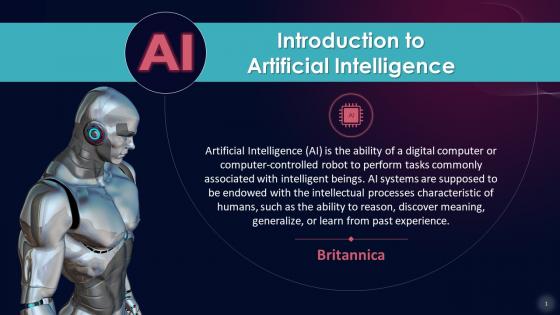
This slide provides an introduction to Artificial Intelligence AI, which involves embedding intelligence in machines so that these can function like humans. Machines use this AI to make decisions in real-time. An Artificially Intelligent computer receives real-time data, discovers its meaning and responds appropriately.
People who downloaded this PowerPoint presentation also viewed the following :
Overview Of Artificial Intelligence Training Ppt with all 17 slides:
Use our Overview Of Artificial Intelligence Training Ppt to effectively help you save your valuable time. They are readymade to fit into any presentation structure.







FAQs for Overview Of Artificial
Definitely need Python and stats/data analysis skills as your foundation. Machine learning fundamentals are key too. Ethics and bias stuff is huge right now - can't ignore that. Problem-solving matters just as much though, since you're constantly breaking down messy problems. Oh and communication skills! You'll be explaining models to people who don't get the technical side all the time. Critical thinking is massive. Start with basics first - I see way too many people jumping straight into deep learning and they're totally lost. Build up from there and you'll be solid.
Honestly, whatever paradigm you pick completely shapes how you'll train your model. Supervised learning needs tons of labeled data but it's pretty cut-and-dry - you're just trying to minimize errors. Unsupervised is way trickier because there's no "correct" answer to aim for, so you end up doing clustering or reducing dimensions instead. Reinforcement learning reminds me of training a dog - lots of rewards and punishments until it figures things out. Really depends on what data you've got and what you're actually trying to accomplish though. I'd start by figuring out which approach matches your problem first.
Honestly, your data is everything. Garbage in, garbage out - doesn't matter how fancy your algorithms are. I've seen people spend weeks trying to fix model issues when the real problem was just messy data from the start. Biased or poorly labeled datasets will tank your results every time. Clean, representative data directly impacts how well your model actually works. Trust me on this - spend the extra time upfront cleaning and validating your dataset. Way easier than debugging weird model behavior later and wondering what went wrong.
So biased training data is basically poison for AI systems. Your algorithm learns whatever patterns exist in the data - including all the nasty historical prejudices. I read about this hiring tool that totally screwed over female candidates because it learned from decades of male-heavy resumes. Crazy, right? Poor performance on underrepresented groups is just the start. We're talking real damage in healthcare, loans, criminal justice. You've got to audit your datasets constantly and hunt down diverse, representative data before you even think about training. It's honestly exhausting but necessary.
So for classification stuff, stick with the usual suspects - accuracy, precision, recall, F1 scores. Cross-validation is huge though, that's what actually tells you if your model works on new data. I do like 70/15/15 splits for train/validation/test because overfitting will totally screw you over if you're not careful. Oh and watch those loss curves while training - they're super telling about whether you're actually learning or just memorizing everything. Honestly, setting up automated testing early saves so much headache when you're comparing different versions later.
Honestly, most teams mess this up by training once and calling it done. Build feedback loops right from the start - track metrics that actually tie to your business goals, not just vanity numbers. Get your end-users reporting issues regularly. Monthly performance reviews are a good starting point. Keep experimenting with new techniques too, because the research moves fast. When you get fresh data or better methods, don't hesitate to retrain. I know it sounds like a lot, but making it systematic instead of random will save you headaches later.
Dude, transfer learning is honestly a lifesaver. You grab a pre-trained model like BERT or ResNet that already knows the basics, then just tweak it for your specific thing. Way better than starting from scratch - we're talking 70-90% less training time. It's like teaching someone to drive in your neighborhood when they already know how cars work, you know? Someone else already spent millions of hours training these models. Why reinvent the wheel? I probably should've used this approach way earlier in my projects, but whatever. Definitely try it for your next one.
So quantum computing could totally change AI training - certain calculations would run exponentially faster than regular computers. Matrix operations and optimization stuff would see huge speedups. But honestly, we're still pretty early in the game. Current quantum computers are super temperamental and make tons of errors. IBM and Google are pushing hard on quantum ML algorithms though, which is cool. You won't need to worry about changing your training setup anytime soon, but I'd definitely watch this space. Could completely flip how we do large-scale model training within ten years.
Honestly, start with your data - biased training sets create biased AI, period. Privacy stuff matters too, like did people actually consent to having their info used? Job displacement is kinda huge depending on what you're building. Also think about whether bad actors could weaponize this thing (sounds dramatic but it's real). Training these models burns through energy like crazy btw. I'd audit your dataset first to make sure it's actually diverse, then set up some deployment rules. Oh and be transparent about how decisions get made - people hate black box algorithms for good reason.
So you'll want to grab datasets that actually match your field - medical records if you're doing healthcare stuff, transaction data for fintech, whatever. Fine-tuning is where the magic happens honestly. Quality labeled data is such a pain to get though, that's always the biggest headache. Transfer learning saves you tons of time since you can build off existing models instead of reinventing the wheel. Oh and definitely start with something small first - like a pilot project to see if your approach even works. Way better than going all-in and realizing you messed up the whole thing.
Honestly, you gotta nail the tech stuff first - ML fundamentals, data science, current AI tools. Teaching skills are equally crucial though. Breaking down crazy complex concepts so people actually get it? That's an art. I'd say pick one AI area and go deep rather than being shallow everywhere. You'll need hands-on experience with whatever tools you're teaching - can't fake that. Communication matters tons since everyone learns differently, and let's be real, AI changes every five minutes. Also connecting abstract ideas to stuff people care about in real life makes all the difference.
Honestly, gamification is perfect for AI training - people get weirdly competitive about it. Add points and leaderboards to your modules. I've watched entire teams get obsessed with beating each other on ML coursework completion rates. Make the achievements actually matter though. Like, lock advanced topics until they nail the basics first. Team challenges work great too - have groups compete on accuracy metrics or who finishes modules fastest. The whole thing stops feeling like boring technical training. Instead of dreading it, people actually start asking when the next module drops. It's pretty wild how well it works.
Honestly, TensorFlow and PyTorch are what everyone uses - they're the main ones you'll see everywhere. I'd start with Google Colab since it's free and you get GPU access without buying expensive hardware. Jupyter notebooks are pretty standard for testing stuff out. PyTorch is really picking up steam lately, especially if you're into research (though both are solid). When you need more power, there's AWS SageMaker, Google Cloud AI, Azure ML - the usual suspects. My take? Jump in with Colab and PyTorch first. You can mess around quickly, then move to cloud platforms later when you actually need the heavy lifting.
Don't try making AI act human - that's backwards thinking. Instead, play to each side's strengths. Your team handles the creative stuff, relationships, strategy calls. AI crushes the data work and repetitive tasks. Most people screw up the handoffs though, so nail down those transition points first. Run through actual scenarios with your team so they get when to bring in AI vs. trusting their gut. Honestly, I'd start super small with just one workflow. Let everyone get comfortable with the rhythm before you go crazy expanding it.
Okay so there's some cool stuff happening with AI training right now. Federated learning is blowing up - basically you can train models without having to dump all your data in one place, which is amazing for privacy reasons. Everyone's also obsessed with edge AI training because local processing is just faster. Automated ML pipelines are getting ridiculously good too (honestly saves me so much headache). But the real game-changer? Human-in-the-loop training where people and AI work together the whole time, not just humans checking at the end. Your competitors are probably already messing around with this stuff, so don't sleep on it.
-
Been using SlideTeam for some time now…can’t imagine why I wasted all that time in front of the screen trying to make the perfect presentation.
-
They had the topic I was looking for in a readymade presentation…helped me meet my deadline.