

Adding value to your customers template powerpoint topics




Try Before you Buy Download Free Sample Product
 Impress Your
 Audience
 100%
100% Editable
 Save Hours
 of Time


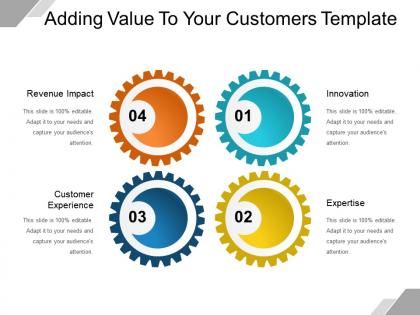
We have been talking about value in a lot of different ways over the years. We have evolved us from creating value through products to creating value through products or services, then through a combination of products, service, and information. Adding value to your customer PowerPoint slide usually talks about it as co-creating value for clients, the idea that a salesperson can only develop access to value, and that the customer must get involved in order for them to experience the value. You can use adding value to the customer PPT template to encourage your team that your business must offer the best to the customers and for that your targeted customers have to perceive the offering as the most valuable. A user can illustrate that strategically added value is cost-effective and will leave your customers with a warm feeling by using the strategic adding value presentation slide. When an individual is looking to build stronger brand loyalty, more as well as repeat sales, engaged customers, and a better bottom line, he needs to add some value and the presenter can demonstrate the same using the value added example template. Act the joker with our Adding Value To Your Customers Template Powerpoint Topics. Entertain folks with a comic interlude.
People who downloaded this PowerPoint presentation also viewed the following :
Adding value to your customers template powerpoint topics with all 5 slides:
Build firm affiliations with our Adding Value To Your Customers Template Powerpoint Topics. Establish connections that have the capability to endure.

FAQs for Adding value to your customers
Honestly, it's pretty simple but most people mess it up. Figure out your customer's exact problem first - not some vague thing, but the specific frustration that keeps them up at night. Then show how you solve it better than anyone else. Here's the thing though - skip the boring "increased efficiency" crap. Instead say something like "saves you 3 hours of reporting every week." Numbers hit different. Oh and don't forget the emotional side! People buy with feelings, then justify with logic. Start by literally writing down what your customer would complain about to their spouse, then work backwards from there.
Look, customers are drowning in choices right now, so you've gotta give them one solid reason to pick you over everyone else. What's the thing you do differently? Maybe it's how you approach problems, or some specific expertise nobody else has. Most companies honestly just blend together - which is actually perfect for you. Pick that one thing that sets you apart and hammer it home consistently. Don't try to be everything to everyone (I see this mistake constantly). Just focus on what makes you genuinely different and make sure people can't miss it.
Dude, customer feedback is everything for your value prop. Honestly, you'll be shocked how often people use your product for something completely different than what you built it for. Their actual words when they describe why they love it? Pure gold for your messaging. Survey them regularly about what they actually value and why they picked you instead of competitors. Then tweak your positioning based on that - not whatever you think sounds good internally. I learned this the hard way, but it's way more accurate than guessing.
Honestly, emotions beat logic almost every time when you're selling something. People buy with their feelings first, then justify it with facts later. Like, "save 20%" is fine, but "protect your family's future" actually makes you feel something, you know? I've seen this work so well - fear, excitement, that sense of belonging... they're way more powerful than spreadsheets. Just don't be sleazy about it though. Mix in some real benefits so you're not manipulating people. Try tweaking one thing in your value prop to hit an emotion and watch what happens.
So you want to know if your value prop is actually working? Track customer acquisition cost and conversion rates first - those are your reality check. Churn rate shows if people bail after trying you out. NPS is clutch because it tells you if customers would recommend you to friends (honestly, word of mouth is everything). Also watch how long your sales cycle takes - good messaging should speed that up. Revenue growth and satisfaction scores help too, obviously. I'd pick maybe 3-4 metrics that make sense for your business instead of trying to track everything at once.
Honestly, you just need to make sure your brand messaging and value prop aren't contradicting each other. Like if you're positioning as the "premium" brand, don't lead with cheap prices - talk up your quality instead. I've seen this go wrong so many times when marketing teams work totally separate from product people. Map out your brand pillars against what you're actually promising customers. Look for weird gaps or places where they clash. The whole thing falls apart if they're not backing each other up, you know?
Don't make it about you - focus on what your customer's actually struggling with. "We provide excellent service" is basically meaningless, honestly. Being too vague kills everything. Also, trying to appeal to everyone? You'll end up appealing to nobody instead. Features aren't benefits - people don't care about your fancy dashboard, they care about saving time. Make sure you're different from competitors too. Oh, and test it with real people before you go all-in. I've seen so many founders fall in love with value props that sound great in their heads but totally flop with actual customers.
Look at where people actually drop off in your customer journey - that's where your value prop isn't doing its job. Map out every touchpoint and you'll spot the weak spots pretty fast. If everyone's bailing during onboarding, you're not selling the benefits hard enough at that moment. Different stages need different messaging too. Someone just discovering you cares about different stuff than someone ready to buy. I'd start by going through your current journey with fresh eyes - honestly, you'll probably cringe at how unclear some parts are. Fix those first.
Dude, visuals are game-changers for value props. People need to *see* the benefit, not just read about it. Before/after shots, ROI charts, even basic icons - they turn fuzzy concepts into something concrete. I swear, most presentations I sit through bury amazing value props under boring text walls. Such a waste! Complex stuff works great as infographics since you're breaking down multiple benefits into bite-sized pieces. Oh, and your audience will remember a good visual way longer than bullet points. Next time, swap out half your text for actual graphics or diagrams.
Talk to your customers first - surveys, casual chats, whatever works. Figure out what's actually bugging them. Most companies screw this up by listing features instead of explaining why someone should care. Your job is showing how you fix their problems better than the other guys. Test different ways of saying this with real people and see what clicks. I'd probably try 2-3 versions honestly. Keep the language simple - no fancy business speak that makes people's eyes glaze over. And obviously you've got to deliver on whatever you're promising, or none of this matters.
Stay glued to your customers - what's bugging them now vs six months ago? Their priorities shift constantly. Your value prop should be a living doc, not set in stone. I'm big on regular customer interviews and competitor watching. Track industry signals too. Honestly, most companies wait way too long to adjust their messaging. When you catch a trend early, test small tweaks first. Don't go nuclear with changes right away. Pick one channel or segment to experiment with. See how it lands before you roll it out everywhere else.
Think of pricing and value prop as a married couple - they've gotta be on the same page or everything falls apart. Premium positioning? Your prices better reflect that, or people won't buy the "high quality" story. Budget messaging with luxury pricing is honestly just confusing as hell for customers. I've watched so many businesses shoot themselves in the foot this way - they'll talk about being affordable while charging top dollar. Short path to zero sales. Whatever value story you're selling, your price needs to back it up, not work against you.
Honestly, stories just stick way better than boring feature lists. Nobody remembers bullet points, but they'll totally remember how Customer X was drowning in chaos until your thing saved the day. Structure it simple: show the mess they were in, what changed, then boom - happy ending. People instantly picture themselves getting that same win. I'd go with like a 30-second version first? Test it on a few people and see if their eyes glaze over or if they actually lean in. Way more powerful than rattling off benefits that sound like everyone else's pitch deck.
Think about Uber's "tap a button, get a ride" or how Slack just says "be less busy." Those work because you instantly know what problem they're solving. Dollar Shave Club crushed it with "great razors for a few bucks a month" (that launch video was pretty genius too). FedEx went with the classic "when it absolutely, positively has to be there overnight." See the pattern? None of them drone on about features or company history. They tell you exactly what you'll get and why it matters to YOU specifically. When you're writing yours, pretend you're explaining it to someone who's never heard of your business. Would they immediately get what's in it for them? If not, keep simplifying.
CRM systems are game-changers for segmenting your customers - you'll actually reach the right people with messages that matter. Analytics tell you what's working instead of throwing stuff at the wall. Automation handles the consistent touchpoints across email and social (saves so much time honestly). The real magic happens with personalization though. AI can adjust your messaging based on how people behave on your site, which is pretty wild when you think about it. I'd start by looking at where you're communicating now and figuring out where you can get more personal with it.
-
Amazing product with appealing content and design.
-
Great quality product.