


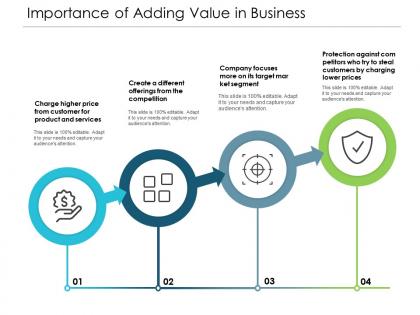
Importance of adding value in business




Try Before you Buy Download Free Sample Product
 Impress Your
 Audience
 100%
100% Editable
 Save Hours
 of Time


Handle the hounds with our Importance Of Adding Value In Business. Force your critics to actually back off.
People who downloaded this PowerPoint presentation also viewed the following :
Importance of adding value in business with all 5 slides:
Force your critics to actually back off with our Importance Of Adding Value In Business. It helps handle the hounds.



FAQs for Importance of adding
With startups, you're basically gambling on potential - can this thing actually grow and take over a market? Forget current profits for now. What matters is proving product-market fit, how fast you're getting users, and whether you can scale without everything falling apart. Big companies are the opposite - they already have revenue streams, so it's all about efficiency and steady margins. Speed kills for startups (in a good way), while established businesses need that boring consistency. Honestly, I'd rather nail the scalability piece early than waste time perfecting operations you'll probably change anyway.
You gotta track both money stuff and the softer metrics. Revenue growth, profit margins, customer lifetime value - that's your financial side. Then look at customer satisfaction, how engaged your employees are, market share shifts. Those actually predict future money better than just staring at last quarter's numbers. Most companies get obsessed with quarterly reports and totally miss what's really happening. Set up some surveys, watch your retention rates, see how well you're actually delivering value. Pick maybe 3-5 metrics that connect to what you're trying to do - don't go crazy with like 20 different dashboards. Review monthly instead of waiting for those painful annual planning meetings.
Dude, customer feedback is literally your cheat code for building stuff people will actually buy. Skip the guessing game - just listen to what they're telling you. Complaints show you what's broken. Suggestions reveal what they want next. Even praise tells you what to double down on. I learned this the hard way tbh, used to just build what I thought was cool. Now I set up feedback loops and actually close the loop when I fix something they mentioned. It's way more effective than throwing ideas at the wall and hoping something sticks.
Look, automation tools are where you'll see the biggest impact - they knock out all that repetitive stuff that eats your day. Real-time analytics help you catch opportunities way faster too. Cloud platforms? Total game-changer for team collaboration, especially if people work remotely. Here's the thing though - don't just grab every fancy new tool that pops up. Figure out where your processes are actually broken first. Then find tech that fixes those specific problems. I made that mistake early on, honestly. Focus on eliminating bottlenecks and you'll see productivity jump pretty quickly.
Dude, going green actually saves you serious money long-term. Energy bills drop, you waste less stuff, and employees stick around longer. The crazy part? Investors are literally throwing cash at companies doing ESG stuff right now - like, it's honestly insane how much they care about it. Your brand looks way better to customers too, which obviously helps sales. Plus you're basically bulletproofing your business against new regulations and supply chain weirdness down the road. My advice? Just audit what you're doing now and grab the easy wins first - some of them pay for themselves pretty quick.
Ugh, it's brutal out there - everyone's fighting for the same customers who can basically jump ship whenever they want. Margins get squeezed to nothing while you're trying to stand out from like 20 other companies doing the exact same thing. And don't even get me started on customer acquisition costs... everyone's bidding on identical keywords so prices just keep climbing. Honestly? The only companies I see making it work are either finding these super specific niches nobody else noticed, or they completely flip how the whole customer experience works. You can't just make your product 10% better anymore.
So the thing is, when teams actually communicate, everything just works better. Your sales people can tell product what customers are actually complaining about. Finance and operations team up to cut costs without screwing up quality. It's honestly wild how much changes when marketing knows what engineering is building and vice versa. The whole silo thing is such a waste - I've seen companies where departments literally work against each other without realizing it. Start with simple monthly check-ins where everyone shares their current projects and blockers. You'll be surprised how many "aha" moments happen.
Think of brand equity as your reputation turned into actual money. Strong brands let you charge more and keep customers longer - plus you don't have to spend as much hunting for new ones since people already know you're legit. Competitors can't just copy that overnight, which is honestly pretty powerful. Your cash flow becomes way more predictable too. Investors notice this stuff and will pay higher valuations for it. I'd definitely track how people actually perceive your brand regularly - it usually tells you where your finances are headed before the numbers do.
Look, data analytics basically shows you where you're missing out on money. It spots patterns in how customers behave, finds bottlenecks slowing you down, reveals market gaps you didn't even know existed. Like, you might discover certain customer groups aren't being served properly by looking at purchase data. Or find weird connections between stuff that seems totally unrelated - that's honestly where the coolest insights come from. Best approach? Pick one area where you've got solid data already and ask yourself what story it's telling about missed opportunities.
Look, people won't take risks if they're scared of getting fired for failing. So build that trust first. Give them actual time to mess around with ideas - Google does that 20% thing for a reason. When smart experiments don't work out, celebrate what you learned instead of punishing anyone. Mix up your teams too. Innovation happens when the marketing person talks to the engineer, you know? But here's the thing - don't just innovate because it sounds cool. Ask your team what's driving them crazy every day and let them figure out fixes. That's where the real wins are.
Honestly, engaged employees are like gold - they're way more productive and actually stick around. When people give a damn about their job, they'll solve problems you didn't even know existed. Customer satisfaction goes up, turnover drops (which saves you tons), and your numbers just look better overall. Short sentences here work. The whole thing creates this ripple effect where happy employees attract other good people too. Oh, and definitely track engagement metrics regularly - sounds boring but you need to connect it to your actual business results to prove it's working.
Look, when the economy goes sideways, you've gotta throw out your old playbook. Inflation hits? Time to get lean on costs and position yourself as premium. Recession mode means people only buy essentials, so that's where you focus. Tech disruptions are honestly the worst if you're not ready - go digital or get crushed. Some industries ride it out better than others though. Healthcare barely flinches while restaurants and hotels get absolutely wrecked. The trick is keeping your business model flexible enough to pivot fast when things inevitably change.
Honestly, the trick is finding CSR stuff that actually makes business sense too. Like, sustainability programs often cut costs while helping the environment. Community partnerships build customer loyalty. Meaningful social work attracts better employees - win-win. But here's the thing - authenticity matters big time. People spot fake corporate do-gooding instantly, and it backfires. Start by figuring out what your company's genuinely good at, then see how that connects to real problems in your area. Don't just pick random charity stuff because it looks nice. The best CSR creates value for everyone involved.
Look, people don't buy products - they buy into stories. When you tell compelling narratives about why you started your company or share real customer wins, suddenly you're not just another option on their list. Stories let customers picture themselves actually using your stuff and getting results. Plus they stick in people's heads way better than boring feature lists ever will. I honestly think most brands miss this completely. Find your core story (the founding moment, your mission, whatever feels authentic) and just... tell it everywhere. Your website, social, emails - make it consistent but not robotic, you know?
So basically, competitive analysis helps you find the holes in your market - that's where the money is. Check out what your competitors are crushing (and yeah, totally steal those ideas), but the real gold is spotting what they suck at or ignore completely. That's your chance to be different and actually give customers what they want. Look at their pricing, features, what people complain about - honestly, customer reviews are a goldmine. Then you can either beat them at their own game, undercut their prices, or do something totally new. Find that gap between what customers need and what's out there.
No Reviews