


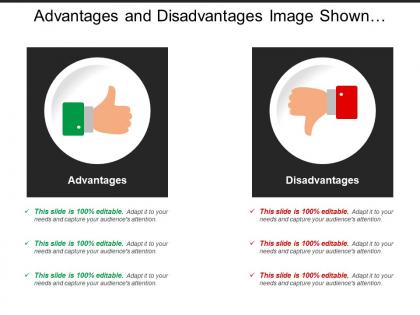
Advantages and disadvantages image shown with thumbs up and down




Try Before you Buy Download Free Sample Product
 Impress Your
 Audience
 100%
100% Editable
 Save Hours
 of Time


Feel assured of beating back any challenge with our Advantages And Disadvantages Image Shown With Thumbs Up And Down. You will experience infinite confidence.
People who downloaded this PowerPoint presentation also viewed the following :
Advantages and disadvantages image shown with thumbs up and down with all 5 slides:
You've put a lot of effort into developing your presentation. Make design effortless by choosing from thousands of Advantages And Disadvantages Image Shown With Thumbs Up And Down.
FAQs for Advantages and disadvantages image shown with thumbs
Premade presentation templates offer significant time savings, consistent professional design, cost-effectiveness, and immediate accessibility for urgent deadlines. These templates streamline workflow by eliminating design-from-scratch requirements, ensure brand consistency across teams, and deliver polished results within tight timeframes, with many organizations finding that template libraries enhance productivity while maintaining high visual standards for client presentations.
Presentation templates enhance visual storytelling by providing consistent branding, professional layouts, structured narrative flow, and cohesive design elements that guide audience attention effectively. While templates streamline content creation and ensure brand consistency across teams, they can sometimes limit creative flexibility, with many corporations finding that strategic template customization delivers faster presentation development, improved message clarity, and stronger stakeholder engagement.
Over-reliance on templates can stifle creative originality, create generic presentations that lack brand differentiation, and limit innovative storytelling approaches that engage audiences effectively. While templates streamline design processes, many organizations find that strategic customization delivers stronger audience connection, memorable experiences, and competitive advantage in increasingly crowded presentation landscapes.
Template customization significantly impacts brand consistency by ensuring uniform visual identity, standardized messaging, consistent color schemes, and cohesive typography across all presentations. While extensive customization strengthens brand recognition and professional credibility, it also requires ongoing maintenance and design oversight, with many organizations finding that strategic template control ultimately delivers stronger market presence and enhanced audience trust.
Presentation templates aid audience engagement by providing consistent visual flow, strategic content placement, and professional aesthetics that minimize distractions while maximizing message clarity. Through structured layouts and visual hierarchy, templates enable presenters to maintain narrative momentum, highlight key insights effectively, and deliver polished pitches that command attention, with many finding that well-designed templates significantly enhance audience retention and response rates.
Selecting the right template involves understanding your audience's industry context, technical expertise, cultural preferences, and decision-making hierarchy, while ensuring visual clarity aligns with content complexity. These considerations streamline presentation effectiveness by matching design sophistication to audience expectations, incorporating relevant sector-specific imagery, and optimizing information density, ultimately delivering enhanced engagement and clearer communication outcomes.
Templates significantly enhance presentation professionalism by ensuring consistent formatting, polished visual design, structured layouts, and cohesive branding elements throughout the content. While well-designed templates create immediate credibility and streamline preparation time, generic or overused templates can diminish uniqueness, with many organizations finding that customized, industry-specific templates deliver the optimal balance of efficiency and distinctive professional impact.
Template limitations in data visualization include restricted chart types, fixed color schemes, predetermined layouts, limited customization options, and constrained interactive features. While templates streamline design processes and ensure consistency, they can restrict creative storytelling and unique data presentations, with many analysts finding that complex datasets require custom visualization approaches to effectively communicate insights and maintain competitive advantage.
Presenters can balance template use with originality by customizing color schemes, typography, and visual elements while maintaining the template's structural foundation, incorporating branded graphics, icons, and imagery that reflect their unique message. This strategic combination enables consistent professional layouts with personalized aesthetics, ultimately delivering polished presentations that stand out in competitive environments while streamlining design workflows.
User feedback drives template refinement by identifying usability issues, highlighting design preferences, revealing accessibility gaps, and uncovering functionality needs across different industries and use cases. This strategic input enables designers to enhance visual appeal, streamline user workflows, and optimize template versatility, with many organizations finding that feedback-driven iterations ultimately deliver more intuitive templates and improved user adoption rates.
Industries differ significantly in presentation template preferences based on their unique communication needs and audience expectations. Financial services favor data-heavy templates with charts and graphs, healthcare prioritizes clean layouts emphasizing patient outcomes, while creative agencies embrace bold designs with visual storytelling elements, ultimately reflecting each sector's professional standards and strategic messaging requirements.
Educational template usage requires balancing efficiency with academic integrity, ensuring proper attribution, avoiding over-reliance that limits critical thinking, and maintaining originality in student work. While templates streamline lesson planning and provide structural frameworks, educators must encourage customization, foster creative adaptation, and ensure students understand underlying concepts rather than simply filling blanks, ultimately delivering enhanced learning outcomes.
Color schemes significantly influence viewer perception by enhancing readability, creating emotional responses, guiding attention to key information, and establishing visual hierarchy within templates. While strategic color choices can improve comprehension and brand recognition, poorly coordinated palettes may distract audiences or reduce accessibility, with many organizations finding that consistent, purposeful color application ultimately delivers stronger engagement and more effective knowledge transfer.
Common pitfalls include over-relying on generic templates without customization, failing to align design with audience expectations, neglecting brand consistency, and choosing inappropriate layouts for complex data. These mistakes can undermine credibility by creating disconnected messaging, poor visual hierarchy, and unprofessional appearance, with many executives finding that strategic template selection and thoughtful customization ultimately delivers greater impact and audience engagement.
Template-technology integration enhances presentation effectiveness by enabling real-time audience engagement, dynamic content updates, and immersive multimedia experiences that capture attention more effectively than static slides. These interactive elements streamline presenter-audience communication through polls, clickable navigation, and embedded analytics, with many organizations finding that technology-enhanced presentations deliver significantly higher engagement rates, better information retention, and more compelling business outcomes.
-
The Designed Graphic are very professional and classic.
-
Professional and unique presentations.