


Advantages of cyber security





Try Before you Buy Download Free Sample Product
 Impress Your
 Audience
 100%
100% Editable
 Save Hours
 of Time


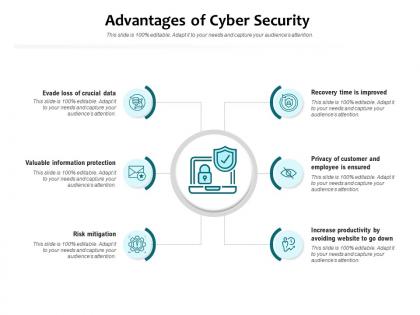
The most important advantage is that the top in IT security cyber security solutions can provide full digital protection for your firm. Personal information is one of the most precious commodities in today's technologically driven society. If a virus is able to capture personal information about your employees or customers, it will almost certainly be sold or exploited to steal their money. Viruses invading your systems and network will cause them to stop operating, making it very impossible to continue working. As a result, your employees will experience downtime at work and waste, putting the entire firm to a standstill. Cybercrime is on the rise and it’s more important than ever to make sure your business is protected. SlideTeam has a variety of cyber security PowerPoint templates that will help you get in-depth information about the Advantages of cyber security for your business. Our templates are easy to use, customizable. So get started today and protect your business from online threats.
People who downloaded this PowerPoint presentation also viewed the following :
Advantages of cyber security with all 2 slides:
Use our Advantages Of Cyber Security to effectively help you save your valuable time. They are readymade to fit into any presentation structure.

FAQs for Advantages
Okay so there's basically five things you need to get right. Multi-factor authentication and proper user permissions are huge - start there. Next up is endpoint and network protection to catch threats before they spread. Train your people regularly too because let's be real, someone's always clicking something they shouldn't. You'll want monitoring systems running 24/7 plus a solid incident response plan. Oh and this isn't a "set it and forget it" thing - you've got to keep tweaking and updating everything. But honestly? Nail those basics first and you're already ahead of most companies.
Start with a full security audit - map out your defenses, weak spots, and where hackers could slip in. Run pen testing to see what's actually vulnerable. Most companies are genuinely horrified by what they discover! Check if your software's current and review employee training programs. Don't forget your incident response plan and backups either. Be brutally honest about gaps instead of pretending you're covered. I'd honestly hire an outside firm for a fresh perspective - you're probably too close to spot everything yourself.
Dude, train your people - that's honestly your best bet. Most hacks happen because someone clicks a bad link or downloads weird stuff. Teach them to spot phishing emails and use decent passwords. Monthly training sessions work great, plus you can send fake phishing tests to see who's paying attention (kinda mean but it works). Way cheaper than cleaning up after a breach, trust me. Don't just do it once though - has to be ongoing or they'll forget everything. Turn your team into your first line of defense.
Dude, cyber threats are brutal for small businesses. Ransomware locks up all your files until you pay - super common now. Phishing emails fool your employees (and honestly they're getting scary good at it). Weak passwords lead to data breaches constantly. Then there's supply chain attacks where hackers go after your vendors first to reach you. Business email scams are wild too - they'll pretend to be your boss and trick someone into wiring cash. Here's the crazy part: 60% of small businesses actually shut down within six months after getting hit. Multi-factor authentication helps tons though, plus training your team on spotting scams.
Oh man, MFA is such a lifesaver! Basically you're adding extra steps beyond your password - like a code from your phone or your fingerprint. Yeah, it's annoying when you're trying to log in quickly, but trust me it's worth it. Hackers might steal your password through some sketchy email or data breach, but they're screwed without that second piece. I'd start with your email and bank accounts first. Those are the big ones. Even work stuff if you can. It's one of those things that feels like overkill until you actually need it.
So basically a VPN creates this encrypted tunnel for all your internet stuff - think of it like a secret passageway hackers can't see into. Your IP address gets hidden too, which is clutch for public WiFi since those networks are sketchy as hell. Websites can't track your real location, and your ISP stops being nosy about your browsing habits. The encryption scrambles everything you send back and forth. Oh, and definitely go with a VPN that doesn't keep logs of what you do - otherwise you're just trading one spy for another, you know?
First thing - figure out which regs actually hit your industry. GDPR, HIPAA, SOX, whatever applies to you specifically. Don't waste time on generic security stuff that doesn't matter for compliance. Build your controls around those exact requirements. Documentation is super tedious but honestly saves your ass during audits. I'd set up both internal reviews and third-party audits to catch problems early. Oh, and make sure your incident response covers the compliance reporting side too - that always gets forgotten. Treat this whole thing as ongoing work, not something you knock out once and forget about.
Dude, cybersecurity is one of those things that actually pays for itself. Data breaches are insanely expensive - we're talking millions in fines and legal costs, not to mention customers fleeing when they lose trust in you. I've seen companies get absolutely crushed by this stuff. Prevention beats damage control every single time. Your insurance premiums drop when you have solid security, and you won't get hit with regulatory fines either. Most businesses see around 3-5x ROI on their cybersecurity spend. Start with a risk assessment to figure out where you're most vulnerable - that'll show you exactly where to focus first.
Dude, cybersecurity is moving crazy fast right now. AI and machine learning can catch threats way quicker than old-school methods - they're really good at spotting weird patterns in network traffic. There's also this zero-trust thing where you basically don't trust anything until it proves it's legit. XDR platforms give you one dashboard for all your security stuff, which is actually pretty handy. Oh, and honestly? If you're gonna pick one thing to invest in, I'd go with AI-powered threat detection first. Best return on investment by far.
Think of incident response plans as your "oh shit" handbook for when hackers strike. You'll contain threats way faster instead of scrambling around like headless chickens. Clear steps for isolating systems, saving evidence, talking to the big bosses - all mapped out beforehand. Quick detection means less time for bad guys to wreak havoc on your stuff. Everyone knows their role during the madness too. Honestly, most companies skip the practice part, but you should run fake scenarios quarterly. Otherwise your fancy plan just collects dust when you actually need it.
Honestly, cybersecurity audits are like getting a checkup before you're sick - way better than dealing with a breach later. They catch weak spots attackers would exploit and keep you compliant with whatever regulations your industry throws at you. I've seen companies skip this stuff and regret it big time. The cool thing is, over time your team starts thinking about security naturally instead of scrambling when something goes wrong. You'll spot patterns in how hackers target businesses like yours too. I'd probably do them quarterly - seems like the sweet spot for staying ahead without overdoing it.
Honestly, measuring cybersecurity ROI is kinda backwards - you're trying to prove value from stuff that *didn't* happen. Start with baseline costs before adding new security tools. Then track what you're saving: fewer successful phishing hits, lower incident response bills, better audit scores. The math is simple enough - compare your security spending against potential breach costs like downtime, fines, and angry customers jumping ship. I'd give it 12-18 months to see real patterns. Just don't get too caught up in perfect numbers since "prevented attacks" are pretty much impossible to count accurately.
Look, good cybersecurity is basically like having really solid locks on your house - customers feel way more comfortable doing business with you. Nobody wants their credit card info stolen, you know? But here's the thing - one bad breach and you're screwed for years. Equifax is still trying to dig out of that hole. Companies that actually invest in security early? They turn it into a selling point. My advice is don't wait around hoping nothing happens. Be upfront about how you protect people's data instead of playing defense later.
Yeah so basically each industry tailors their cybersecurity to whatever scares them most. Healthcare's all about protecting patient records and staying HIPAA compliant. Banks obsess over transaction security and stopping fraud - makes sense since that's literally their business. Manufacturing worries about ransomware hitting their factory floors, which would be a nightmare. Retail focuses on payment data and PCI stuff. Government goes overboard with access controls and clearance levels, but I guess they have to. Really depends on what kind of data you're sitting on and which regulations you need to follow.
Honestly, the threat stuff changes so damn fast that keeping up in-house is brutal. These experts see patterns across tons of companies, so they'll catch blind spots your team totally missed. Plus they know all the compliance weirdness - which honestly can be a nightmare to navigate alone. I'd focus on your biggest pain points first rather than hiring some generalist who does everything. They're good at helping you figure out where to actually spend your security money instead of just throwing it everywhere. Outside perspective is clutch here.
-
Informative presentations that are easily editable.
-
Much better than the original! Thanks for the quick turnaround.
-
Appreciate the research and its presentable format.