

Affiliate Marketing KPI Dashboard With Click Through Rate





Try Before you Buy Download Free Sample Product
 Impress Your
Audience
 100%
Editable
 Save Hours
of Time


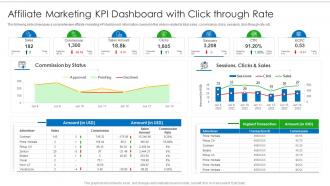
The following slide showcases a comprehensive affiliate marketing KPI dashboard. Information covered in this slide is related to total sales , commission, clicks, sessions, click-through rate, etc.
People who downloaded this PowerPoint presentation also viewed the following :
Affiliate Marketing KPI Dashboard With Click Through Rate with all 7 slides:
Use our Affiliate Marketing KPI Dashboard With Click Through Rate to effectively help you save your valuable time. They are readymade to fit into any presentation structure.






FAQs for Affiliate Marketing KPI Dashboard With
Essential affiliate marketing KPIs include conversion rates, click-through rates, cost per acquisition, revenue per click, and lifetime customer value, alongside commission costs and affiliate performance rankings. These metrics enable marketing teams to optimize campaign spend, identify top-performing partners, and maximize ROI, with many e-commerce and SaaS companies finding that comprehensive tracking ultimately delivers better partner relationships and significantly improved revenue growth.
Affiliate marketers can utilize conversion rates by analyzing performance across different traffic sources, promotional content, and audience segments to identify top-performing strategies. By tracking conversion data, marketers can reallocate budgets toward high-converting affiliates, refine targeting parameters, and optimize landing pages, ultimately increasing campaign ROI and revenue generation.
Traffic source analysis enables affiliate marketers to identify which channels, websites, and campaigns generate the highest-quality conversions, revenue, and customer lifetime value. By tracking metrics across organic search, social media, email campaigns, and partner sites, marketers can optimize budget allocation, strengthen relationships with top-performing affiliates, and eliminate underperforming sources, ultimately delivering improved ROI and strategic competitive advantage.
Click-through rate directly influences affiliate marketing strategies by determining content effectiveness, audience engagement levels, and campaign profitability across different platforms and promotional channels. Higher CTRs enable marketers to optimize ad placements, refine targeting parameters, and allocate budgets more strategically, with many affiliate programs finding that improved CTR metrics ultimately deliver better conversion rates and increased commission revenues.
Best practices for tracking affiliate marketing KPIs include implementing real-time data integration, establishing clear conversion attribution models, segmenting performance by traffic sources and partner types, and creating customizable visualization hierarchies. These approaches enhance decision-making by providing granular insights into commission structures, campaign ROI, and partner performance trends, with many affiliate networks finding that automated reporting and mobile-responsive dashboards ultimately streamline partner management and accelerate revenue optimization.
ROI in affiliate marketing is calculated by subtracting total program costs from affiliate-generated revenue, then dividing by total costs and multiplying by 100. This comprehensive approach includes tracking commissions, platform fees, management costs, and creative development expenses against conversions, with many organizations finding that segment-specific ROI analysis across different affiliate tiers delivers deeper insights and enables more strategic resource allocation.
Key metrics include conversion rates, click-through rates, average order value, customer lifetime value, and return on ad spend (ROAS). These performance indicators enable businesses to assess partner quality, optimize commission structures, and identify top-performing affiliates across different sectors, with many organizations finding that tracking these metrics simultaneously delivers improved partner relationships and higher overall campaign profitability.
Customer lifetime value integration involves tracking CLV metrics across affiliate channels, segmenting customers by acquisition source, and measuring long-term revenue attribution beyond initial conversions. Through advanced analytics, businesses can identify high-CLV affiliate partners, optimize commission structures based on customer quality rather than volume, and allocate resources strategically, ultimately enabling more profitable partnerships and sustainable growth in an increasingly competitive affiliate landscape.
Recommended tools for affiliate marketing KPI dashboards include Google Analytics, Tableau, Power BI, affiliate networks' built-in reporting, and specialized platforms like Impact or PartnerStack. These solutions streamline performance tracking by automating data collection, visualizing conversion metrics, and integrating multiple affiliate channels, with many organizations finding that centralized dashboards ultimately deliver faster insights and enhanced campaign optimization.
A/B testing data in affiliate marketing dashboards can be represented through conversion rate comparisons, traffic split visualizations, revenue performance metrics, statistical significance indicators, and campaign variant analysis. These visual elements enable marketers to quickly identify winning strategies by comparing click-through rates, commission values, and customer acquisition costs across different affiliate creatives, ultimately streamlining optimization decisions and enhancing overall campaign profitability.
Average order value (AOV) measures the typical purchase amount per transaction, serving as a critical metric for evaluating affiliate campaign profitability, commission structures, and partner performance effectiveness. Through AOV tracking, affiliate marketers can identify high-value partners, optimize promotional strategies, and enhance revenue per conversion, with many e-commerce businesses finding that focusing on AOV improvements delivers greater long-term profitability than solely pursuing transaction volume.
Seasonality trends significantly impact affiliate marketing KPIs through fluctuating conversion rates, varying commission structures, and shifting consumer demand patterns across different periods. During peak seasons like holidays, affiliates often experience higher click-through rates and revenue per click, while off-peak periods may show improved cost-per-acquisition metrics, ultimately requiring strategic budget reallocation and performance forecasting adjustments.
Geographical data reveals regional conversion rates, customer acquisition costs, preferred products, seasonal purchasing patterns, and market penetration levels across different territories. This location-based intelligence enables affiliates and marketers to optimize campaign targeting, adjust promotional strategies for local preferences, and identify high-performing regions for expansion, ultimately delivering more personalized customer experiences and improved ROI.
Affiliate marketing KPI dashboards should be updated daily for real-time campaign performance monitoring, with comprehensive weekly reviews for strategic adjustments and monthly deep-dive analyses for long-term optimization. This multi-tiered approach enables marketers to quickly identify trending products, adjust commission structures, and reallocate resources, while comprehensive reviews reveal seasonal patterns and partnership opportunities, ultimately delivering improved conversion rates and enhanced affiliate relationship management.
Social media engagement metrics include likes, shares, comments, click-through rates, follower growth, and conversion tracking from social platforms. These metrics enhance affiliate marketing dashboards by connecting social activity to sales performance, measuring content effectiveness across channels, and identifying high-converting social campaigns, ultimately delivering deeper audience insights and optimized affiliate strategies.
-
Great quality product.
-
Use of different colors is good. It's simple and attractive.