


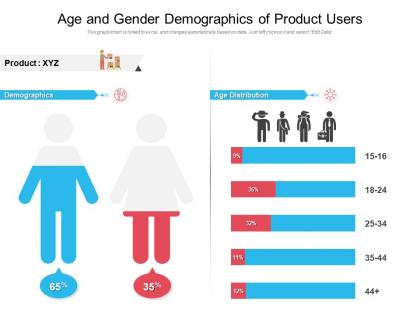
Age and gender demographics of product users




Try Before you Buy Download Free Sample Product
 Impress Your
 Audience
 100%
100% Editable
 Save Hours
 of Time


Our Age And Gender Demographics Of Product Users are topically designed to provide an attractive backdrop to any subject. Use them to look like a presentation pro.
People who downloaded this PowerPoint presentation also viewed the following :
Age and gender demographics of product users with all 2 slides:
Use our Age And Gender Demographics Of Product Users to effectively help you save your valuable time. They are readymade to fit into any presentation structure.
FAQs for Age and gender demographics
Aging populations are huge right now, plus you've got crazy urbanization happening and way more ethnic diversity - Hispanic and Asian markets are exploding. Millennials and Gen Z? They're all about mobile shopping and actually give a damn about sustainability. Boomers still spend the most money though, so don't ignore them. More people are living alone these days and putting off big stuff like buying houses. Oh, and delayed marriages too. Your best bet is nailing the mobile experience and being real with your messaging. Different generations shop completely differently, so you'll need to figure out where each one hangs out.
Honestly, age is huge for marketing strategy. Gen Z? They're scrolling TikTok wanting that raw, unfiltered content. Millennials are more Instagram stories and those detailed email newsletters about their 10-step skincare routines (guilty as charged lol). Boomers still check Facebook daily, plus they actually open direct mail - weird but true. Younger people expect everything personalized and mobile-optimized. Older demographics want straightforward messaging and prefer building actual relationships with brands. Figure out where your target ages hang out first, then match your approach to their vibe.
Dude, geography is everything when you're looking at demographic changes. National averages are basically useless - you need to see WHERE stuff is happening. Like, rural towns are bleeding young people while cities suck them up, or maybe coastal areas are getting older way faster than anywhere inland. Climate, jobs, housing prices - all that creates totally different pressures depending on location. I'm obsessed with Census maps (probably unhealthy tbh) but they show the real patterns. Always map your data first. You'll catch trends that straight numbers would totally miss.
Honestly, demographic data is like a cheat code for spotting product gaps. Pull your customer info and see what patterns jump out - age, income, where they live, all that stuff. Say your 25-34 crowd is super into eco-friendly products but you're not offering any? Boom, there's your next move. I'd map this against your current roadmap to find the biggest wins first. You can also use it to figure out which features to prioritize or how to reposition what you already have. It's actually pretty fun once you get into it - way more revealing than you'd think.
Dude, remote work basically blew up the whole job market. People are ditching expensive cities for random small towns - I know someone who moved from NYC to Montana and kept their tech job. Companies don't care where you live anymore, so a startup in SF will totally hire someone from like, Iowa now. The migration patterns are crazy different. Younger people especially are bouncing from high-cost areas. Oh and age demographics in smaller towns are shifting too since remote workers can live anywhere. For your stuff, just assume geography doesn't really limit hiring anymore and people move around way more than before.
Dude, the income gap in education and healthcare is brutal. Rich families get private schools, tutors, fancy insurance - you know the drill. Meanwhile, poor families are stuck with whatever underfunded public options exist. Rural areas are screwed twice over since they have less money AND fewer services nearby. Minorities face even more barriers on top of all that. When you're analyzing this stuff, you'll want to break it down by income AND demographic groups - that's where you really see how bad the disparities get. The data is honestly depressing but super revealing.
Honestly, it comes down to jobs, age, and what people want from life. Young people flock to cities for careers and college - that's where the opportunities are. Rural places? They're losing population as older folks pass away and fewer young families stick around. Cities also pull in immigrants who want those economic opportunities, plus they've got established communities already there. Rural areas get hit hard - crappy healthcare access, not many services, and the economy just isn't great. Oh, and if you're looking at data for this stuff, employment numbers and age breakdowns will tell you everything you need to know about where people are moving.
Dude, demographic segmentation is seriously a game-changer. You basically split your audience by age, income, location - that kind of stuff. Then you can actually talk to them properly instead of blasting everyone with the same boring message. Like, show student discounts to college kids and fancy products to people with money. Makes total sense, right? Your open rates and clicks will thank you because people actually feel like you get them. I'd start by looking at your customer data - find maybe 2 or 3 patterns that jump out, then make campaigns for each group. Way better than the spray-and-pray approach most people do.
Migration totally flips a city's whole vibe. Austin's packed with young tech people now, so education levels and income shot up. Meanwhile Florida gets all the retirees, which changes what services they need. Age, income, education, culture - it all shifts based on who's moving where. Neighborhoods can change crazy fast too. Oh and here's the thing - if you're trying to figure out where a city's headed demographically, don't just look at census data. Check the migration patterns because that shows you the future, not just what already happened.
So here's the thing - age and culture both matter way more than people realize. TikTok and Instagram pull in younger diverse users hard, but older folks? They're glued to Facebook no matter what. Cultural stuff gets interesting though. Families from collectivist backgrounds post tons of family pics across all ages, while individualistic cultures are all about that personal brand life. Religious and ethnic groups do their own thing too, honestly. Oh and don't just target by age OR culture - you've gotta do both. That's where the magic happens.
Age distribution is probably the biggest one to watch - it drives everything from spending habits to healthcare demand. Education levels matter too since they predict how productive the workforce will be. Labor participation rates show you the actual economic potential. Honestly, I'd focus on those three first. Population growth and urbanization are important but they move pretty slowly, so you've got time there. What I'd do is grab demographic data for whatever markets you're looking at and compare it to their economic performance over the past decade or so. You'll start seeing patterns pretty quickly.
Dude, the aging workforce thing is getting wild. Manufacturing, healthcare, and trades are losing experienced people way faster than they can train new ones. Wages are shooting up because there just aren't enough workers. Healthcare's probably getting slammed the worst - they're losing staff while also dealing with more elderly patients needing care. Tech companies are freaking out too, trying to get all that knowledge from senior employees before they retire. Honestly, if I were you, I'd start having younger workers shadow the older ones now. Document everything while you still can - that stuff's gold once people leave.
Ugh, the complexity is brutal - you're basically trying to please groups that want totally different things. Resource constraints suck too since personalized stuff costs way more. Plus most companies have terrible demographic data, so you're kind of flying blind half the time. Oh and there's this constant fear of pissing off one group while trying to win over another, which honestly happens more than people admit. My advice? Pick your top 2-3 demographic groups first. Don't try to be everything to everyone right away - you'll just spread yourself too thin.
Honestly, it's pretty straightforward once you get it. Map out who actually lives where, then match services to what they need. Got tons of seniors? Focus on accessible buses and clinics, not skateparks. I see planners screw this up constantly - they just assume everyone wants the same stuff. Go deeper than basic age/income stats though. Look at how people actually move around, what they use, cultural stuff that matters. Then you can spot who's getting ignored and fix your resource allocation. Oh, and don't forget to cluster your demographic data first - makes the patterns way clearer.
Yeah, so demographics totally shape how people approach environmental stuff. Younger folks are way more into climate action - honestly makes sense since they're the ones who'll deal with the mess longer. Rich people can afford solar panels and Teslas but also fly everywhere, which is kinda ironic. Education matters too for awareness levels. Location's huge though - city people vs rural folks have completely different conservation priorities. Oh, and income obviously affects what green options people can actually afford. Bottom line: you gotta know your audience if you want your sustainability programs to actually work instead of just talking to yourself.
-
Easy to edit slides with easy to understand instructions.