


Data profiling dashboard of gender and age demographics




Try Before you Buy Download Free Sample Product
 Impress Your
 Audience
 100%
100% Editable
 Save Hours
 of Time


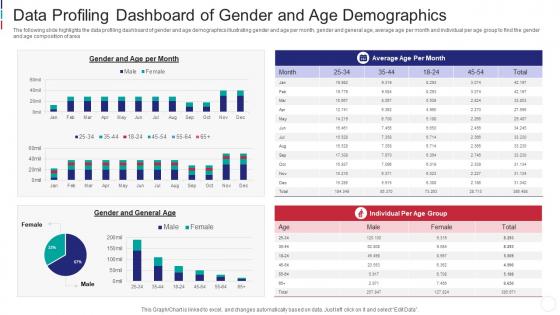
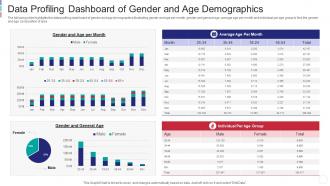
The following slide highlights the data profiling dashboard of gender and age demographics illustrating gender and age per month, gender and general age, average age per month and individual per age group to find the gender and age composition of area.
People who downloaded this PowerPoint presentation also viewed the following :
Data profiling dashboard of gender and age demographics with all 7 slides:
Use our Data Profiling Dashboard Of Gender And Age Demographics to effectively help you save your valuable time. They are readymade to fit into any presentation structure.





FAQs for Data profiling dashboard of gender
So basically you want to get familiar with your dataset before jumping into anything else. Check for missing values, duplicates, weird outliers - all that fun stuff. Honestly, you'll probably be shocked at how messy most data actually is when you first look at it! It's like giving your data a physical exam. You're also looking for patterns and making sure everything matches up with business rules. I'd start with some automated profiling tools to get the big picture, then dive deeper into whatever looks suspicious. Trust me, this step saves you tons of headaches later.
Okay so data profiling is basically like getting a full checkup on your data before you actually use it. It'll scan through everything and catch duplicates, missing stuff, weird inconsistencies - all that messy data that screws up your analysis later. Way better to find this junk early than have your reports blow up, you know? I always tell people to start with their most important datasets first - no point fixing data nobody cares about. The cool part is it also shows you patterns that might hint at bigger problems in how data's getting collected. Honestly saves so much headache down the road.
So for data profiling, there's actually a bunch of good options out there. Informatica Data Quality and Talend are solid commercial tools, though they'll cost you. IBM InfoSphere too. If you're working with Python already, Great Expectations is pretty sweet - it's open source so won't break the bank. Apache Griffin's another free option. Honestly? Sometimes I just write basic SQL queries when I need quick profiling insights. Gets the job done. AWS Glue DataBrew and Google Cloud Dataprep are decent if you're in the cloud. My advice - start simple to show it works, then upgrade later.
So profiling is like being a detective - you're digging into your data to see what you actually have. Patterns, duplicates, weird data types, all that stuff. Validation happens after and tests whether your data follows the rules you set up. Then cleansing is where you fix whatever's broken. I always think of it as: profiling = diagnosis, validation = testing, cleansing = fixing the mess. Honestly, just start with profiling every time you get new data. Trust me, it's way better than discovering problems halfway through your project when you're already stressed.
Start with column profiling - check data types, nulls, and uniqueness first. That gives you the foundation you need. Then move into cross-column analysis to spot relationships between fields. Pattern detection is huge for catching format issues and weird anomalies. Statistical profiling helps with distributions and outliers too. Honestly, duplicate detection is boring but you can't skip it. Once you get into the statistical stuff, it's kind of fascinating how much junk data you'll find - I always end up going down rabbit holes with outliers. Don't forget data quality scoring at the end.
Honestly, data profiling is a game changer for BI - you basically audit your data before jumping into dashboards and reports. Think of it as knowing what you're dealing with upfront. Quality issues? Incomplete records? Weird patterns? You'll spot all that stuff early instead of wondering why your charts look wonky later. Plus you'll find connections between datasets you didn't even know existed. My advice? Start with your most important data sources first. Trust me, you'll discover things that'll make you question everything you thought you knew about your data. Worth the time investment.
So data profiling is like having a map of all your sensitive info - shows you what customer data you've got and where it's hiding. Can't protect stuff if you don't even know it exists, you know? It automatically hunts through your databases looking for personal info and flags anything that might piss off GDPR or HIPAA auditors. Quality issues get spotted too. Honestly, I'd set it up on any system touching customer data because those compliance reviews always seem to find the one sketchy dataset you forgot about. Plus regulators eat up that documentation trail it creates.
Track your before/after numbers - completeness rates, duplicates, accuracy stuff. The best part though is when your team isn't constantly fixing broken data anymore. They'll actually trust what they're seeing. Also count how many issues you catch early vs. finding them the hard way later (trust me, catching them early feels way better). Set up some kind of scorecard thing and honestly, celebrate the wins when those metrics go up. Oh, and start measuring this baseline stuff now so you've got proof later that it's working.
Honestly, the scale thing will kill you - massive datasets just take forever to profile and can crash your systems. Dirty data throws off your accuracy big time, giving you totally wrong insights. You'll need decent computational power too, which isn't cheap. Finding people who can actually read profiling results correctly? Good luck with that. Legacy system integration is such a pain, especially if you're working with older tools. My advice? Start with a small pilot dataset first. Test your approach there before going crazy and trying to profile everything. Way less headache that way.
Honestly, you want to make this ongoing - not just a one-off thing. For your most critical datasets, I'd set up automated profiling daily or weekly. Then do deeper manual reviews quarterly, plus whenever new data sources come in. The frequency really depends on how quickly your data shifts and your risk tolerance. Static reference stuff? Maybe monthly checks work fine. But transactional data needs way more babysitting - learned that the hard way at my last job. Set up alerts so you catch problems before they cascade downstream. Start with whatever's most business-critical and expand from there.
Yeah, data profiling is perfect for this stuff! It scans through everything and spots duplicate records, conflicting info, mismatched fields - you name it. I've watched it catch the same customer entered three different ways or identical addresses with weird formatting differences. Pretty satisfying honestly when you see all those inconsistencies laid out in the reports. You'll get detailed breakdowns showing exactly where the problems are hiding, which makes it way easier to figure out what needs fixing first based on how much it's actually screwing things up.
So you'll want to track completeness first - like what percentage of data is actually missing. Uniqueness matters too (basically duplicate records). Then there's validity - does your data match the formats you expect? Consistency across different sources is another big one. Accuracy is probably the most critical though - how well does everything reflect what's actually happening? I'd definitely check distribution patterns and outliers since they catch quality issues you might totally miss. Most tools calculate this stuff automatically, but honestly you should set your own thresholds based on what actually makes sense for your business before you start.
So data profiling is basically your sanity check before building ML models. You get to see what's actually in your dataset - missing values, weird outliers, inconsistencies that'll totally screw up training. Honestly, skipping this step is like cooking without tasting first. It shows you patterns for feature engineering and helps pick better algorithms too. The garbage in, garbage out thing is so real with AI it's not even funny. Do this early in your pipeline though - I've wasted way too many hours debugging models when the issue was just messy data from the start.
Tons of big companies are crushing it with data profiling. Netflix spots weird viewing patterns to fix their recommendations. JPMorgan profiles transactions to catch fraud before it hits. Walmart does it with inventory across all their stores - honestly makes sense given how massive they are. Healthcare systems clean up patient records this way too, which cuts down on medical mistakes. The trick? Don't go crazy trying to do everything at once. Pick your worst dataset that actually matters to your business and start there. You can always expand later once you've got the hang of it.
Look, most companies screw this up by treating data profiling like some optional nice-to-have thing. Big mistake. You've gotta build it right into your governance process from the start - make it part of how you onboard new data sources every single time. Set up automated runs on your critical datasets so you're always checking data health. I'd start with whatever datasets are most important to the business first, then expand out. Use those profiling results to set quality thresholds and make smarter architecture choices. Trust me, doing this upfront saves you from so many headaches later when your analytics projects inevitably hit roadblocks.
-
Best way of representation of the topic.
-
Innovative and Colorful designs.