

Bar graph showing customer spending distribution using age demographic




Try Before you Buy Download Free Sample Product
 Impress Your
 Audience
 100%
100% Editable
 Save Hours
 of Time


Our Bar Graph Showing Customer Spending Distribution Using Age Demographic are topically designed to provide an attractive backdrop to any subject. Use them to look like a presentation pro.
People who downloaded this PowerPoint presentation also viewed the following :
Content of this Powerpoint Presentation
Description:
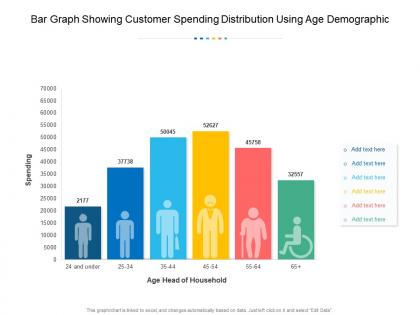
The image displays a bar graph titled "Bar Graph Showing Customer Spending Distribution Using Age Demographic." It visualizes spending amounts for different age groups represented by icons. The age groups are '24 and under', '25-34', '35-44', '45-54', '55-64', and '65+'. The corresponding spending values are 2177, 37738, 50045, 52627, 45758, and 32557, respectively. These figures are most likely in currency units, but the specific currency is not indicated. There are placeholders to add text, indicating that the slide is a template meant to be customized.
Use Cases:
Industries where this slide could be particularly useful include:
1. Retail:
Use: Customer segmentation analysis.
Presenter: Marketing Analyst.
Audience: Marketing team, product managers.
2. Financial Services:
Use: Investment strategy based on demographic spending.
Presenter: Financial Planner.
Audience: Clients, investors.
3. Healthcare:
Use: Allocation of healthcare resources.
Presenter: Health Economist.
Audience: Policy makers, hospital administrators.
4. Real Estate:
Use: Targeting housing markets.
Presenter: Real Estate Developer.
Audience: Investors, sales agents.
5. Consumer Electronics:
Use: Product development and marketing.
Presenter: Product Manager.
Audience: R&D team, marketing department.
6. E-commerce:
Use: Tailoring online shopping experience.
Presenter: E-commerce Strategist.
Audience: Web designers, UX/UI team.
7. Automotive:
Use: Vehicle sales trends by demographic.
Presenter: Sales Manager.
Audience: Dealership owners, sales teams.
Bar graph showing customer spending distribution using age demographic with all 2 slides:
Use our Bar Graph Showing Customer Spending Distribution Using Age Demographic to effectively help you save your valuable time. They are readymade to fit into any presentation structure.

FAQs for Bar graph showing customer spending distribution
Okay so Gen Z throws money at experiences and causes they care about - they'll literally pay extra for brands that match their values. Most of their shopping happens on mobile through TikTok Shop or Instagram checkout. Millennials are different though, they actually research stuff before buying and stick with brands once they find ones they like. Gen Z? Total opposite - they'll ditch you for the next trendy thing immediately. Honestly the loyalty thing is wild to me. If you want Gen Z customers, your social media better be authentic and your mobile checkout needs to be seamless.
So Boomers are all about the basics first - healthcare's their biggest expense, like 15-20% of everything they spend. Crazy how much medical stuff costs now. Most own their homes so they're dropping money on maintenance and utilities too. But here's what's interesting - they actually travel way more than you'd think and will pay extra for brands they trust. My mom's the same way with her skincare routine, won't budge on what works. Don't try selling them trendy stuff though. They've got money but want proof it's worth it first.
So basically, people in their 20s and 30s save like 10-15% of what they make. The rest goes to rent, student loans, and yeah... overpriced lattes. But once you hit your 40s-50s, most folks bump that up to 15-20%. Makes sense since you're finally earning decent money. People close to retirement? They're saving 20-25% or even more because panic mode kicks in. It's wild how the pattern totally flips - younger people have all these expenses but lower salaries, while older adults are in their peak earning years but suddenly realize they need to catch up for retirement.
So COVID totally scrambled everyone's shopping habits, but not equally. Your younger customers (18-34) basically panicked and only bought necessities plus streaming services - makes sense since so many lost jobs. Older folks though? They kept spending pretty normally because pensions and stable careers, you know? But here's what's wild - suddenly grandparents were ordering everything on Amazon. Millennials are still being super careful with money while boomers finally figured out online shopping. For your business, just remember younger people want deals and flexibility now, but older customers aren't scared of buying digital anymore.
Gen X is dropping serious cash on home stuff and family expenses right now. They're buying appliances, home improvements, kids' education - basically anything that makes family life work better. Travel and dining out too, since they've got the income for it. Quality matters more than getting the cheapest option. Oh, and they love convenience services that save time - makes sense when you're juggling teenagers and aging parents. They get overlooked between Boomers and Millennials but honestly have way more spending power than people realize. Skip the trendy marketing angle - they want practical value that actually improves their daily grind.
Okay so age groups totally spend differently based on their culture. Older people stick with brands they trust and care more about quality - especially if they're from traditional backgrounds. Younger folks though? They're obsessed with whatever's trending on social media. I swear one viral TikTok can make a random product sell out overnight. But here's what's interesting - family values and how different communities view money and status completely change these patterns. You really can't just target by age anymore. Gotta think about cultural background too when you're planning campaigns.
Yeah so Gen Z and younger millennials are crushing it with online shopping - like 70% of their purchases happen online compared to maybe 40-50% for older folks. Makes total sense since they basically had iPhones glued to their hands growing up. Older millennials and Gen X still bounce between online and stores, but Boomers? They're definitely team in-person shopping. Honestly if you're planning where to spend marketing money, I'd go heavy on digital stuff and make sure your mobile experience doesn't suck - that's where the younger crowd with actual spending power hangs out.
Older shoppers are crazy loyal compared to younger ones. They'll shop at the same grocery store for like 20 years straight, buy the same car brand forever - you know the type. Consistency matters way more to them than whatever's trendy. Makes total sense honestly, why risk disappointment when you know what works? They're not gonna jump ship just because something's cheaper either. So if you're trying to reach them, lean into your brand's history and reputation. Don't waste time hyping up every new feature or flash sale.
Dude, the spending patterns are crazy different between age groups! Younger people research everything online first - they're scrolling through reviews and TikTok before buying anything. Meanwhile, my parents still want to touch stuff in stores and ask the salesperson a million questions. Gen Z and millennials are way more price-conscious but also weirdly impulsive with that one-click purchasing. Boomers take forever to decide but drop way more money per purchase since they're not constantly comparing prices online. You'll want to split your marketing - digital for young people, more traditional approaches for older customers. Makes total sense when you think about it.
Young people are cutting dining out and entertainment first when money gets tight. They're absolutely ruthless at finding deals too - like seriously, they put the rest of us to shame. But here's what's wild: instead of just buying cheaper stuff, they're straight up eliminating whole spending categories. Major purchases like cars and houses? Totally delayed. For your business, don't just slash prices. Focus on showing real value and offer payment plans or something flexible. That's what actually moves the needle with this crowd.
Women tend to drop more cash on health, beauty, and household stuff, while guys go for tech and cars. But Gen Z's kinda breaking all these old rules tbh. What's really interesting is women over 50 have the most spending power - they're splurging on experiences and nice products. Men and women's buying habits are getting more similar too, especially with younger people. My advice? Don't just look at age or gender separately. You'll get way better insights if you combine both when you're trying to figure out what your customers actually want.
Basically, social media is making young people spend way more money. They're getting hit with targeted ads, influencer posts, and seeing what their friends buy constantly. FOMO is real - nobody wants to miss out on the latest trend. Those one-click purchase buttons don't help either, honestly they're kind of evil lol. Most younger shoppers actually discover products through Instagram and TikTok now instead of traditional stores. Everything looks so appealing in those perfectly curated posts too. If you're trying to reach them, focus your ad budget on social platforms - that's where they're actually paying attention and making buying decisions.
So marriage hits your wallet pretty hard, especially if you're in your late twenties or thirties. You're suddenly splitting everything and saving for bigger goals instead of buying random stuff. Kids though? That's where it gets expensive - childcare alone will make you cry, plus healthcare and moving to a house with actual space. Oh, and safer cars because apparently your old Honda isn't "family appropriate" anymore. Once the kids leave home, people start traveling way more since they're not paying for college. Then retirement flips everything again. Honestly, if you're tracking customer spending, these life changes matter way more than just looking at age.
So here's the thing - younger people buy luxury for the 'gram and status, right? They want those Instagram moments and trendy pieces they can show off. But older customers? Totally different mindset. They're all about quality and craftsmanship that'll actually last forever. Gen Z will drop serious cash on something they can share online, while Boomers invest in timeless stuff that won't fall apart in five years. It's wild how different they are! Oh, and this means you gotta switch up your marketing - play up the social factor for young people, but talk heritage and durability for older folks.
Look, each generation shops totally differently so you gotta adapt your approach. Boomers still check email religiously and love Facebook - hit them with detailed product info and focus on value. Gen X lives on LinkedIn and wants everything to save them time (they're so busy with kids and aging parents, honestly). Millennials? Instagram and TikTok all day, but they actually care if your brand stands for something real. Gen Z is glued to their phones wanting quick visual stuff with tons of reviews and social proof. Don't waste money using the same strategy for everyone - test what works for each group then go all in.
-
Good research work and creative work done on every template.
-
Qualitative and comprehensive slides.
-
Informative presentations that are easily editable.
-
Colors used are bright and distinctive.