


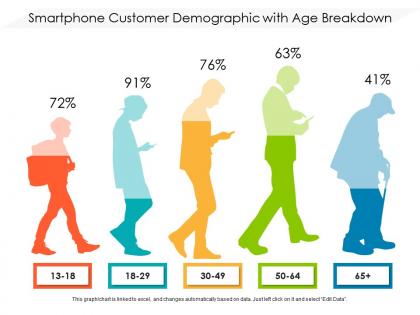
Smartphone customer demographic with age breakdown




Try Before you Buy Download Free Sample Product
 Impress Your
 Audience
 100%
100% Editable
 Save Hours
 of Time


Our Smartphone Customer Demographic With Age Breakdown are topically designed to provide an attractive backdrop to any subject. Use them to look like a presentation pro.
People who downloaded this PowerPoint presentation also viewed the following :
Smartphone customer demographic with age breakdown with all 2 slides:
Use our Smartphone Customer Demographic With Age Breakdown to effectively help you save your valuable time. They are readymade to fit into any presentation structure.
FAQs for Smartphone customer demographic
Young adults aged 18-34 and millennials demonstrate the highest smartphone adoption rates, driven by factors including social media integration, mobile banking capabilities, entertainment streaming, and career demands. These demographics prioritize advanced camera features, processing power, and app ecosystem compatibility, with many finding that premium devices enhance productivity, social connectivity, and digital lifestyle management, ultimately delivering competitive advantages in increasingly mobile-driven professional and personal environments.
Urban populations typically demonstrate higher smartphone adoption rates, greater data consumption, and more diverse app usage spanning entertainment, productivity, and on-demand services. Rural users often prioritize communication and essential services, facing connectivity challenges but increasingly embracing mobile banking and agricultural applications, with many telecommunications companies finding that targeted rural initiatives deliver significant market expansion opportunities.
Income level significantly influences smartphone ownership rates and brand preferences, with higher earners typically choosing premium brands like Apple and Samsung, while budget-conscious consumers gravitate toward value-focused options like Xiaomi and OnePlus. This economic divide creates distinct market segments, with luxury brands emphasizing advanced features and status appeal, while affordable manufacturers focus on essential functionality, ultimately enabling broader market penetration and diverse consumer choice across all income brackets.
Gender differences in smartphone usage manifest through app preferences, usage duration, and engagement patterns, with women typically favoring social media, shopping, and health apps while men gravitate toward gaming, news, and productivity tools. These preferences influence purchasing decisions and content consumption, with women showing higher engagement in photo-sharing and communication apps, while men demonstrate longer gaming sessions, ultimately enabling businesses to tailor marketing strategies and app development for enhanced user experiences.
Age, income, education, and geographic location significantly influence Android versus iOS preferences, with younger users and emerging markets typically favoring Android's affordability and customization options. Meanwhile, higher-income professionals and users in developed markets often choose iOS for its premium ecosystem integration, with many organizations finding that understanding these patterns enables more targeted product development and strategic market positioning.
Smartphone trends are both bridging and widening the digital divide, with affordable devices increasing access while advanced features create new disparities across age, income, and geographic lines. While seniors and rural communities gain basic connectivity through budget smartphones, younger urban users leverage premium features for enhanced opportunities, ultimately creating layered digital experiences that require targeted solutions for equitable access.
Education level significantly influences smartphone preferences and usage patterns, with higher-educated users gravitating toward advanced features like productivity apps, cloud integration, and sophisticated security options. While college graduates often maximize multitasking capabilities and professional applications, users across all education levels increasingly adopt core smartphone technologies, with many organizations finding that targeted training programs help bridge digital divides and enhance workplace efficiency.
Cultural differences significantly shape smartphone usage through communication styles, payment preferences, social media habits, and content consumption patterns. Asian markets favor super-apps like WeChat for multiple functions, while Western users prefer specialized apps, with entertainment preferences varying from gaming in South Korea to video streaming in North America, ultimately creating distinct digital ecosystems.
Smartphone usage drives social media engagement through enhanced accessibility, real-time connectivity, and personalized experiences, with younger demographics typically showing higher engagement rates through visual platforms like Instagram and TikTok. Across age groups, smartphones enable seamless content sharing, instant messaging, and location-based interactions, ultimately delivering targeted marketing opportunities and deeper customer insights for businesses seeking competitive advantage.
Parental controls and child-friendly apps show higher adoption rates among millennial and Gen X parents, tech-savvy households, and higher-income families who prioritize digital safety. Parents in urban areas and those with higher education levels increasingly embrace these tools, while traditional families often rely on time-based restrictions, ultimately delivering enhanced child protection and peace of mind.
**INPUT**: What demographic factors contribute to the rise of mobile gaming on smartphones? **OUTPUT**: Key demographic factors driving mobile gaming growth include younger millennials and Gen Z users, increased smartphone penetration across income levels, longer commute times, and growing female participation in gaming. These trends converge with improved mobile processing power and accessible game designs, enabling gaming companies to reach broader audiences while delivering engaging experiences that fit seamlessly into daily routines, ultimately expanding the traditional gaming market significantly.
Multiple device ownership creates varied usage patterns, with younger demographics using smartphones as primary coordination hubs while older segments maintain more distinct device roles for specific tasks. Tech-savvy professionals increasingly leverage smartphones for seamless integration across tablets, laptops, and wearables, while traditional users compartmentalize functions, ultimately delivering personalized digital ecosystems that enhance productivity and connectivity across all age groups.
Emerging smartphone health trends show younger users (18-34) gravitating toward fitness tracking and mental wellness apps, while older adults (55+) increasingly adopt medication management, telehealth, and chronic condition monitoring tools. This generational divide presents significant opportunities for healthcare providers and app developers, with many finding that age-specific features and simplified interfaces drive higher engagement and better health outcomes.
Smartphone accessibility significantly enhances communication methods for older populations by providing larger text options, voice-to-text capabilities, simplified interfaces, and emergency features. These accessibility improvements enable seniors to engage more frequently through video calls, messaging apps, and social media platforms, while reducing digital barriers, ultimately delivering stronger family connections and increased social engagement across aging communities.
Millennials prioritize brand loyalty and comprehensive online research, Gen Z emphasizes social media influence and sustainability features, while Baby Boomers focus on functionality, in-store experiences, and customer service support. These generational preferences drive different purchasing patterns, with younger consumers leveraging peer reviews and social proof, while older demographics value traditional retail relationships, ultimately requiring businesses to adapt multi-channel strategies.
-
Easily Understandable slides.