


RAD Model Rapid Application Development Vs Agile Methodology Ppt Portfolio Visual Aids




Try Before you Buy Download Free Sample Product
 Impress Your
 Audience
 100%
100% Editable
 Save Hours
 of Time


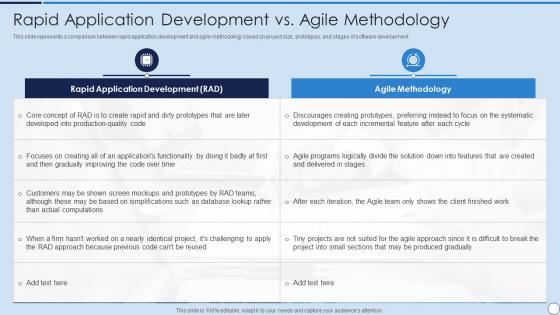
This slide represents a comparison between rapid application development and agile methodology based on project size, prototypes, and stages of software development.
People who downloaded this PowerPoint presentation also viewed the following :
RAD Model Rapid Application Development Vs Agile Methodology Ppt Portfolio Visual Aids with all 6 slides:
Use our RAD Model Rapid Application Development Vs Agile Methodology Ppt Portfolio Visual Aids to effectively help you save your valuable time. They are readymade to fit into any presentation structure.





FAQs for RAD Model Rapid Application Development Vs Agile Methodology Ppt
RAD emphasizes rapid prototyping with fixed timelines and smaller teams, while Agile focuses on iterative development with flexible timelines and cross-functional collaboration. RAD works well for projects with clear requirements and tight deadlines, whereas Agile excels in dynamic environments where requirements evolve, with many organizations finding that Agile delivers greater long-term scalability and customer satisfaction.
RAD excels in projects requiring rapid prototyping, fixed deadlines, and small teams with clearly defined scope, while Agile performs better for complex, evolving requirements with larger teams and long-term strategic initiatives. Organizations in time-sensitive environments like marketing campaigns often favor RAD, whereas software development companies building scalable platforms typically choose Agile for sustained competitive advantage.
RAD emphasizes rapid prototyping with intense customer collaboration during short development cycles, while Agile incorporates feedback through regular sprints and continuous stakeholder engagement throughout the entire project lifecycle. These approaches streamline development by enabling faster course corrections, reducing costly late-stage changes, and ultimately delivering more user-aligned products, with many organizations finding that both methodologies significantly enhance customer satisfaction.
Documentation in RAD emphasizes essential prototypes and user feedback records, while Agile prioritizes working software over comprehensive documentation, focusing on user stories, sprint planning, and retrospective notes. Both methodologies streamline documentation to accelerate development cycles, with software teams in finance, healthcare, and retail finding that minimal but strategic documentation enhances collaboration and delivers faster project outcomes.
RAD integrates seamlessly with Agile practices through shared iterative development, rapid prototyping, and continuous user feedback cycles. Many organizations combine RAD's visual modeling and time-boxed phases with Agile's sprint methodologies and collaborative frameworks, ultimately delivering faster product iterations while maintaining flexibility, with development teams finding that this strategic combination enhances both speed and adaptability.
RAD emphasizes specialized roles like system architects, developers, and business analysts working in dedicated phases, while Agile promotes cross-functional teams with shared responsibilities and collaborative decision-making. Through iterative sprints and daily standups, Agile teams adapt roles dynamically based on project needs, whereas RAD maintains more structured role definitions, with many organizations finding that Agile's flexibility ultimately delivers faster adaptation and enhanced team ownership.
RAD projects typically span 2-6 months with fixed timelines, while Agile projects run in continuous sprints of 1-4 weeks with flexible, iterative timelines. RAD emphasizes rapid prototyping and faster delivery for specific applications, whereas Agile focuses on ongoing development cycles, with many organizations finding that Agile's adaptability better supports long-term product evolution and changing requirements.
RAD manages risks through rapid prototyping and iterative feedback loops, while Agile uses continuous integration, sprint reviews, and adaptive planning to address changes. Both methodologies embrace change as inevitable, with RAD focusing on quick user validation and Agile emphasizing collaborative responses, ultimately enabling organizations to deliver more resilient software solutions.
RAD environments typically utilize rapid prototyping tools like PowerBuilder, Visual Basic, and low-code platforms, alongside database management systems and GUI builders for fast application development. Agile environments favor collaborative tools like Jira, Scrum boards, and continuous integration platforms such as Jenkins, with many organizations finding that Agile's diverse toolset enables greater flexibility and cross-functional team coordination.
RAD and Agile approaches enhance team collaboration through frequent iterations, cross-functional teamwork, and continuous stakeholder feedback, while emphasizing rapid prototyping and adaptive planning. These methodologies streamline communication by implementing daily standups, regular retrospectives, and collaborative development cycles, with many software development teams finding that both approaches ultimately deliver faster project completion and improved team alignment.
RAD projects typically measure success through rapid prototyping cycles, user feedback integration, and time-to-market acceleration, while Agile emphasizes sprint velocity, customer satisfaction scores, and iterative delivery efficiency. Both methodologies enable organizations to track development speed, quality improvements, and stakeholder engagement levels, with many software companies finding that these metrics ultimately deliver enhanced product outcomes and competitive advantage.
RAD prioritizes user experience through rapid prototyping, continuous user feedback loops, and iterative design refinements that allow immediate interface adjustments. Agile emphasizes user experience through user stories, sprint reviews, and consistent stakeholder collaboration, with many development teams finding that Agile's structured sprints enable more systematic UX integration and long-term usability optimization.
RAD offers rapid prototyping, faster development cycles, and flexible requirement adaptations that accommodate evolving project needs effectively. While this enables organizations to respond quickly to market changes and deliver functional prototypes faster, it can present challenges with documentation and long-term maintenance, with many development teams finding that strategic planning balances speed with sustainable project outcomes.
RAD teams require specialized skills in rapid prototyping tools, visual development environments, and intensive user collaboration techniques, while Agile teams focus on iterative development practices, cross-functional collaboration, and continuous integration methodologies. Many organizations find that RAD demands more technical specialization in specific platforms, whereas Agile emphasizes broader collaborative skills and adaptive project management capabilities.
RAD and Agile both enhance innovation through rapid prototyping, iterative feedback cycles, and collaborative development approaches that accelerate experimentation and reduce time-to-market. While RAD's speed can sometimes compromise thorough testing, and Agile's incremental focus may limit breakthrough thinking, both methodologies ultimately deliver faster product iterations, enhanced customer alignment, and competitive advantage through responsive development processes.
-
The best collection of PPT templates!! Totally worth the money.
-
I downloaded some of the presentations for work. They were simple to modify and saved me a lot of time and effort.