


Sdlc agile model it detailed framework of agile software development lifecycle




Try Before you Buy Download Free Sample Product
 Impress Your
 Audience
 100%
100% Editable
 Save Hours
 of Time


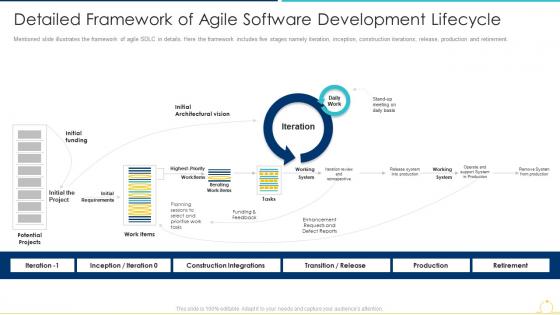
Mentioned slide illustrates the framework of agile SDLC in details. Here the framework includes five stages namely iteration, inception, construction iterations, release, production and retirement.
People who downloaded this PowerPoint presentation also viewed the following :
Sdlc agile model it detailed framework of agile software development lifecycle with all 6 slides:
Use our SDLC Agile Model It Detailed Framework Of Agile Software Development Lifecycle to effectively help you save your valuable time. They are readymade to fit into any presentation structure.





FAQs for Sdlc agile model it detailed framework of agile
Key components of Agile SDLC include iterative sprints, continuous integration, user story development, daily standups, and retrospective reviews. These methodologies streamline software delivery by enhancing team collaboration, accelerating feedback cycles, and minimizing development risks, with many technology organizations finding that agile practices ultimately deliver faster product releases and improved customer satisfaction.
Agile SDLC differs from traditional Waterfall by emphasizing iterative development, continuous feedback, and adaptive planning, while Waterfall follows sequential phases with fixed requirements and limited flexibility. Through shorter sprints and regular stakeholder collaboration, organizations in sectors like fintech and healthcare deliver faster time-to-market, reduced project risks, and enhanced customer satisfaction, ultimately achieving greater competitive advantage.
Stakeholders in Agile SDLC serve as product owners, end users, business analysts, subject matter experts, and feedback providers throughout development cycles. These roles enhance project success by providing continuous input, validating requirements, prioritizing features, and ensuring alignment with business objectives, with many organizations finding that active stakeholder engagement significantly reduces project risks and accelerates delivery timelines.
Teams effectively prioritize their backlog through value-based ranking, stakeholder collaboration, MoSCoW method categorization, and regular refinement sessions that assess business impact and technical dependencies. Through continuous stakeholder feedback and sprint retrospectives, development teams streamline delivery cycles, enhance product-market alignment, and accelerate time-to-value, with many organizations finding that structured prioritization frameworks ultimately deliver higher customer satisfaction and competitive advantage.
Iterative development in Agile SDLC delivers faster feedback cycles, reduced project risks, enhanced flexibility for changing requirements, improved product quality through continuous testing, and stronger stakeholder collaboration. This approach enables organizations to adapt quickly to market demands, minimize costly late-stage changes, and ultimately deliver more valuable software products that better align with customer needs and business objectives.
Agile practices integrate into existing frameworks through iterative planning cycles, cross-functional team structures, regular stakeholder feedback loops, and adaptive requirement management. Many organizations blend Agile sprints with traditional project phases, enabling faster delivery cycles, improved risk management, and enhanced stakeholder engagement, while maintaining established governance structures and ultimately delivering greater project flexibility and success rates.
Agile SDLC tools include Jira for project management, Git for version control, Jenkins for continuous integration, Slack for team communication, and Docker for containerization. These technologies streamline development by enabling real-time collaboration, automated testing, and faster deployment cycles, with many software teams finding that this integrated approach delivers shorter release cycles and enhanced product quality.
Agile methodologies address risk management through iterative development cycles, continuous testing, regular stakeholder feedback, and adaptive planning that identifies issues early. These approaches enable teams to mitigate technical debt, scope creep, and integration challenges through frequent releases and retrospectives, with many software development organizations finding that shorter sprints ultimately deliver reduced project risks and faster time-to-market.
Agile SDLC promotes collaboration through daily stand-ups, sprint planning sessions, retrospectives, cross-functional teams, and continuous stakeholder feedback loops. These practices streamline communication by fostering transparency, eliminating silos, and enabling real-time problem-solving, with many software development organizations finding that enhanced team dynamics ultimately deliver faster project completion and higher-quality products.
Common challenges include cultural resistance to change, difficulty coordinating multiple distributed teams, maintaining consistent communication across departments, integrating with existing legacy systems, and scaling Agile practices effectively. Large organizations often find that traditional hierarchical structures clash with Agile's collaborative approach, while complex compliance requirements and established processes create additional friction, ultimately requiring strategic change management and executive support.
Customer feedback is integrated into Agile SDLC through regular sprint reviews, continuous user testing, and iterative development cycles that incorporate client input at each stage. This approach enables development teams to adapt requirements quickly, reduce costly late-stage changes, and deliver products that better align with user expectations, with many organizations finding that this continuous feedback loop significantly enhances customer satisfaction and project success rates.
Agile SDLC success metrics include velocity, sprint burndown rates, cycle time, defect density, customer satisfaction scores, and team productivity indicators. These measurements enable organizations to track delivery efficiency, code quality, and stakeholder value, with many development teams finding that combining velocity tracking with customer feedback delivers enhanced project predictability and ultimately stronger competitive advantage.
Agile SDLC adapts to changing requirements through iterative sprints, continuous stakeholder feedback, flexible backlog management, and regular retrospectives that enable real-time adjustments. This adaptive framework allows development teams to pivot quickly when business needs evolve, with many organizations finding that iterative development cycles reduce project risks while delivering products that better align with market demands and user expectations.
CI/CD enables Agile teams to automate code integration, testing, and deployment processes, significantly reducing manual errors, accelerating release cycles, and maintaining consistent code quality throughout development iterations. This automation streamlines collaboration between development and operations teams, with many software organizations finding that CI/CD pipelines deliver faster time-to-market, improved reliability, and enhanced competitive advantage in increasingly dynamic business environments.
Agile SDLC ensures quality through continuous testing, regular code reviews, iterative feedback loops, automated testing frameworks, and frequent stakeholder collaboration throughout each sprint cycle. These practices enable development teams to identify and resolve defects early, maintain coding standards consistently, and deliver reliable software solutions, with many organizations finding that this approach significantly reduces post-deployment issues while accelerating time-to-market.
-
Out of the box and creative design.