


Agile testing strategy ppt ideas





Try Before you Buy Download Free Sample Product
 Impress Your
 Audience
 100%
100% Editable
 Save Hours
 of Time


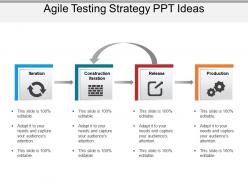
Here is a professionally designed Agile Testing Strategy PowerPoint Slide that takes you through the process at the start to end with exact description of each cycle. Download our Sprint testing PPT slide to make the viewers understand the iteration cycle clearly as that is the base of the entire process. Since an iterative process is a process for calculating the desired result by means of a repeated cycle of operations. Use our scrum testing slide to project the importance of developing requirements gradually from customers and testing teams. Once you move to the stage of constructing the iterations and releasing them, it is important to map the data of how many return cycles are run between construction iteration and release. With our scrum testing PPT, you will be able to manage the data that comes with the product development as this data helps your team to implement efficiency in product development. Use this slide keep a tab on your production rates as soon as it completes the release cycle. Elaborate on irresponsible behavior with our Agile Testing Strategy Ppt Ideas. Discourage any display of a casual attitude.
People who downloaded this PowerPoint presentation also viewed the following :
Agile testing strategy ppt ideas with all 5 slides:
Be the star of the boardroom for your next presentation. Carefully crafted Agile Testing Strategy Ppt Ideas design for all of your presentation needs.



FAQs for Agile testing
Agile testing principles include continuous testing throughout development cycles, collaborative cross-functional teamwork, early defect detection, customer feedback integration, and adaptive test planning based on iterative requirements. These approaches streamline quality assurance by eliminating lengthy testing phases, enhancing team communication, and delivering faster feedback loops, with many software development organizations finding that this integrated methodology ultimately reduces time-to-market while maintaining higher product quality.
Teams integrate test automation within Agile by implementing continuous integration pipelines, adopting test-driven development practices, creating automated regression suites, and establishing cross-functional collaboration between developers and testers. Through strategic automation frameworks, organizations streamline testing cycles, accelerate feedback loops, and maintain code quality, with many software teams finding that automated testing enables faster sprint deliveries while reducing manual testing overhead.
Testers in Agile teams serve as quality advocates, collaborating continuously with developers and product owners throughout sprints, participating in planning sessions, writing acceptance criteria, and conducting real-time testing during development cycles. Their responsibilities evolve from early requirement clarification and test planning to active development support, automated test creation, and continuous feedback provision, ultimately enabling faster delivery cycles and higher product quality through embedded quality assurance rather than end-stage testing.
Continuous feedback loops enhance Agile testing strategy by enabling real-time defect identification, accelerating iteration cycles, and improving cross-team collaboration throughout development phases. Through automated testing frameworks and stakeholder reviews, development teams streamline quality assurance processes, reduce time-to-market, and deliver more reliable software products, with many organizations finding that integrated feedback mechanisms ultimately boost customer satisfaction and competitive advantage.
**INPUT**: What metrics should be used to assess the effectiveness of an Agile testing strategy? **OUTPUT**: Key metrics include defect detection rate, test coverage percentage, sprint velocity, cycle time, and customer satisfaction scores. These measurements enable teams to streamline quality assurance processes, enhance delivery speed, and minimize post-release issues, with many organizations finding that comprehensive metric tracking ultimately delivers faster time-to-market and improved product reliability.
Collaboration between developers and testers in Agile environments improves software quality by enabling early defect detection, shared code ownership, continuous feedback loops, and unified quality standards throughout development cycles. This strategic partnership streamlines communication, reduces rework costs, and accelerates delivery timelines, with many software teams finding that integrated testing approaches ultimately deliver more reliable products and enhanced customer satisfaction.
Agile methodologies drive the selection of testing tools that support continuous integration, automated testing frameworks, collaborative platforms, and rapid feedback mechanisms. These technologies streamline development cycles by enabling real-time collaboration, automated regression testing, and seamless deployment pipelines, with many software teams finding that integrated toolchains ultimately deliver faster releases and enhanced product quality.
Best practices for ensuring test coverage in Agile projects include test-driven development, continuous integration testing, automated regression suites, risk-based testing prioritization, and collaborative acceptance criteria definition. These approaches streamline quality assurance by embedding testing throughout sprints, enabling faster feedback cycles, and maintaining comprehensive coverage, with many development teams finding that strategic automation ultimately delivers higher software quality and accelerated release schedules.
Agile teams manage technical debt through continuous refactoring, automated regression testing, and regular code reviews integrated into sprint cycles. By implementing test-driven development, maintaining comprehensive test suites, and allocating dedicated sprint capacity for debt reduction, teams streamline quality assurance while preventing accumulation, ultimately delivering faster releases and improved system maintainability.
Distributed Agile teams face testing challenges including communication gaps across time zones, inconsistent testing environments, delayed feedback loops, and coordination difficulties between developers and testers. These obstacles can be overcome through standardized automated testing frameworks, collaborative tools for real-time communication, shared testing environments, and synchronized sprint ceremonies, ultimately enabling seamless integration and maintaining quality standards across global teams.
User stories should follow the "As a [user], I want [functionality], so that [benefit]" format with clear acceptance criteria, testable conditions, and defined scope boundaries. These structured stories enable testers to create targeted test cases, validate business value early, and ensure comprehensive coverage, while development teams can deliver incremental functionality that meets user expectations and business objectives effectively.
Exploratory testing offers significant value in Agile projects by providing rapid feedback, uncovering unexpected issues, and validating user experiences beyond scripted test cases. It integrates effectively through time-boxed sessions within sprints, pairing testers with developers, and combining structured exploration with automated regression testing, ultimately delivering enhanced product quality and faster defect discovery that keeps pace with Agile's iterative development cycles.
An Agile testing strategy addresses evolving customer requirements through continuous feedback loops, iterative testing cycles, collaborative planning sessions, and adaptive test case management that adjusts with each sprint. This approach enables development teams to validate changes quickly, incorporate user feedback seamlessly, and maintain quality standards while delivering responsive solutions, with many software organizations finding that integrated testing accelerates time-to-market and enhances customer satisfaction.
Essential training for Agile testers includes test automation frameworks, continuous integration tools, collaborative communication techniques, user story analysis, and cross-functional team dynamics. These skills enable testers to integrate seamlessly with development sprints, deliver faster feedback cycles, and enhance product quality through real-time collaboration, with many organizations finding that well-trained Agile testers significantly accelerate delivery timelines.
Agile teams balance speed and quality through test automation, continuous integration, risk-based testing, collaborative planning, and early defect detection. These approaches streamline testing by automating repetitive tasks, enabling faster feedback loops, and prioritizing critical features, with many development organizations finding that strategic test automation and cross-functional collaboration ultimately deliver higher quality software while maintaining rapid deployment cycles.
-
Innovative and attractive designs.
-
Great designs, really helpful.