


Powerpoint-Präsentationsfolien für den Amazon-Geschäftsplan





Try Before you Buy Download Free Sample Product
 Impress Your
 Audience
 100%
100% Editable
 Save Hours
 of Time


Holen Sie sich unsere fachmännisch erstellte Amazon-Geschäftsplan-Präsentation, die Unternehmern dabei helfen soll, im wettbewerbsintensiven E-Commerce-Markt erfolgreich zu sein, indem sie einen umfassenden Überblick über ihre Online-Geschäftsstrategie bieten. Unser Amazon-Unternehmensplan umfasst eine Zusammenfassung, eine Marktanalyse und eine Aufschlüsselung wichtiger Erfolgsfaktoren. Darüber hinaus werden die Mission, die Vision und die Finanzübersicht des Unternehmens hervorgehoben. Darüber hinaus zeigt unser Amazon-Geschäftsmodell-PPT eine potenzielle Wachstumsanalyse und umfasst eine SWOT-Analyse mit dem Fünf-Kräfte-Analysemodell von Porter, eine Kundenanalyse und eine Marktgrößenbestimmung. Der Plan beschreibt außerdem eine Offline- und Online-Marketing-Strategie sowie einen Verkaufstrichter zur Kundenbindung. Die Finanzübersicht umfasst eine Szenarioanalyse, eine Gewinn- und Verlustrechnung, eine Kapitalflussrechnung, eine Bilanz und ein DCF-Bewertungsmodell für das Unternehmen nach fünf Jahren. Durch die Umsetzung der in diesem Plan beschriebenen Strategien können Sie Ihren Umsatz steigern, die Kundenbindung verbessern und letztendlich im hart umkämpften Markt erhebliche Erfolge erzielen. Greifen Sie jetzt auf die PPT zu, um Ihr E-Commerce-Geschäft auf die nächste Stufe zu bringen.
People who downloaded this PowerPoint presentation also viewed the following :
Inhalt dieser Powerpoint-Präsentation
Folie 1 : Auf dieser Folie wird der Amazon Business Plan vorgestellt. Beginnen Sie mit der Angabe Ihres Firmennamens.
Folie 2 : Diese Folie zeigt die Agenda der Präsentation.
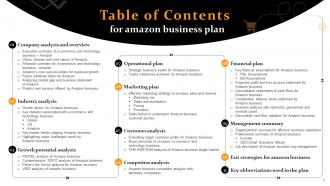
Folie 3 : Diese Folie enthält das Inhaltsverzeichnis.
Folie 4 : Diese Folie hebt den Titel der Themen hervor, die weiter behandelt werden sollen.
Folie 5 : Diese Folie präsentiert die Zusammenfassung des E-Commerce- und Technologiegeschäfts – Amazon.
Folie 6 : Diese Folie behandelt die Details zur Vision, Mission und den Grundwerten von Amazon.
Folie 7 : Diese Folie enthält Einzelheiten zur finanziellen Leistung von Amazon basierend auf Umsatzwachstum und Rentabilität.
Folie 8 : Diese Folie zeigt die wichtigsten Erfolgssäulen von Amazon, die das Wachstum und die Rentabilität des Unternehmens bestimmen.
Folie 9 : Diese Folie enthält Details zu den zukünftigen Initiativen von Amazon und seinem Fokus auf den Ausbau bestehender Geschäfte und Investitionen in neue Technologien.
Folie 10 : Diese Folie behandelt die Probleme im Zusammenhang mit der E-Commerce- und Technologiebranche.
Folie 11 : Der Zweck dieser Folie besteht darin, Informationen über die breite Palette an Produkten und Dienstleistungen bereitzustellen, die das Amazon-Unternehmen anbietet.
Folie 12 : Diese Folie enthält die Überschrift für den Inhalt, der als Nächstes besprochen wird.
Folie 13 : Diese Folie hebt die wichtigsten Statistiken zum E-Commerce- und Technologiegeschäft hervor – weltweit.
Folie 14 : Auf dieser Folie werden die wichtigsten Statistiken zum E-Commerce- und Technologiegeschäft – weltweit – fortgesetzt.
Folie 15 : Diese Folie präsentiert die wichtigsten Statistiken zum E-Commerce- und Technologiegeschäft – USA.
Folie 16 : Auf dieser Folie werden die wichtigsten Statistiken zum E-Commerce- und Technologiegeschäft aufgeführt – Amazon.
Folie 17 : Diese Folie stellt die wichtigsten Markttrends dar, die das Amazon-Geschäft prägen.
Folie 18 : Auf dieser Folie geht es darum, die wichtigsten Herausforderungen hervorzuheben, mit denen das Amazon-Geschäft konfrontiert ist.
Folie 19 : Diese Folie enthält den Titel der Ideen, die weiter besprochen werden sollen.
Folie 20 : Diese Folie zeigt die PESTEL-Analyse des Amazon-Geschäfts.
Folie 21 : Diese Folie zeigt die umfassende SWOT-Analyse des Amazon-Geschäfts.
Folie 22 : Die Folie beleuchtet das Fünf-Kräfte-Modell von Porter und seine Auswirkungen auf die US-amerikanische E-Commerce- und Technologiebranche.
Folie 23 : Diese Folie zeigt die VRIO-Analyse des Amazon-Geschäfts.
Folie 24 : Diese Folie enthält die Überschrift für die Ideen, die als Nächstes behandelt werden sollen.
Folie 25 : Diese Folie zeigt die Amazon-Geschäftskonkurrentenanalyse mit Attributvergleich.
Folie 26 : Auf dieser Folie wird die Analyse der Amazon-Geschäftskonkurrenz mit einem Attributvergleich fortgesetzt.
Folie 27 : Diese Folie zeigt den Titel der Themen, die in der kommenden Vorlage besprochen werden sollen.
Folie 28 : Auf dieser Folie wird beurteilt, wie die Produkte des Unternehmens in einen bestimmten Markt passen und wo sie bei den Kunden am meisten Anklang finden.
Folie 29 : Diese Folie bietet einen Überblick darüber, wie Sie die Zielgruppe besser verstehen können.
Folie 30 : Diese Folie zeigt die TAM SAM SOM-Analyse des Amazon-Geschäftszielmarkts.
Folie 31 : Diese Folie gibt die Überschrift für den Inhalt an, der weiter behandelt werden soll.
Folie 32 : Diese Folie stellt die effektive Marketingstrategie zur Steigerung von Umsatz und Umsatz dar – Marketing-Mix.
Folie 33 : Diese Folie zeigt die effektive Marketingstrategie zur Steigerung von Umsatz und Ertrag – Verkauf und Vertrieb.
Folie 34 : Diese Folie zeigt die effektive Marketingstrategie zur Steigerung von Umsatz und Ertrag – Preisgestaltung.
Folie 35 : Der Zweck dieser Folie besteht darin, eine effektive Markteinführungsstrategie umzusetzen, um die Produkte oder Dienstleistungen des Unternehmens einem Endkunden anzubieten.
Folie 36 : Diese Folie setzt die effektive Marketingstrategie zur Steigerung von Umsatz und Umsatz fort – Werbung.
Folie 37 : Diese Folie zeigt den Verkaufstrichter, um die Customer Journey von Amazon-Geschäftskunden zu verstehen.
Folie 38 : Diese Folie hebt den Titel des Inhalts hervor, der als Nächstes besprochen wird.
Folie 39 : Diese Folie stellt das strategische Geschäftsmodell für das Amazon-Geschäft vor.
Folie 40 : Die Folie behandelt bestimmte Ziele oder Ziele, die eine Organisation in verschiedenen Jahren erreicht hat.
Folie 41 : Diese Folie stellt die Überschrift für die Themen dar, die in der kommenden Vorlage behandelt werden sollen.
Folie 42 : Auf dieser Folie werden die wichtigen finanziellen Annahmen dargestellt, die beim Aufbau des Amazon-Geschäfts getroffen werden müssen.
Folie 43 : Auf dieser Folie werden die wichtigsten finanziellen Annahmen für Amazon Business aufgeführt – BS-Annahmen.
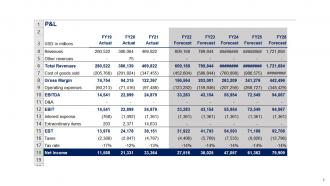
Folie 44 : Diese Folie stellt die voraussichtliche Gewinn- und Verlustrechnung für das Amazon-Geschäft dar.
Folie 45 : Auf dieser Folie wird die prognostizierte Gewinn- und Verlustrechnung für das Amazon-Geschäft fortgesetzt.
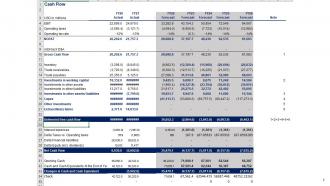
Folie 46 : Auf dieser Folie werden die konsolidierten Kapitalflussrechnungen für das Amazon-Geschäft angezeigt.
Folie 47 : Auf dieser Folie wird die konsolidierte Kapitalflussrechnung für das Amazon-Geschäft fortgesetzt.
Folie 48 : Diese Folie behandelt die vergleichende Bilanz für das Amazon-Geschäft.
Folie 49 : Diese Folie zeigt die Szenarioanalyse mit optimistischen, pessimistischen und nominalen Fällen.
Folie 50 : Diese Folie setzt die Szenarioanalyse mit optimistischen, pessimistischen und nominalen Fällen fort.
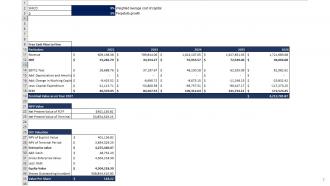
Folie 51 : Diese Folie zeigt die Discounted-Cashflow-Bewertung für Amazon-Geschäfte.
Folie 52 : Diese Folie enthält den Titel für die Themen, die als Nächstes besprochen werden sollen.
Folie 53 : Die Folie beleuchtet die Organisationshierarchie im Unternehmen, anhand derer die Personalstruktur definiert wurde.
Folie 54 : Auf dieser Folie werden die größten beruflichen Erfolge und wertvollsten Fähigkeiten des Gründers vorgestellt.
Folie 55 : Diese Folie zeigt die größten beruflichen Erfolge und wertvollsten Fähigkeiten des CEO (Chief Executive Officer).
Folie 56 : Diese Folie zeigt die Stellenbeschreibung des Amazon-Geschäftsschlüsselmanagements.
Folie 57 : Auf dieser Folie wird die Stellenbeschreibung des Amazon-Geschäftsschlüsselmanagements fortgesetzt.
Folie 58 : Diese Folie zeigt die Überschrift für den Inhalt, der weiter behandelt wird.
Folie 59 : Diese Folie stellt Exit-Strategien wie Ausverkäufe, Börsengänge, Fusionen und Übernahmen dar.
Folie 60 : Diese Folie zeigt den Titel der Ideen, die in der kommenden Vorlage besprochen werden sollen.
Folie 61 : Auf dieser Folie werden die im Plan verwendeten Schlüsselabkürzungen vorgestellt.
Folie 62 : Dies ist die Icons-Folie, die alle im Plan verwendeten Icons enthält.
Folie 63 : Diese Folie dient zur Darstellung einiger zusätzlicher Informationen.
Folie 64 : Dies ist die 30-, 60- und 90-Tage-Planfolie für eine effektive Planung.
Folie 65 : Diese Folie hebt die unternehmensbezogenen Informationen hervor.
Folie 66 : Dies ist die Folie „Treffen Sie unser Team“.
Folie 67 : Diese Folie enthält die Beiträge, die sie für Erinnerungen und Fristen notiert.
Folie 68 : Diese Folie erläutert die organisationsbezogene Roadmap.
Folie 69 : Diese Folie zeigt die Zeitleiste des Unternehmens.
Folie 70 : Dies ist die Folie mit Zitaten zur Motivation.
Folie 71 : Dies ist die Dankesfolie für die Danksagung.
Amazon Business Plan Powerpoint-Präsentationsfolien mit allen 76 Folien:
Nutzen Sie unsere Powerpoint-Präsentationsfolien für den Amazon-Geschäftsplan, um effektiv wertvolle Zeit zu sparen. Sie sind gebrauchsfertig und passen in jede Präsentationsstruktur.








































































FAQs for Amazon Business Plan
Dude, you gotta nail the market research first - figure out your niche and scope out competitors. Product sourcing is huge too, plus pricing that covers all those annoying Amazon fees (seriously, they add up fast). Don't skip inventory planning and marketing for visibility. Financial projections are clutch because margins get tight real quick. Also map out brand protection and customer service stuff. Honestly? Start small with just one product category. Test it out, see what works, then expand once you've got the hang of it. Way less overwhelming that way.
Look, market research is what separates successful Amazon sellers from people who just burn through cash. Without it, you're basically guessing at everything - pricing, competition, what people actually want to buy. Pretty risky move if you ask me. Tools like Jungle Scout or Helium 10 will show you real demand numbers and how saturated different niches are. You'll spot seasonal patterns, find keywords that convert, and figure out pricing that actually works. Honestly beats the hell out of launching something random and hoping for the best. Do this homework first before you pick any product.
Look, you gotta spy on your competition or you'll get destroyed. Check what they're charging, which keywords they use, how they write their listings - basically everything. I know it sounds creepy but it works. Track your top 5-10 competitors every week and see what moves they make. This stuff helps you find pricing sweet spots and gaps in the market nobody's filling yet. Without doing this research, you're basically gambling with your money. Trust me, I learned this the hard way when I first started selling.
Start with Helium 10 or Jungle Scout to see what keywords people actually search for - that data's everything. Then dig into your competitors' listings and find the gaps. The reviews section is honestly where the magic happens though. Read what customers complain about and how they describe problems. Use their exact words in your listings, not some corporate speak. Set up PPC campaigns targeting those high-intent searches, and Amazon's advertising console has decent audience insights if you poke around. Pick one customer type first - trying to target everyone usually backfires.
Dude, be super conservative with your Amazon forecasts - that platform is wild. Don't just burn cash on random keywords, figure out what ads actually convert. Seasonal stuff will mess with your numbers big time, plus Amazon loves changing their fees randomly (ugh). Rolling 13-week forecasts work way better than trying to predict a whole year. Amazon moves too fast for that. Oh and if you're new, account for the fact that you'll probably screw some things up at first - we all do. Track your weekly actuals religiously so you can pivot when things go sideways. Buffer time for inventory delays too.
Dude, inventory is everything - don't treat it like some side thing. Stock out and your rankings tank hard. But don't go crazy buying too much either (learned that with $10K of fidget spinners just sitting there lol). Amazon's forecasting tools help but they're not gospel, you know? Track your velocity like crazy and set up those auto-reorder points. Always add buffer time for delays because stuff happens. Oh and with new products? Start small. Scale up once you see real sales, not what you hope will happen. Cash tied up in dead inventory is the worst feeling ever.
Honestly, start with your product photos - they're everything on Amazon. Bad pics = no sales, period. Then work on getting those first few reviews, which takes forever but you need them. Keywords in your listings matter too, just don't stuff them awkwardly. Once you've got maybe 10-15 reviews, try some Sponsored Product ads. Don't go crazy with the budget though - I learned that the hard way lol. Test small amounts first, see what actually works for your stuff specifically. The algorithm's weird and takes time to figure you out, so be patient while you're tweaking things based on real data.
Honestly, start with Amazon's seller tools - the data you'll get on customer behavior and competitor pricing is insane. Their ad platform is perfect for testing what actually works before you scale up. I'd definitely use FBA so you're not dealing with shipping headaches (trust me on this one). Brand registry is a must too - protects your listings and gives you way better content options. The Seller Central dashboard might look overwhelming at first, but those performance metrics will literally show you where to adjust your strategy. Oh and seasonal trends - that data alone is worth diving in.
Honestly, supply chain issues are probably your biggest headache - stuff just stops showing up sometimes. Competition's brutal too, and don't even get me started on Amazon randomly changing their algorithm and tanking your listings. You'll have cash tied up in inventory that might just sit there for months. The worst part? Amazon controls everything with your customers, so you're basically at their mercy. Their fees keep going up too, which sucks. Oh, and definitely stash away like 3-6 months of expenses because things get weird fast. Multiple income streams are clutch from the start.
Honestly, branding is everything on Amazon. You'll stand out from all the generic crap flooding the marketplace. Customers actually search for YOUR stuff specifically instead of just grabbing whatever's cheapest - which means better margins. Amazon's algorithm loves branded sellers too. You get A+ content, brand stores, sponsored ads that regular sellers can't touch. I know this one guy who literally tripled his profits just from better packaging and a solid brand name (kinda crazy but true). Start simple - consistent logo and packaging across your listings. Then you can build out from there. Worth the investment for sure.
Honestly, there's like 5 main things I'd watch if I were you. Your conversion rate and ad click-through rates are huge - they tell you if people actually want your stuff. Check your organic keyword rankings too. Profit margins are critical because Amazon's fees will eat you alive if you're not careful. Also track how fast inventory moves and keep an eye on reviews/return rates. I pull these numbers every week now - way easier to catch issues early. Oh and inventory turnover rate matters more than people think.
Dude, Amazon policy changes will mess up your plans so fast. Last year they switched up seller fees with barely any heads up - totally caught me off guard. Fee changes, new FBA rules, advertising tweaks... all of it hits your profit margins hard. I always build in some extra cushion now when I'm projecting costs. Check Seller Central regularly (I know, it's boring) and set up those notification alerts. Honestly, reviewing your whole setup every few months isn't overkill anymore. Having a backup plan ready has saved me more times than I can count.
Honestly, customer feedback is like a mirror for your Amazon business - shows you what's really happening vs what you think is happening. Reviews and DMs are pure gold (I swear, read them all even when they sting). You'll spot issues with product quality, pricing problems, shipping delays before they wreck your metrics. Common complaints usually follow patterns. Track those monthly and tweak your business plan every quarter based on what you're seeing. It's wild how one bad review can point you toward a product improvement that doubles your sales.
Honestly, start by figuring out what actually makes your product better than everyone else's. Could be quality, features, whatever - just make it real. Get some solid photos up and use keywords people are actually searching for (not what you think sounds cool). Reviews are huge, so follow up with customers and make sure they're happy. PPC ads help too if you're just starting out. Oh, and don't sleep on your brand story - people buy from companies they connect with. I'd probably audit your biggest competitors first though. See what gaps they're missing that you can jump on.
So for your operational plan, map out the boring stuff first - sourcing, inventory, fulfillment, customer service. You'll want workflows for daily tasks written down somewhere (seriously, future you will love having this when orders start flooding in). Don't skip the unsexy parts like returns and quality checks. Document what you're doing now, then spot where things might get messy later. Oh, and definitely think through how you'll handle growth - like, what happens when you're doing 10x the volume? The logistics piece is honestly where most people mess up.
-
You guys are life-saver when it comes to presentations. Honestly I cannot do much without your services. Thank you!!!
-
Wow! The design and quality of templates on SlideTeam are simply the best.