


Export Business Plan Powerpoint Presentation Slides




Try Before you Buy Download Free Sample Product
 Impress Your
 Audience
 100%
100% Editable
 Save Hours
 of Time


Grab our Export Business Plan Presentation, meticulously crafted to empower entrepreneurs to achieve remarkable success in the global market. It offers a comprehensive and strategic outline through the intricacies of the export business strategy. By encompassing essential elements like an executive summary, thorough market analysis, and a meticulous breakdown of key success factors, our International Trade deck equips entrepreneurs with the tools they need to thrive. Additionally, it incorporates a clear mission and vision statement, which serve as guiding beacons for the businesss future endeavors. The potential growth analysis section delves into critical evaluation tools like the SWOT analysis and Porters Five Forces analysis model. By examining internal strengths, weaknesses, external opportunities, and threats, entrepreneurs can gain valuable insights that inform their strategic decision making. Furthermore, our Cross Border Commerce PPT exhibits meticulous customer analysis and market sizing study to help entrepreneurs identify target demographics and gauge the markets potential. Moreover, a thoughtfully designed sales funnel is provided to guide entrepreneurs in nurturing customer relationships and fostering customer retention. Lastly, to determine the businesss long term value, a DCF Discounted Cash Flow valuation model is employed to project its worth after five years. Get instant access.
People who downloaded this PowerPoint presentation also viewed the following :
Content of this Powerpoint Presentation
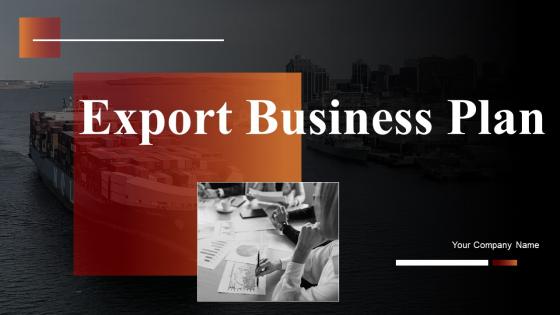
Slide 1: This slide introduces Export Business Plan. Commence by stating Your Company Name.
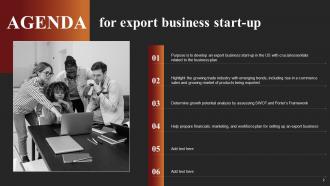
Slide 2: This slide depicts the Agenda of the presentation.
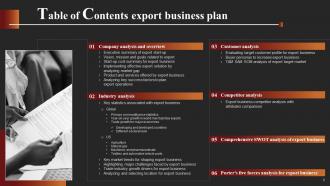
Slide 3: This slide includes the Table of Contents.
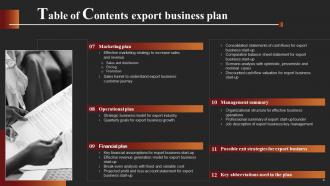
Slide 4: This slide further includes the Table of Contents.
Slide 5: This slide highlights the Title for the Topics to be covered further.
Slide 6: This slide provides the key highlights of the export business.
Slide 7: This slide covers the export industry's vision, mission, and goals .
Slide 8: This slide reveals the Start-up cost summary for export business.
Slide 9: This slide focuses on Implementing effective export solution by analyzing market gap.
Slide 10: This slide talks about the Product and services offered by export business.
Slide 11: This slide deals with Analyzing key success factors to plan export operations.
Slide 12: This slide presents the Heading for the Contents to be discussed next.
Slide 13: This slide highlights the Key statistics associated with export business.
Slide 14: This slide mentions the detailed assessment of different commodity export within the trade industry.
Slide 15: This slide presents the detailed assessment of the merchandising exports in the trade industry.
Slide 16: This slide indicates the details related to the trade growth for the major economies in the goods and service sector.
Slide 17: This slide highlights the details related to the trade growth for the major economies in the goods and service sector.
Slide 18: This slide states the details related to the trade growth for the major economies in the goods and service sector.
Slide 19: This slide portrays the Key statistics associated with export business.
Slide 20: This slide highlights the detailed assessment of agricultural export in the United States.
Slide 21: This slide portrays the detailed assessment of natural gas export in the United States.
Slide 22: This slide shows the detailed assessment of machinery and pharmaceuticals export in the United States. It
Slide 23: This slide highlights the detailed assessment of textiles and automotive vehicle parts export in the United States.
Slide 24: This slide exhibits the Key market trends for shaping export business.
Slide 25: This slide deals with Highlighting major challenges faced by export business.
Slide 26: This slide provide the details about various growth drivers resulting in export progress.
Slide 27: This slide focuses on Analyzing and selecting location for export business.
Slide 28: This slide contains the Title for the Ideas to be coveerd further.
Slide 29: This slide focuses on Evaluating target customer profile for export business.
Slide 30: This slide provides an overview of how to better understand the target audience.
Slide 31: The purpose of this slide is to depict the market potential of exports in terms of TAM, SAM, and SOM.
Slide 32: This slide exhibits the Heading for the Ideas to be discussed next.
Slide 33: This slide reveals the Export business competitor analysis with attributes comparison.
Slide 34: This slide states the Title for the Contents to be coveerd in the upcoming template.
Slide 35: This slide presents the Comprehensive SWOT analysis of export business.
Slide 36: This slide indicates the Heading for the Topics to be covered further.
Slide 37: The slide highlights porter’s five forces model and its implications in the US exports industry.
Slide 38: This slide presents the Title for the Topics to be discussed next.
Slide 39: This slide states the Effective marketing strategy to increase sales and revenue.
Slide 40: This slide shows the Effective marketing strategy to increase sales and revenue.
Slide 41: This slide implements an effective go-to-market strategy for bringing the company's products or services to an end customer.
Slide 42: This slide illustrates the Sales funnel to understand export business customer journey.
Slide 43: This slide reveals the Heading for the Contents to be covered in the following template.
Slide 44: This slide displays the Strategic business model for export industry.
Slide 45: The slide covers particular objectives or goals that the organization intends to attain as part of its business plan.
Slide 46: This slide exhibits the Title for the Ideas to be discussed next.
Slide 47: This slide depicts the important financial assumptions that are to be made while setting export business.
Slide 48: This slide shows the Effective revenue generation model for export business start-up.
Slide 49: This slide highlights the Break-even analysis with fixed and variable cost.
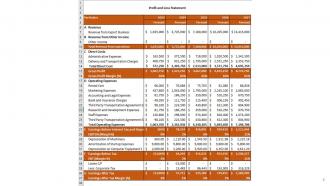
Slide 50: This slide talks about the Projected profit and loss account statement for export business start-up.
Slide 51: This slide conrinues the Projected profit and loss account statement for export business start-up.
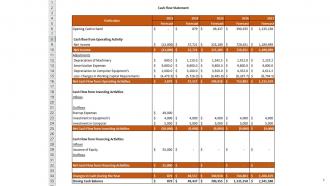
Slide 52: This slide reveals the Consolidated statements of cash flows for export business start-up.
Slide 53: This slide continues the Consolidated statements of cash flows for export business start-up.
Slide 54: This slide displays the Comparative balance sheet statement for export business start-up.
Slide 55: This slide further continues the Comparative balance sheet statement for export business start-up.
Slide 56: This slide presents the Scenario analysis with optimistic, pessimistic and nominal cases.
Slide 57: This slide continues the Scenario analysis with optimistic, pessimistic and nominal cases.
Slide 58: This slide portrays the Discounted cash flow valuation for export business start-up.
Slide 59: This slide exhibits the Heading for the Ideas to be covered in the upcoming template.
Slide 60: This slide displays the Organizational structure for effective business operations.
Slide 61: This slide reveals the Professional summary of export start-up founder.
Slide 62: This slide highlights the job roles and responsibilities of export business key management people. Roles and Responsibilities
Slide 63: This slide continues the Job description of export business key management.
Slide 64: This slide shows the Title for the Contents to be discussed further.
Slide 65: This slide represents exit strategies.
Slide 66: This slide reveals the Heading for the Topics to be covered next.
Slide 67: This slide states the Key abbreviations used in the plan.
Slide 68: This is the Icons slide containing all the Icons used in the plan.
Slide 69: This slide is used for showcasing some Additional information.
Slide 70: This is the Venn diagram slide.
Slide 71: This slide contains the Post it notes for reminders and deadlines.
Slide 72: This slide elucidates the Mind map of the company.
Slide 73: This slide indicates the Timeline process.
Slide 74: This slide depicts the organization's Roadmap.
Slide 75: This is the Column chart slide.
Slide 76: This is the Thank You slide for acknowledgement.
Export Business Plan Powerpoint Presentation Slides with all 81 slides:
Use our Export Business Plan Powerpoint Presentation Slides to effectively help you save your valuable time. They are readymade to fit into any presentation structure.












FAQs for Export Business Plan
Honestly, you're gonna need five main pieces. Market research first - figure out what people actually want in those countries and what red tape you'll hit. Pick your entry strategy next (direct sales, finding distributors, whatever works). Currency swings and shipping costs will mess with your numbers more than you think, so build that into your financial projections. Operations stuff like supply chains and compliance requirements are boring but critical. Marketing strategy comes last - tailor it for each place since what works here might flop there. Oh, and definitely test everything in just one country first before you go crazy expanding everywhere.
Honestly, you can't wing international expansion without solid market research. It shows you which countries actually want what you're selling and at what price points. Plus you'll figure out how people prefer to shop there - some places are still big on brick-and-mortar while others are all digital. The research also reveals what competitors are up to (trust me, there's always something you didn't expect). Without it you're basically gambling with your money. Oh, and it helps you avoid those cringe cultural mistakes that go viral for all the wrong reasons. Pick one market first and really understand it before jumping around.
So you'll need export licenses and permits first - that's the big one. US export regs like EAR and ITAR are a pain but mandatory, plus whatever import rules your target country has. Trade agreements and tariffs will totally mess with your profit margins if you're not careful. Product standards and labeling are another headache to deal with. Oh, and check those restricted goods lists - I've seen people get burned there. IP protection is smart to think about upfront. Honestly, sanctions screening is becoming such a big deal now that you can't skip it. The Commerce Department's export.gov site is surprisingly decent for getting started.
Look, you gotta be real about three things before jumping in. First - is there actually demand for your stuff overseas? I made this mistake once assuming my product would kill it everywhere just because it worked here. Big nope. Then figure out if you can actually handle the logistics nightmare - shipping, regulations, dealing with customers at 3am their time. It's messier than you think. Money-wise, make sure you've got cash to cover the longer wait times for payments plus all the upfront costs. Rate yourself 1-10 on each area. Anything below 7? Fix that first.
Hey! So you're gonna need five main projections. Sales forecasts for each market you're targeting. Cash flow stuff - and honestly, this one's huge because export payments take FOREVER, like 30-90 days sometimes. Then startup costs for all the compliance headaches and shipping setup. Operating expenses too, but build in buffers for when currencies go crazy on you. Finally, break-even analysis per market. Oh and definitely lowball your revenue estimates starting out. I'd bump up expense projections by maybe 15-20% because something always goes sideways with international stuff.
Honestly, figure out what makes your product special first, then find markets where people actually care about that thing. Don't just chase the biggest markets - that's what everyone does. Sometimes those smaller, ignored markets are way better anyway. Check out demographics and spending power, sure, but also see where your competitors aren't already crushing it. I'd dig into trade reports and social media data to back up whatever gut feeling you have. Oh, and definitely test in like 2-3 spots before you blow your budget. Way smarter than going all-in somewhere and hoping it works out.
Dude, logistics will make or break your whole export thing. Map out shipping routes, costs, and how long stuff takes to get there for each market you're targeting. Don't forget customs requirements - that's where people usually mess up. I learned this the hard way when my first shipment showed up three weeks late and cost double what I quoted the customer. Your logistics directly affects pricing and whether customers actually get their stuff on time. Get quotes from freight forwarders first. That'll give you realistic numbers to build your pricing around instead of just guessing.
Don't treat risk management like some add-on you slap together at the end. Build it right into each part of your export plan from day one. For every market you're eyeing, figure out what could go sideways - currency swings, political drama, trade barriers, whatever. Map your backup plans alongside your market entry stuff. Budget for hedging costs and alternate shipping routes too (learned that one the hard way). Honestly, quarterly risk reviews are a game-changer because markets shift constantly. Makes your whole plan way more realistic and flexible when things inevitably change.
Okay so first thing - dig into what competitors are charging and how price-sensitive your target customers actually are. That's your starting point. Then add up all the extra costs you're gonna hit: shipping, duties, currency swaps, local distributor cuts. Currency hedging is honestly where I've seen people get totally screwed on margins, so don't sleep on that. Instead of just marking up costs, think about what value you're actually bringing - especially if you're solving something unique. You might need to price low initially just to get your foot in the door. Oh and build in like a 20-30% cushion for random expenses that'll definitely pop up.
Honestly, digital marketing is your best bet for reaching international customers without breaking the bank. Pick 2-3 countries first - don't try to conquer the world at once. Social media and Google Ads let you target specific regions super cheaply compared to traditional advertising. Make sure your website works on mobile and has multiple languages since that's probably where people will find you. LinkedIn's amazing for B2B stuff if that's your thing. Oh, and email campaigns work really well for keeping overseas leads warm. Way easier than flying around the world for meetings!
Dude, definitely dig into their communication style and business customs first. Like, do meetings actually start on time or is showing up 15 minutes late the norm? How strict is their hierarchy? I'd also check what colors or symbols might accidentally offend people - sounds silly but it matters. Religious holidays can mess with your timeline too. Oh, and figure out if they're all about building relationships first or if they just want to get straight to business. Some cultures you'll be having dinner with clients for months before any real deals happen. Try finding a local consultant who actually knows the scene - way better than reading generic articles online.
Dude, networking is HUGE for exports - probably the thing that separates successful companies from the ones that flop. You'll get connected to distributors, figure out local regulations without going insane, and understand what customers actually want (not just what Google tells you). Trust matters so much more when you're dealing internationally. Everything feels sketchy when it's across borders, right? Local partners will also save your ass from cultural screwups that could destroy your rep. Oh, and start building these connections early - before you desperately need them. Trade shows, LinkedIn, industry groups, whatever works.
So for export financing, you've got a few routes. Bank loans are okay, but export-specific stuff is usually better - like trade finance loans and letters of credit. Honestly though? Government programs are where it's at. The Export-Import Bank does loan guarantees that make regular banks way more cooperative. You can also factor your receivables or get export credit insurance (which I always forget exists but it's actually pretty useful). I'd definitely start with whatever government export programs are in your area since they'll have the best rates. Way cheaper than going straight to banks.
Honestly, the paperwork is brutal at first - commercial invoices, packing lists, certificates of origin, plus whatever random permits each country wants. But find yourself a solid freight forwarder or customs broker who actually knows their stuff. They're worth every penny because one screwed up classification code can mess up your whole shipment. I'd start making templates for the docs you use most. Oh, and double-check those product codes since they determine what duties you'll pay. Once you get into a rhythm with it, becomes way more manageable.
Focus on revenue growth and market penetration in your target regions first - those numbers don't lie. Customer acquisition costs matter too, especially when you're breaking into new markets. I'd also watch your export volumes closely since they show real momentum (or lack of it). Operational stuff like shipping delays and customs headaches will bite you if you ignore them. Customer satisfaction scores by region are gold too. Honestly, profit margins per market can vary wildly, so track those separately. Pick maybe 3-4 metrics that match your biggest goals and check them monthly. Don't overcomplicate it.
-
SlideTeam offers so many variations of designs and topics. It’s unbelievable! Easy to create such stunning presentations now.
-
Informative presentations that are easily editable.