


Boutique Business Plan Powerpoint Presentation Slides




Try Before you Buy Download Free Sample Product
 Impress Your
 Audience
 100%
100% Editable
 Save Hours
 of Time


Starting and maintaining a fashion business looks simple however, the truth is that if you want to reduce stress, you must take the necessary measures to guarantee that it will endure. Grab Our professionally curated Boutique Business Plan. It provides a complete overview of the pertinent sector. Our Fashion boutique business plan overviews your boutiques current situation and outlines your growth strategy for the following five years. It outlines your companys objectives and your plan for achieving them. Market research is also included to help you with your ideas. Additionally, our Growth of fashion industry PPT discusses Porters framework and how it affects the fashion industry, market gaps, opportunities, market sizing, including TAM, SAM, and SOM, go-to marketing strategy, sales funnel, etc. It further contains a financial review that offers a comprehensive 5-year analysis while considering market circumstances. Lastly, our Growing fashion awareness module consists of the revenue model, balance sheet, cash flow statement, break-even analysis, DCF valuation, and profit and loss statement. Download this utterly editable presentation to get our well-researched and expertly crafted offering.
People who downloaded this PowerPoint presentation also viewed the following :
Content of this Powerpoint Presentation
Slide 1: This slide introduces the Boutique Business Plan. Commence by stating Your Company Name.
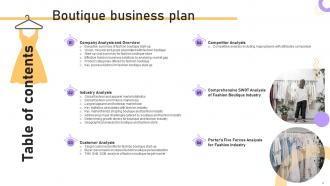
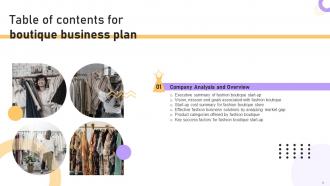
Slide 2: This slide incorporates the Table of contents.
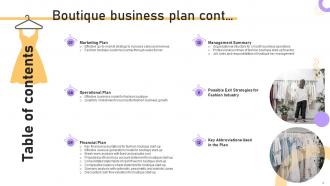
Slide 3: This is yet another slide continuing the Table of contents.
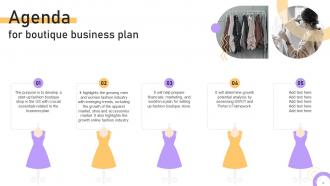
Slide 4: This slide depicts the Agenda of the presentation.
Slide 5: This slide highlights the Title for the Topics to be covered further.
Slide 6: This slide shows the Executive summary of fashion boutique start-up.
Slide 7: This slide includes the comapny's Vision, mission and goals associated with fashion boutique.
Slide 8: This slide reveals the Start-up cost summary for fashion boutique store.
Slide 9: This slide focuses on Effective fashion business solutions by analyzing market gap.
Slide 10: This slide exhibits the Product categories offered by fashion boutique.
Slide 11: This slide states the Key success factors for fashion boutique start-up.
Slide 12: This slide portrays the Heading for the Contents to be discussed next.
Slide 13: This slide showcases the Global fashion and apparel market statistics.
Slide 14: This slide reveals the Global fashion-ecommerce market size.
Slide 15: This slide highlights the largest apparel and footwear market worldwide.
Slide 16: This slide presents the Key statistics associated with fashion industry.
Slide 17: This slide continues the Key statistics associated with fashion industry.
Slide 18: This is yet another slide continuing the Key statistics associated with fashion industry.
Slide 19: This slide further continues the Key statistics associated with fashion industry.
Slide 20: This slide shows the Key market trends shaping boutique and fashion industry.
Slide 21: This slide deals with Addressing major challenges catered by boutique and fashion industry.
Slide 22: This slide focuses on Determining growth drivers for boutique and fashion industry.
Slide 23: This slide states the Geographical analysis for boutique and fashion store.
Slide 24: This slide contains the Title for the Ideas to be further discussed.
Slide 25: This slide covers the Target customer profile for fashion boutique start-up.
Slide 26: This slide continues the Target customer profile for fashion boutique store.
Slide 27: This slide exhibits the Buyer personas to increase fashion boutique personalization.
Slide 28: This slide showcases the TAM SAM SOM analysis of fashion boutique target market.
Slide 29: This slide includes the Heading for the Ideas to be covered in the upcoming template.
Slide 30: This slide portrays the Competitive analysis including major players with attributes comparison.
Slide 31: This slide displays the Title for the Contents to be discused next.
Slide 32: This slide reveals the Comprehensive SWOT analysis of fashion boutique industry.
Slide 33: This slide presents the Heading for the Topics to be covered further.
Slide 34: This slide shows the Porter’s five forces analysis for fashion industry.
Slide 35: This slide depicts the Title for the Topics to be discussed next.
Slide 36: This slide portrays the Effective go-to-market strategy to increase sales and revenue.
Slide 37: This slide continues the Effective go-to-market strategy to increase sales and revenue.
Slide 38: This slide further continues the Effective go-to-market strategy to increase sales and revenue.
Slide 39: This is yet another slide continuing the Effective go-to-market strategy to increase sales and revenue.
Slide 40: This slide further continues the Effective go-to-market strategy to increase sales and revenue.
Slide 41: This slide illustrates the Fashion boutique customer journey through sales funnel.
Slide 42: This slide continues the Fashion boutique customer journey through sales funnel.
Slide 43: This slide shows the Heading for the Contents to be covered in the following template.
Slide 44: This slide displays the Effective business model for fashion boutique.
Slide 45: The slide covers particular objectives or goals the organization intends to attain as part of its business plan.
Slide 46: This slide contains the Title for the Ideas to be further discussed.
Slide 47: This slide states the Key financial assumptions for fashion boutique start-up.
Slide 48: This slide portrays the Effective revenue generation model for boutique start-up.
Slide 49: This slide highlights the Break-even analysis with fixed and variable cost.
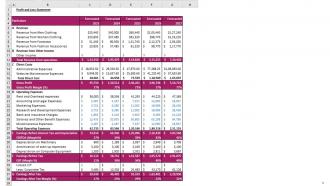
Slide 50: This slide deals with Projected profit and loss account statement for boutique start-up.
Slide 51: This slide continues the Projected profit and loss account statement for boutique start-up.
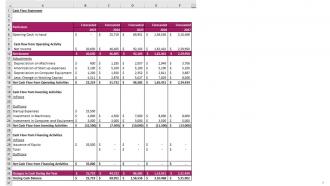
Slide 52: This slide depicts the Consolidated statements of cash flows for boutique start-up.
Slide 53: This slide continues the Consolidated statements of cash flows for boutique start-up.
Slide 54: This slide represents the Comparative balance sheet statement for boutique start-up.
Slide 55: This slide continues the Comparative balance sheet statement for boutique start-up.
Slide 56: This slide showcases the Scenario analysis with optimistic, pessimistic and realistic cases.
Slide 57: This slide continues the Scenario analysis with optimistic, pessimistic and realistic cases.
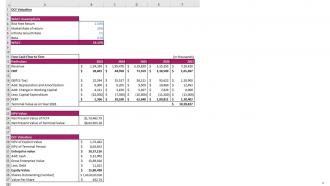
Slide 58: This slide highlights the Discounted cash flow valuation for boutique start-up.
Slide 59: This slide incorporates the Heading for the Ideas to be covered in the upcoming template.
Slide 60: The slide highlights the organizational hierarchy in the company.
Slide 61: This slide revals the Professional summary of fashion boutique start-up founder.
Slide 62: This slide exhibits the Job roles and responsibilities of boutique key management.
Slide 63: This slide continues the Job roles and responsibilities of boutique key management.
Slide 64: This slide further continues the Job roles and responsibilities of boutique key management.
Slide 65: This slide exhibits the Title for the Contents to be discussed further.
Slide 66: This slide represents exit strategies for fashion industry.
Slide 67: This slide states the Possible exit strategies for fashion industry.
Slide 68: This slide depicts the Heading for the Topics to be covered in the forthcoming template.
Slide 69: This slide highlights the Key abbreviations used in the plan.
Slide 70: This is the Icons slide containing all the Icon used in the plan.
Slide 71: This slide is used for showing some Additional information.
Slide 72: This slide reveals the organization's Vision, mission, and goals.
Slide 73: This is the 30 60 90 days plan slide for effective planning.
Slide 74: This is Our target slide. State your organization's targets here.
Slide 75: This slide represents the SWOT analysis.
Slide 76: This slide elucidates the Roadmap of the firm.
Slide 77: This is the Venn diagram slide.
Slide 78: This is the Idea generation slide for encouraging fresh ideas.
Slide 79: This slide exhibits the company's Timeline.
Slide 80: This is the Thank You slide for acknowledgement.
Boutique Business Plan Powerpoint Presentation Slides with all 85 slides:
Use our Boutique Business Plan Powerpoint Presentation Slides to effectively help you save your valuable time. They are readymade to fit into any presentation structure.





















FAQs for Boutique Business Plan
Okay so first things first - nail down who your customers actually are through some solid market research. Location is huge too, like seriously, bad foot traffic will kill you fast. Figure out your brand identity and what makes you different from every other boutique out there. Money stuff is obviously crucial - startup costs, cash flow projections, all that fun financial planning. Don't skip the pricing strategy since you'll need those higher margins to survive. Oh and sourcing your inventory, plus how you'll actually market this thing through social media and local connections. Start with a killer executive summary though - investors need to be hooked from page one.
Honestly, you really need to do market research before dumping your savings into this. It'll show you who's actually gonna shop there and what they'll pay. Look around - are there gaps your boutique could fill? Check out competitor pricing and their reviews online. Survey people in your area too. The data helps with everything from what inventory to buy (trust me, you don't want racks of unsold clothes) to convincing banks you're not just winging it. My cousin skipped this step and... yeah, don't be like her. Do the homework first.
Okay so you'll definitely need revenue forecasts, startup costs, operating expenses, and cash flow for the first three years minimum. Break down revenue by product lines and seasons - boutiques get hit hard by seasonal swings. Cover all your operating costs: rent, inventory, staff, marketing, utilities, everything. A break-even analysis is crucial too so you know when you'll stop bleeding money. Oh, and create best-case/worst-case scenarios because retail is honestly a rollercoaster. Back everything up with solid market research though - investors spot BS projections instantly and it kills your credibility.
Okay so first thing - ditch the "women 25-45" thing because that's literally everyone lol. Get way more specific about who you're targeting. What's their income? Where do they shop now? Are they scrolling Instagram at lunch or browsing Pinterest on weekends? I'd make like 2-3 super detailed customer profiles instead. Stalk your competitors' followers a bit - see who's actually commenting and buying. Then just ask people directly! Survey friends or potential customers about their budgets and what they actually want. Way more useful than guessing.
Instagram and TikTok are your best friends here - fashion just sells itself visually, you know? Post your pieces, some behind-the-scenes stuff, maybe styling tips. Email your customers about new arrivals and sales too. But honestly? Word-of-mouth still beats everything. I'd team up with local influencers, throw some in-store events, really get to know your customers. Pop-ups at farmers markets work great too - though that might sound random, it actually gets you in front of new people. Don't try everything at once though. Pick like 2-3 things and nail those first.
Look, you've gotta map out your competition first - other boutiques, department stores, even online shops your customers might hit up instead. The research part is honestly kinda fun once you get into it! Figure out what makes you different. Maybe it's your styling services or those local designers nobody else carries. I'd build everything around that - your prices, marketing, what you stock. Oh and don't just copy everyone else's playbook. Give people an actual reason to walk through your door instead of ordering from their couch.
Honestly, branding is everything for a boutique - without it, you're just another clothing store. You can't compete on price like Target or whatever, so your brand identity becomes your whole differentiator. Investors want to see you've actually thought this through too. Cover your target customer, store vibe, how you'll curate products, even your Instagram voice. The aesthetic stuff matters way more than you'd think. Don't forget to budget real money for this in your financial projections - brand development isn't cheap but it's what'll make or break you.
Okay so you definitely need both online and in-store working together. Budget for an e-commerce site and social media ads - Instagram and TikTok are honestly where it's at right now for boutiques. I'd also look into influencer collabs since they actually convert well. Make sure your inventory system can handle both channels though, that's key. Oh and services like curbside pickup are still popular! Virtual styling sessions could be cool too. The trick is making your online vibe match your store's personality. Don't spread yourself too thin - pick one platform first and really master it before jumping to others.
Honestly, the biggest headaches you're gonna face are inventory and staffing. Dead stock will kill your cash flow faster than anything - boutiques just can't afford stuff sitting around collecting dust. Seasonal swings are intense too, so build flexibility into how many people you schedule and what you're buying. Oh, and competing with online stores while paying rent? That's rough. Your customers will expect amazing service since they're shopping small, so your staff needs to actually care about helping people. I'd start by figuring out your busy seasons and plan everything around those.
Dude, location is seriously everything for a boutique. I've watched beautiful stores tank because they picked dead areas while basic ones killed it in busy spots. You'll want to check out foot traffic, who's walking by (are they your people?), and what other stores are around. Rent's obviously huge too - don't blow your budget on the "perfect" spot if it means you can't afford inventory. Oh and visit potential places at different times, like weekday mornings vs Friday nights. The vibe can be totally different. Your location basically dictates everything else - pricing, marketing, even what you stock. Check out at least 3-5 places before deciding.
Honestly, you've got advantages they'll never have. Big stores are just warehouses with registers - you can actually get to know your customers and remember what they like. Stock weird, unique stuff they can't get at Target. Make the whole experience feel special, you know? Like they're discovering something cool. One-on-one styling sessions, cozy vibes, real relationships. You can also pivot super fast when trends shift - no waiting around for some corporate team to approve anything. Oh, and build an actual community instead of just trying to move product. That personal touch is everything.
Instagram and TikTok are your best bet - they're made for showing off cute clothes! I'd focus on daily outfit posts, behind-the-scenes content, and definitely repost customer photos. That stuff performs so well for boutiques. Local micro-influencers are where it's at too - way cheaper than big accounts and honestly their followers trust them more. Don't forget to actually respond to comments and DMs fast. Oh, and pick good hashtags but don't go overboard with them. Start with just those two platforms though. Better to post consistently on a couple than barely keep up with five different apps.
Honestly, I'd go with bottom-up costing first - basically just list out every single thing you'll need to spend money on. Rent, that POS system, inventory, permits, even that cute chandelier if you're set on it. Way more accurate than guessing. You could also look at what other similar boutiques spent, but good luck getting real numbers from people lol. The percentage-of-sales thing works too if you find decent industry data. Whatever method you pick, add like 15-20% extra because trust me, there's always some random expense that pops up. I'd start with the itemized approach then double-check it against whatever industry benchmarks you can find online.
Ok so you want customers feeling special, right? Personalized service is huge - remember their sizes, what they like. Loyalty programs work really well too. Early access to new stuff, birthday discounts, maybe VIP styling sessions. Email them about new arrivals and outfit ideas... honestly people eat that personal stylist vibe up. Build real relationships so shopping with you feels way more personal than some random department store. Oh and definitely track your repeat customer rate - that's how you'll know if any of this is actually working. The whole goal is making them feel like your favorite customer every time.
Honestly, start with sourcing - find suppliers who actually care about fair labor and eco materials. Digital receipts are a no-brainer, plus energy-efficient lighting saves you money anyway. People are obsessed with brands that have real values right now, so partner with local artisans to cut down shipping and support your community. Maybe throw in some rental or consignment options? The marketing practically does itself when you've got good sustainability stories. I'd pick like 2-3 things you can actually handle from the start - don't overwhelm yourself trying to be perfect immediately.
-
It’s really cool, and you can find pretty much everything you could need for your work or school.
-
Fantastic collection of visually appealing PowerPoint templates. They certainly uplift the look of the presentation.