


Applications Of Industrial Robotic Systems Powerpoint Presentation Slides




Try Before you Buy Download Free Sample Product
 Impress Your
 Audience
 100%
100% Editable
 Save Hours
 of Time


Industries frequently incorporate robotics and automation into their production processes due to rapid technological advancements. Grab our insightfully designed Applications of industrial robotic systems template. An industrial robot is a machine capable of performing various activities accurately and precisely. Our Robotic automation deck includes an introduction, advantages, components, programming methods, and the importance of industrial robots in business. It demonstrates different types of industrial robots, like SCARA, cartesian, robots, and their business applications. Additionally, our Industrial automation PPT showcases the reasons to implement industrial robots in various domains and how companies can use robotics to increase their productivity and revenue. It also exhibits the market trends and robotics analysis in business and top industrial robot manufacturing companies. Furthermore, our Industrial automation systems module shows the challenges industries face while implementing robotics in business operations and ways to cope with such situations. Lastly, it comprises a roadmap, a 30-60-90 days plan and checklist for integrating industrial robots, top case studies, and a dashboard to monitor the performance of robots. Download our 100 percent editable and customizable template, which is also compatible with Google Slides.
People who downloaded this PowerPoint presentation also viewed the following :
Content of this Powerpoint Presentation
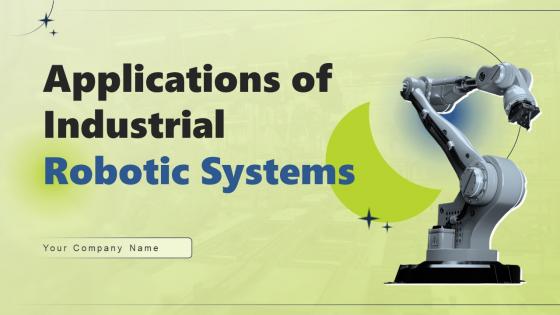
Slide 1: This sldie introduces Applications of industrial robotic systems. Commence by stating Your Company Name.
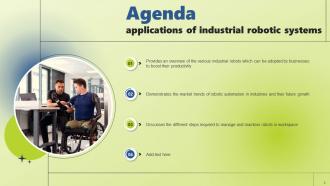
Slide 2: This slide depicts the Agenda of the presentation.
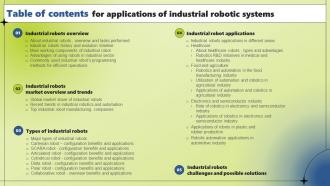
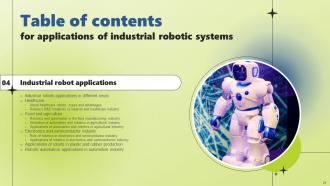
Slide 3: This slide incorporates the Table of contents.
Slide 4: This is yet another slide continuing the Table of contents.
Slide 5: This slide highlights the Title for the Topics to be discussed further.
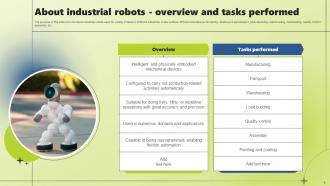
Slide 6: The purpose of this slide is to introduce industrial robots used for variety of tasks in different industries.
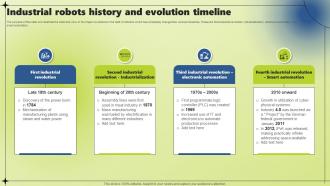
Slide 7: This slide exhibits the Industrial robots history and evolution timeline.
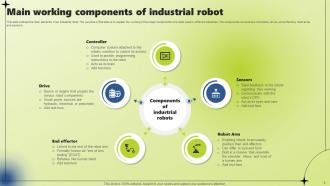
Slide 8: This slide outlines the main elements of an industrial robot.
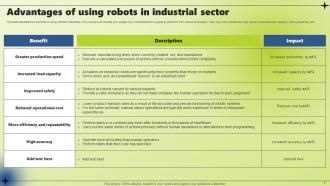
Slide 9: This slide illustrates the benefits of using robots in industries.
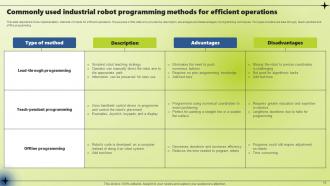
Slide 10: This slide depicts the three implementation methods of robots for efficient operations.
Slide 11: This slide mentions the Heading for the Contents to be covered in the following template.
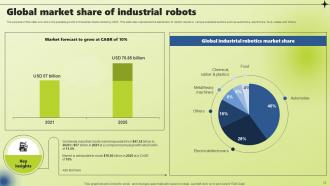
Slide 12: This slide reveals the Global market share of industrial robots.
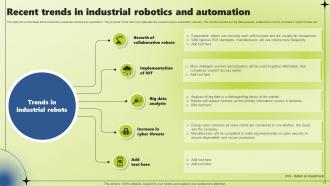
Slide 13: This slide shows the latest advancements in industrial robotics and automation.
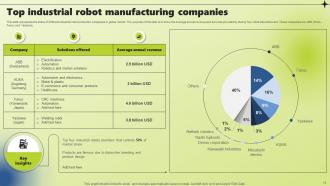
Slide 14: This slide represents the share of different industrial robot production companies in global market.
Slide 15: This slide incorporates the Title for the Ideas to be discussed further.
Slide 16: This slide illustrates the seven major types of industrial robots.
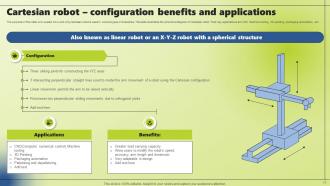
Slide 17: The purpose of this slide is to explain how and why cartesian robot is used in various types of industries.
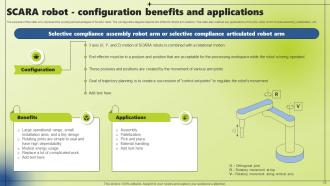
Slide 18: This slide displays the working and advantages of SCARA robot.
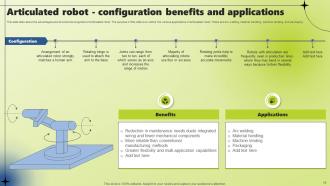
Slide 19: This slide talks about the advantages and structural arrangement of articulated robot.
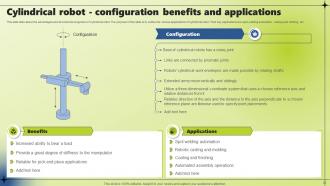
Slide 20: This slide presents the advantages and structural arrangement of cylindrical robot.
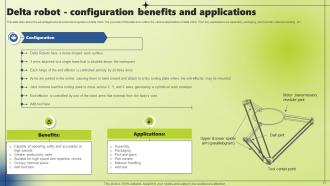
Slide 21: This slide reveals the advantages and structural arrangement of delta robot.
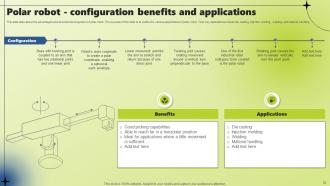
Slide 22: This slide talks about the advantages and structural arrangement of polar robot.
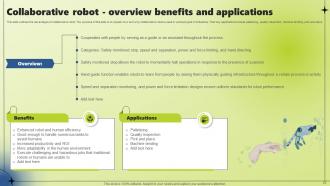
Slide 23: This slide outlines the advantages of collaborative robot.
Slide 24: This slide portrays the Heading for the Ideas to be covered next.
Slide 25: The purpose of this slide is to justify the huge investments made by industries in robotics and automation.
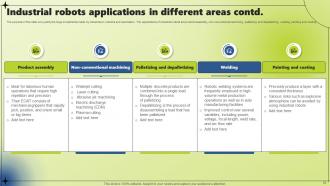
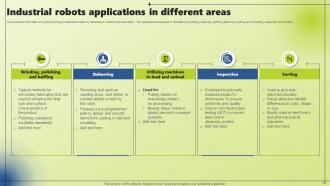
Slide 26: This slide states the Industrial robots applications in different areas.
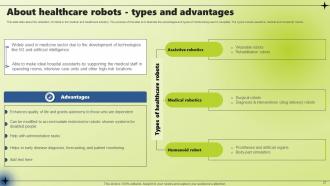
Slide 27: This slide talks about the utilization of robots in the medical and healthcare industry.
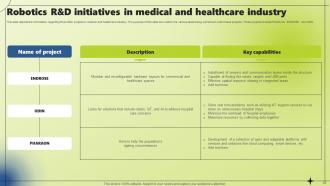
Slide 28: This slide depicts the information regarding three R&D projects in medical and healthcare industry.
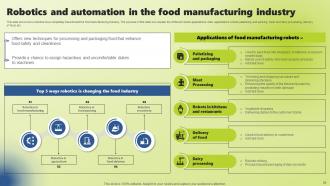
Slide 29: This slide shows how robotics have completely transformed the food manufacturing industry.
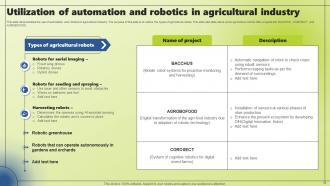
Slide 30: This slide demonstrates the use of automation and robotics in agricultural industry.
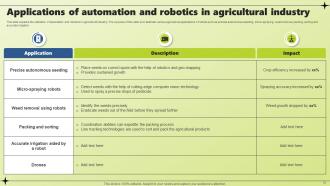
Slide 31: This slide explains the utilization of automation and robotics in agricultural industry.
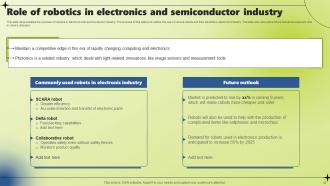
Slide 32: This slide highlights the purpose of robotics in electronic and semiconductor industry.
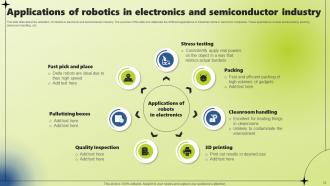
Slide 33: This slide exhibits the Applications of robotics in electronics and semiconductor industry.
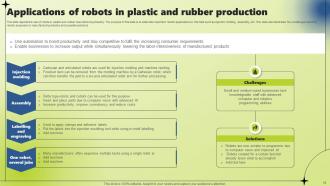
Slide 34: This slide depicts the use of robots in plastic and rubber manufacturing industry.
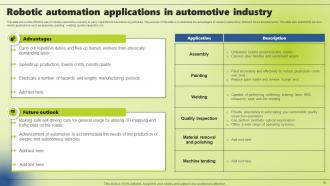
Slide 35: This slide presents the Robotic automation applications in automotive industry.
Slide 36: This slide includes the Title for the Contents to be coveerd next.
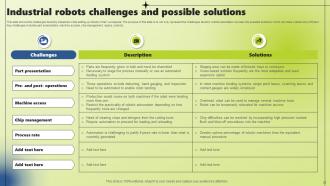
Slide 37: This slide shows the challenges faced by industries while setting up robots in their workspace.
Slide 38: This slide indicates the Heading for the Topics to be discussed further.
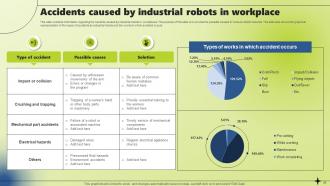
Slide 39: This slide contains information regarding the hazards caused by industrial robots in workplaces.
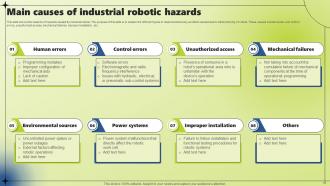
Slide 40: This slide displays the Main causes of industrial robotic hazards.
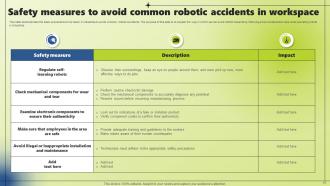
Slide 41: This slide demonstrates the basic precautions to be taken in industries to avoid common robotic accidents.
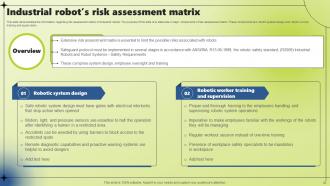
Slide 42: This slide showcases the information regarding risk assessment matrix of industrial robots.
Slide 43: This slide indicates the Title for the Ideas to be covered further.
Slide 44: This slide demonstrates the names of key robot manufacturing companies listed by the type of robot.
Slide 45: This slide states the names of key robot manufacturing companies listed by the type of robot.
Slide 46: This slide highlights the Heading for the Ideas to be discussed next.
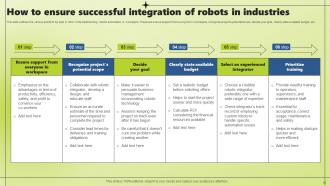
Slide 47: This slide outlines the various points to be kept in mind while implementing robotic automation in workplace.
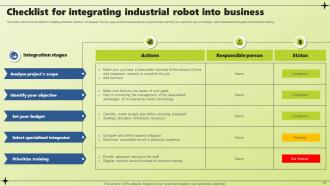
Slide 48: This slide reveals the Checklist for integrating industrial robot into business.
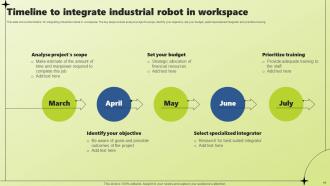
Slide 49: This slide shows the timeline for integrating industrial robots in workspace.
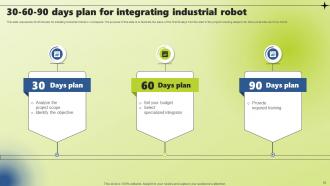
Slide 50: This slide represents 30-60-90 plan for installing industrial robots in workspace.
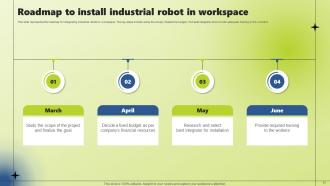
Slide 51: This slide portrays the Roadmap to install industrial robot in workspace.
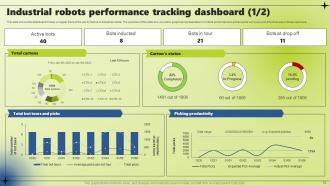
Slide 52: This slide shows the dashboard to keep a regular track of the performance of industrial robots.
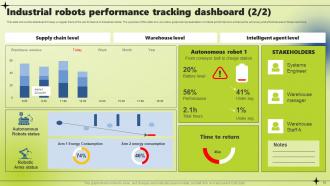
Slide 53: This slide continues Industrial robots performance tracking dashboard.
Slide 54: This slide mentions the Heading for the Contents to be covered in the forth-coming template.
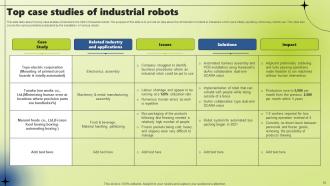
Slide 55: This slide talks about five top case studies conducted in the field of industrial robots.
Slide 56: This slide indicates the Title for the Ideas to be discussed further.
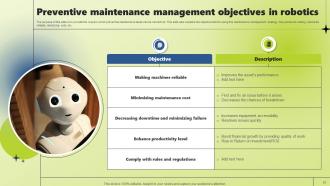
Slide 57: The purpose of this slide is to provide the ways in which preventive maintenance tasks can be carried out.
Slide 58: This slide includes the Heading for the Ideas to be covered next.
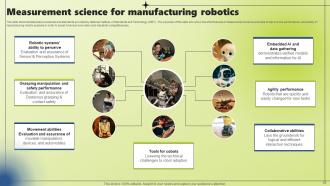
Slide 59: This slide shows test procedures and standards provided by National Institute of Standards and Technology (NIST).
Slide 60: This is the Icons slide containing all the Icons used in the plan.
Slide 61: This slide is used for depicting some Additional information.
Slide 62: This is the About us slide. State your company-related information here.
Slide 63: This slide highlights the Venn diagram.
Slide 64: This slide reveals the SWOT analysis.
Slide 65: This slide exhibits the company's Mind map.
Slide 66: This slide contains the Post it notes for reminders and deadlines.
Slide 67: This is Our team slide. State your team-related information here.
Slide 68: This is the Quotes slide for motivation.
Slide 69: This is the Idea generation slide for encouraging fresh ideas.
Slide 70: This is the Thank You slide for acknowledgement.
Applications Of Industrial Robotic Systems Powerpoint Presentation Slides with all 73 slides:
Use our Applications Of Industrial Robotic Systems Powerpoint Presentation Slides to effectively help you save your valuable time. They are readymade to fit into any presentation structure.









FAQs for Applications Of Industrial Robotic Systems
Dude, the ROI is usually 2-3 years which isn't terrible. Productivity goes through the roof since they work around the clock - no lunch breaks, no sick days, nothing. Quality gets way more consistent too because robots don't have Monday morning brain fog like we do. They're perfect for dangerous stuff humans shouldn't be doing anyway. Yeah the upfront cost sucks, but you save money long-term through less waste and fewer errors. I'd probably start small though - pick one repetitive process that's driving everyone crazy and automate that first.
So basically, traditional robots are super fast and strong but they need those cage things around them for safety. Cobots are the opposite - they're built to work right next to people without barriers. They've got these sensors that make them stop instantly if they bump into someone, which honestly seems like magic to me. Way easier to program too. You can move cobots around for different jobs pretty easily. For your setup, I'd go with cobots if people need to interact with them, and stick with traditional ones for those boring repetitive tasks where speed matters more.
So automotive and electronics are totally dominating the robot space right now. Food processing and pharma are huge too. Warehousing is blowing up because of the whole e-commerce thing - makes sense, right? What's cool is smaller companies are finally getting in on it since robots don't cost a fortune anymore and you don't need a PhD to program them. Honestly, supply chain stuff is where all the serious money's going. If you're thinking investments or job hunting, those are the sectors I'd watch. Logistics especially - that market's insane right now.
Okay so first thing - do a robotics readiness check covering your processes, workforce skills, finances, and infrastructure. Focus on repetitive, dangerous, or quality-critical tasks since those make the best candidates for automation. So many companies mess this up by rushing in without proper mapping (learned that the hard way at my last job). Your team needs technical skills to handle robotic systems, or you'll need training. Don't forget facility requirements like power and network capacity. My advice? Start with auditing just one production line instead of overwhelming yourself with everything at once.
So AI basically makes robots way smarter - they go from just following basic commands to actually adapting on the fly. Computer vision handles quality checks, machine learning predicts when stuff's gonna break before it does. The coolest part? You can literally talk to these systems now with natural language processing. I'm still not over this demo I saw last month, honestly. Instead of robots freaking out when something's even slightly different, they learn and adjust in real-time. If you're thinking about upgrading, definitely start with vision systems first - that's where you'll see the money come back fastest.
Honestly, robots are perfect for the stuff that could seriously hurt people - toxic chemicals, crazy heavy machinery, those furnace-hot environments. They don't get tired on a Friday afternoon and make dumb mistakes like we do. Your workers can focus on the actually interesting strategic work instead of risking their necks. The consistency is insane too - same quality every single time, no off days. I'd probably start with whatever process scares you most safety-wise. Way fewer injuries, way fewer defective products. Pretty much a win-win situation.
Honestly? The money upfront is brutal, and getting your current systems to actually work with new robots can be a total headache. Your team's gonna push back hard on changes too - that's just human nature. Training takes forever, both for programming and keeping everything running. Oh, and don't get me started on all the safety regulations you'll need to navigate. Most executives think they'll see ROI way sooner than reality. Here's what I'd do: pick one small area, test it out there first. Once you've got some solid wins, then think about expanding. Way less risky that way.
Honestly, robots are game-changers for going green. The precision is insane - like 15-30% less material waste because they don't mess up like humans do. Fewer defective products means way less rework too. Energy-wise, they're super efficient, and some can even run in the dark (no lights or heating needed). I read somewhere that BMW does this with their night shifts - pretty wild. Start with whatever process wastes the most material in your operation. That's where you'll see the biggest impact from automation. The consistency alone pays for itself.
Dude, AI integration is making robots crazy adaptable now - they can actually learn different tasks on the fly. Cobots are where it's at though, they're designed to work right next to people without being dangerous. Mobile ones are getting big too since they're not chained to one workstation. Oh and cloud connectivity is pretty nuts - robots can literally share what they learn with other robots instantly. Programming got way easier recently, which is honestly about time. The whole field is moving insanely fast right now. If you're thinking about automation, I'd definitely start looking into cobots first since they won't break your budget.
Track both the obvious stuff and the hidden wins. Labor savings, fewer defects, faster production - that's the easy math. But you're also looking at safety improvements, way better quality consistency, and running operations around the clock if needed. The energy savings with newer robots? Actually pretty shocking when you crunch those numbers. Don't sleep on reduced maintenance costs either. Add up your total implementation costs against all these savings combined. Most companies hit their payback somewhere between 1-3 years, assuming they're actually measuring everything properly instead of just guessing.
Dude, vision sensors are absolutely crushing it right now. Your robots can finally handle precision assembly and QC work that always needed human oversight. Force sensors give them actual touch sensitivity for delicate stuff - honestly game-changing. LiDAR's making navigation way less sketchy too, especially for bin-picking applications. The crazy part? When you combine better sensors with AI processing, robots actually adapt on the fly instead of just running dumb programs. Oh and the improvement speed is nuts lately. If you're buying new systems, definitely go heavy on vision and force capabilities.
Dude, you absolutely cannot just plop robots down and expect things to work. Your operators need to learn programming and troubleshooting. Maintenance guys have to pick up completely different diagnostic skills. People freak out about losing their jobs too - training actually helps calm those nerves, which honestly makes sense. Companies that really invest in teaching their workers see way better returns on the whole automation thing. Oh, and start with your most flexible people first. Build up that knowledge internally before you go crazy expanding everything.
Dude, three big things to watch out for: job displacement, safety, and data privacy. Don't be shady about automation plans - your workers will find out anyway and hate you for it. Invest in retraining instead. Safety's obvious but worth saying - make sure people won't get hurt working alongside these things. Data's tricky because robots hoover up tons of operational info that might be sensitive. The job stuff honestly worries me most. Like, real people's livelihoods are at stake here. But tackle these three areas early and you won't be scrambling later. Maybe start with an audit of what you're doing now?
Honestly, smaller companies can totally win at this game. Skip the massive industrial robots and go for cobots instead - way cheaper and you don't need those crazy safety cages. I'd start super small, like pick one annoying repetitive task that's eating your time. Maybe packaging or inspection, whatever's driving you nuts. The cool thing is you can lease these systems instead of dropping a ton of cash upfront. Actually, being small works in your favor here since you can change direction fast when something clicks. Oh and find a local automation consultant who gets small businesses - they're worth their weight in gold.
Dude, those industry standards totally control how you build and deploy industrial robots. Safety requirements, performance benchmarks, interoperability specs - your robots have to hit all these marks before they can legally run in factories. ISO 10218 covers robot safety, ANSI has collaborative robot standards... honestly the acronym mess gets confusing fast. But hey, at least it means your robots can work safely with humans and play nice with equipment from other manufacturers. Oh, and definitely check what standards you need upfront when planning a project. Trust me, fixing compliance issues after the fact costs way more than just building it right from the start.
-
Thank you for offering such helpful pre-designed templates. They are really beneficial to me in my job.
-
SlideTeam’s readymade presentations have landed my unique images with my bosses in the past and it continues to reward me.