

Artificial Intelligence Powered Drones For Military Operations Training Ppt





Try Before you Buy Download Free Sample Product
 Impress Your
Audience
 100%
Editable
 Save Hours
of Time


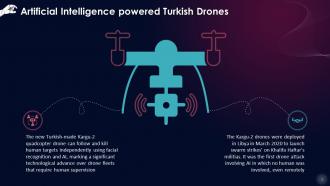
This slide provides information about the AI powered drones used by the Turkish military for use in the defense sector. Turkeys drones are one of the most potent symbols of the countrys air might as they can neutralize enemy targets in high-risk warfares.
People who downloaded this PowerPoint presentation also viewed the following :
Artificial Intelligence Powered Drones For Military Operations Training Ppt with all 17 slides:
Use our Artificial Intelligence Powered Drones For Military Operations Training Ppt to effectively help you save your valuable time. They are readymade to fit into any presentation structure.







FAQs for Artificial Intelligence Powered Drones For Military
So basically they do surveillance stuff - tons of intel gathering with crazy good cameras and sensors. Track enemy movements too. The strike missions get all the headlines but honestly they're doing way more now. Communications, moving supplies around, electronic warfare operations. Pretty wild how fast this tech is moving. Main thing is pilots can be safe somewhere thousands of miles away instead of in harm's way. Oh and if you're thinking about getting into this field, definitely look at the AI training side - that's where all the cool developments are happening right now.
Dude, military drones are getting scary smart with AI now. They're not just filming anymore - they can actually identify targets and track movement patterns in real-time. The computer vision tech is insane, like they'll spot camouflaged stuff or tell civilians from combatants way faster than humans can. Navigation through rough terrain? Yeah, they handle that autonomously now while still doing surveillance. Honestly feels like sci-fi sometimes. If you're thinking defense work, definitely learn some ML frameworks because that's where all the money's going these days.
So basically there are a few huge red flags with AI weapons. First off, you're letting machines decide who lives and dies - no human judgment involved, which is insane if you ask me. Then there's the whole accountability mess: when an AI screws up and kills the wrong person, who takes the blame? The programmer? The military commander? Good luck figuring that out. These systems can also be super biased since they learn from flawed data, so they might unfairly target certain groups. Most experts think humans need to stay in control of lethal decisions, even if AI helps out.
So basically they run tons of simulations first - like thousands before anything gets deployed for real. Plus there's always human oversight when big decisions need to happen. The testing is crazy thorough too, they throw everything at it - equipment breaking, bad weather, you name it. Multiple backup systems are built in so if one AI part craps out, others take over immediately. Honestly the whole approach is pretty smart - they never bet everything on just one system or test. It's all about having multiple layers checking each other, which makes sense for something this serious.
So basically ML is what makes military drones smart enough to operate solo. These algorithms crunch tons of sensor data instantly - identifying targets, dodging obstacles, adapting to whatever's happening on the ground. It's like a super advanced autopilot that can also make combat calls. The training process is pretty wild actually - they feed these systems thousands of different scenarios so they learn to spot patterns and react properly. Oh and if you're messing around with any drone stuff, definitely prioritize your data quality first. That whole "garbage in, garbage out" thing is painfully real with this tech.
So basically, you train the AI on friendly signatures - vehicle types, how allies move, comm protocols, all that stuff. That way drones know what they shouldn't shoot at. Multiple systems work best though - GPS tracking, IFF transponders, visual recognition algorithms. Creates backup layers in case one fails. The whole thing happens crazy fast in actual combat, which is honestly terrifying when you think about it. But that's exactly why the training has to be so thorough on blue force identification. Pattern recognition combined with real-time data analysis is what makes it work.
Honestly, the new AI drone sensors are wild. Multi-spectral imaging can spot camouflaged stuff, infrared works in crappy weather, and radar tracks tons of objects at once. The real magic happens with AI processing everything live - threat detection, movement prediction, even telling fighters from civilians. Some run solo for hours without anyone watching. Computer vision is where I'd dig in first if I were you, that's the biggest tactical leap right now. Though I heard the battery life still sucks on most models.
So basically these drones are processing insane amounts of data every second - terrain, weather, enemy movements, you name it. The AI gets trained on pattern recognition to spot targets and predict what enemies might do next. What would take human analysts like hours to figure out? These things do it in seconds, which is honestly kind of scary when you think about it. Flight path optimization happens automatically while dodging threats. The trick is training them on tons of different combat scenarios so they don't freeze up when things get real. Pretty crazy how much computing power is packed into those things.
So basically, military drones have tons of security layers - encrypted comms, secure boot-up, networks totally cut off from the internet. Only authorized people can control them through authentication protocols. Those Hollywood scenes where hackers take over drones from a coffee shop? Total BS honestly, since everything's compartmentalized. There's also constant security checks, real-time monitoring for weird behavior, plus kill switches operators can hit if things go sideways. Oh and btw - if you're actually working with this stuff, stick to whatever protocols your org uses since they're all different depending on classification levels.
So basically, these military drones can process sensor data in milliseconds instead of waiting for humans to figure stuff out. They spot threats, change flight paths, pick targets - all instantly. Modern combat moves so damn fast that any delay screws everything up, plus you risk hitting your own guys. Honestly the speed is pretty insane when you think about it. Makes the drones way more autonomous too, which matters when human reflexes just can't keep up with whatever's happening.
Dude, it's like several months of crazy intense training. You'll learn regular piloting basics plus all the AI system stuff - honestly the tech side is pretty brutal at first. There's tons of simulator hours and you have to get good at knowing when to let the AI do its thing vs when to take over. Oh and ethics training too since, you know, autonomous weapons and all that. They throw scenario exercises at you to test if you crack under pressure. My advice? Start reading up on basic AI concepts now if you're serious about this - it'll save your ass later.
Dude, the Laws of Armed Conflict are gonna be your biggest headache here. They basically demand human oversight for anything lethal - no fully autonomous killing machines allowed. There's this whole "meaningful human control" debate that's still pretty messy internationally. Different countries interpret the rules their own way, which makes multinational ops a nightmare. Geneva Conventions apply too, plus all the new AI governance stuff that's popping up everywhere. Honestly? Loop in your lawyers from day one. Trust me, building compliance in from the start beats trying to fix it later - that retrofit approach will cost you big time.
Dude, you're gonna hit a wall with legacy compatibility right away - these older drones weren't designed for AI retrofitting, so it's like shoving a Tesla computer into a 90s Honda. Cybersecurity becomes a total mess too since AI opens up attack routes that military systems never had to worry about before. Training data is tricky because you need tons of quality datasets, but obviously that stuff is classified as hell. The regulatory side is... honestly just painful. I'd probably start by checking what your current drone setup can actually handle before getting too deep into this. Some of these birds just aren't worth upgrading tbh.
Dude, these AI sims are honestly insane now. They'll throw random weather at you, simulate equipment breaking down, make enemies move in ways you can't predict - basically everything that'll mess with you in real life. My favorite part? The system learns how you suck (sorry lol) and gives you more practice on weak spots. Struggling with night ops? Boom, more darkness. Different drone models handle completely different too, which the AI nails. You should bug your training coordinator about the newer modules if you haven't tried them yet.
Dude, the swarm thing is wild - multiple drones working together without any human input through shared AI networks. Target recognition is getting crazy good too, plus real-time battlefield analysis. Honestly makes me a bit uncomfortable how fast this stuff is moving. Machine learning for predictive maintenance is another big one, and they're doing adaptive mission planning that changes on the fly. Oh, and enhanced situational awareness - forgot that earlier. The regulatory piece around autonomous weapons will be huge though. That's what'll really determine what actually gets used.
-
“There is so much choice. At first, it seems like there isn't but you have to just keep looking, there are endless amounts to explore.”
-
SlideTeam is a great place for PPT templates. They have many templates on a single topic. It has made my life a lot easier.