


Artificial Intelligence Training Plan For Employees Reshaping Business With Artificial Intelligence





Try Before you Buy Download Free Sample Product
 Impress Your
Audience
 100%
Editable
 Save Hours
of Time


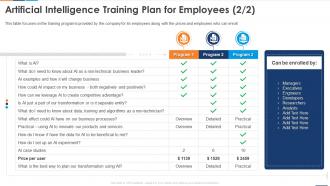
This slide focuses on the 3 day training programs provided by the company for its employees.
People who downloaded this PowerPoint presentation also viewed the following :
Artificial Intelligence Training Plan For Employees Reshaping Business With Artificial Intelligence with all 7 slides:
Use our Artificial Intelligence Training Plan For Employees Reshaping Business With Artificial Intelligence to effectively help you save your valuable time. They are readymade to fit into any presentation structure.






FAQs for Artificial Intelligence Training Plan For Employees Reshaping Business
Effective AI training plans include data preparation and quality assessment, algorithm selection and model architecture design, training methodology with validation protocols, performance monitoring systems, and continuous improvement frameworks. These components work together by ensuring robust data foundations, optimizing model accuracy, and establishing scalable deployment processes, with many organizations finding that structured approaches significantly reduce development time while enhancing AI system reliability and business outcomes.
Organizations can assess current AI skills through competency assessments, skills audits, employee surveys, practical testing scenarios, and performance evaluations of existing AI-related projects. Through comprehensive evaluation frameworks, companies identify skill gaps, benchmark proficiency levels, and prioritize training investments, while many organizations finding that structured assessments ultimately streamline resource allocation and accelerate AI adoption across teams.
Best practices for selecting AI training resources include evaluating content relevance to your industry, verifying instructor credentials, ensuring hands-on project components, checking curriculum currency, and assessing practical application opportunities. These approaches streamline learning by combining theoretical foundations with real-world scenarios, ultimately delivering targeted skill development and competitive advantage, with many organizations finding that industry-specific training accelerates implementation success.
AI training plans should be customized based on role-specific needs, technical proficiency levels, and business applications each position requires. Leadership teams need strategic AI overview and implementation planning, technical staff require hands-on programming and model development skills, while customer-facing employees focus on AI-powered tools and ethical interaction protocols, ultimately ensuring organization-wide competency and seamless AI integration across all departments.
Engagement techniques include interactive workshops, hands-on coding exercises, real-world case studies, gamified learning modules, and collaborative problem-solving sessions. These approaches enhance learning by encouraging active participation, providing immediate feedback, and connecting theoretical concepts to practical applications, with many organizations finding that participants retain knowledge better and develop stronger AI implementation skills.
Companies measure AI training effectiveness through employee skill assessments, practical application evaluations, project completion rates, and business outcome metrics like productivity improvements or error reductions. These measurement approaches enable organizations to track knowledge retention, implementation success, and ROI, with many finding that combining technical competency tests with real-world performance indicators ultimately delivers comprehensive insights into training program value and competitive advantage.
Hands-on projects and case studies provide practical application of AI concepts, allowing learners to work with real datasets, develop models, and solve actual business problems across industries like healthcare, finance, and retail. These experiential learning approaches bridge the gap between theoretical knowledge and practical implementation, enabling participants to build portfolios, understand deployment challenges, and gain confidence in applying AI solutions to complex organizational scenarios.
AI ethics integration involves embedding bias detection protocols, fairness evaluation frameworks, transparency requirements, accountability measures, and stakeholder impact assessments throughout technical modules. This comprehensive approach ensures developers understand algorithmic responsibility while building practical skills, with many organizations finding that ethics-first training reduces deployment risks, enhances user trust, and ultimately delivers more sustainable AI solutions across diverse business applications.
Emerging AI trends for training programs include generative AI, explainable AI, edge computing integration, AI ethics frameworks, and multimodal learning systems. These technologies enhance organizational capabilities by streamlining content creation, improving decision transparency, and enabling real-time processing, with many companies finding that comprehensive AI training ultimately delivers competitive advantage and operational efficiency across departments.
Machine learning concepts can be effectively taught to non-technical staff through visual demonstrations, real-world case studies, hands-on workshops with simplified tools, and business-focused examples that connect algorithms to familiar processes. Interactive training modules help employees in retail, healthcare, and finance understand how these technologies streamline operations, enhance decision-making, and ultimately deliver competitive advantages without requiring deep technical expertise.
Continuous AI learning strategies include automated model retraining, real-time data pipeline integration, feedback loop systems, version control protocols, and performance monitoring frameworks. These approaches enable organizations to maintain model accuracy through dynamic updates, adaptive algorithms, and systematic validation processes, with many financial institutions and healthcare providers finding that continuous learning cycles deliver improved predictions, reduced bias, and sustained competitive advantage in rapidly evolving markets.
Collaboration and teamwork are essential in AI training environments because they facilitate knowledge sharing, accelerate problem-solving, and enhance model development through diverse perspectives and expertise. Cross-functional teams combining data scientists, engineers, and domain experts streamline project timelines, reduce errors, and deliver more robust AI solutions, with many organizations finding that collaborative approaches ultimately enhance innovation and competitive advantage.
Organizations leverage online platforms for scalable AI training through cloud-based learning management systems, virtual simulation environments, interactive coding platforms, automated assessment tools, and collaborative project spaces. These technologies streamline training delivery by reducing infrastructure costs, enabling remote access, and providing personalized learning paths, with many enterprises finding that online platforms accelerate skill development while significantly lowering training expenses.
Mentorship accelerates AI skill development by providing personalized guidance, real-world project experience, and industry insights that complement formal training. Experienced mentors help navigate complex concepts like neural networks and machine learning algorithms, while offering career direction and networking opportunities, with many professionals finding that mentor relationships significantly reduce learning curves and enhance job readiness.
Feedback loops enhance AI training through continuous data collection, real-time performance monitoring, automated error correction, and iterative model refinement based on outcomes. These mechanisms enable organizations to accelerate learning cycles, reduce training time, and improve accuracy rates, with many financial services and healthcare institutions finding that structured feedback ultimately delivers more reliable AI systems and faster deployment timelines.
-
“I required a slide for a board meeting and was so satisfied with the final result !! So much went into designing the slide and the communication was amazing! Can’t wait to have my next slide!”
-
“One of the best experiences with SlideTeam for my presentation.Everything on time, communication is efficient and price is reasonable. All good in one place.”