


Challenges In Implementing AI In HR Training Ppt




Try Before you Buy Download Free Sample Product
 Impress Your
 Audience
 100%
100% Editable
 Save Hours
 of Time


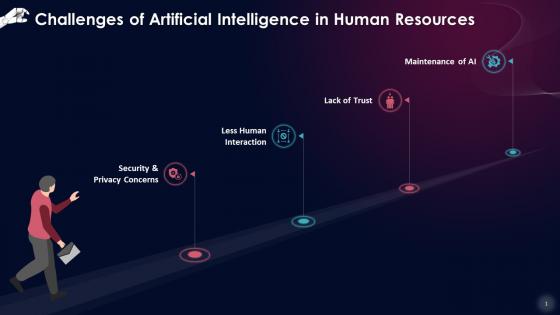
This slide lists challenges faced during the implementation of Artificial Intelligence in Human Resources such as security and privacy concerns, less human interaction, lack of trust, and maintenance of AI.
People who downloaded this PowerPoint presentation also viewed the following :
Challenges In Implementing AI In HR Training Ppt with all 17 slides:
Use our Challenges In Implementing AI In HR Training Ppt to effectively help you save your valuable time. They are readymade to fit into any presentation structure.







FAQs for Challenges In Implementing AI In
Primary challenges include resistance to change, data privacy concerns, skill gaps in AI implementation, integration with existing systems, and ensuring personalized learning experiences. While these obstacles initially seem daunting, many organizations find that strategic planning, comprehensive change management, and gradual rollouts enable successful AI adoption, ultimately delivering enhanced training effectiveness and measurable improvements in employee development outcomes.
AI personalizes learning experiences through adaptive algorithms, skill gap analysis, customized content delivery, and real-time performance tracking. These technologies enable organizations to create individualized training paths by assessing employee competencies, adjusting difficulty levels, and recommending relevant modules, with companies in sectors like healthcare and financial services finding that personalized AI-driven training improves skill development and reduces training time significantly.
HR departments should prioritize data privacy, algorithmic bias prevention, transparency in AI decision-making, employee consent for data usage, and fairness in training opportunities distribution. These considerations ensure AI enhances workforce development while maintaining trust, with many organizations finding that ethical AI frameworks ultimately deliver better employee engagement, reduced legal risks, and stronger organizational reputation in increasingly regulated environments.
Biases in AI algorithms can significantly skew training recommendations, limit diverse learning pathways, and create unequal development opportunities across different employee groups. These algorithmic biases may inadvertently favor certain demographics while overlooking others' potential, ultimately hindering organizational diversity goals and talent optimization, with many companies finding that regular algorithm auditing and diverse data sets help minimize these disparities.
Data privacy plays a critical role in AI-driven training implementation, requiring robust encryption, secure data handling protocols, anonymization techniques, and compliance with regulations like GDPR and CCPA. Organizations must balance personalized learning experiences with employee privacy rights, with many companies finding that transparent data practices and secure cloud infrastructures ultimately enhance trust while delivering effective training outcomes.
HR can ensure AI accessibility by implementing universal design principles, providing multiple interaction modes like voice, text, and visual interfaces, conducting comprehensive accessibility audits, and partnering with assistive technology vendors. These approaches enable organizations to create inclusive training environments that accommodate diverse needs, with many companies finding that accessible AI tools ultimately enhance usability for all employees while demonstrating commitment to workplace equity.
HR should evaluate AI training effectiveness through completion rates, knowledge retention scores, skill assessment improvements, employee engagement levels, and time-to-competency metrics. These measurements enable organizations to track learning outcomes, identify knowledge gaps, and optimize training delivery, with many companies finding that data-driven approaches ultimately enhance workforce development and reduce training costs.
Organizations can balance AI with human interaction by implementing hybrid training models that leverage AI for personalized content delivery, skills assessments, and progress tracking, while preserving human elements for mentoring, complex problem-solving, and emotional intelligence development. This strategic combination enables companies across sectors like healthcare and financial services to deliver scalable, efficient training while maintaining the interpersonal connections essential for leadership development and cultural alignment.
Common misconceptions about AI in HR training include the belief that AI will completely replace human trainers, that it's too complex for smaller organizations, that it lacks personalization capabilities, and that implementation requires extensive technical expertise. These misconceptions overlook AI's role as a strategic enhancement tool, with many companies finding that AI-powered training platforms actually streamline personalized learning experiences while enabling human trainers to focus on higher-value mentoring and strategic development initiatives.
AI identifies skills gaps through performance analytics, competency assessments, learning management system data, employee feedback analysis, and predictive modeling of future skill requirements. These technologies streamline gap identification by analyzing current capabilities against role requirements, benchmarking against industry standards, and forecasting emerging needs, with many organizations finding that AI-driven insights enable more strategic, cost-effective training investments and faster skill development.
HR can overcome AI training resistance through transparent communication about benefits, gradual implementation with pilot programs, comprehensive support systems, and involving employees in the selection process. By demonstrating how AI enhances rather than replaces human skills, organizations enable smoother transitions, with many companies finding that early adopter champions help build broader acceptance and ultimately deliver improved learning outcomes.
AI's rapid evolution requires HR to adopt flexible, modular training strategies that emphasize continuous learning, regular curriculum updates, and adaptable skill frameworks rather than fixed programs. Organizations increasingly implement just-in-time training models, micro-learning modules, and cross-functional development approaches, with many finding that agile training infrastructures deliver sustained competency while minimizing obsolescence risks in dynamic technological landscapes.
Leading AI-powered HR training platforms include Cornerstone OnDemand, Docebo, SAP SuccessFactors, Degreed, and LinkedIn Learning, which leverage machine learning for personalized content delivery and adaptive learning paths. These platforms streamline employee development by analyzing skill gaps, automating training recommendations, and tracking progress in real-time, with many organizations finding that strategic implementation delivers faster upskilling and improved retention rates.
HR departments can maintain AI currency through regular industry webinars, partnerships with AI training providers, subscription to HR technology publications, and cross-functional collaboration with IT teams. Many organizations are establishing dedicated AI learning paths, attending conferences like HR Tech, and creating internal knowledge-sharing sessions, ultimately ensuring their teams stay competitive while adapting training strategies to evolving technological capabilities.
HR professionals should monitor emerging AI trends including personalized learning algorithms, predictive skill gap analytics, virtual reality training simulations, real-time performance coaching tools, and automated competency assessments. These technologies streamline workforce development by delivering customized learning paths, anticipating future skill needs, and enabling immersive training experiences, ultimately helping organizations build more agile, skilled teams while reducing training costs and time-to-competency.
-
It's always a delight to see new templates from you! I am extremely pleased with the fact that they are easy to modify and fit any presentation layout in seconds!
-
The templates are the best in class. Very clear and innovative graphics! I am excited to explore and download more presentations.