


Asking questions powerpoint slide clipart





Try Before you Buy Download Free Sample Product
 Impress Your
 Audience
 100%
100% Editable
 Save Hours
 of Time


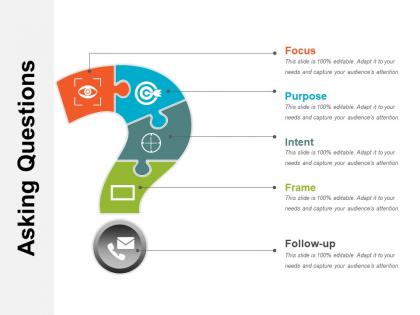
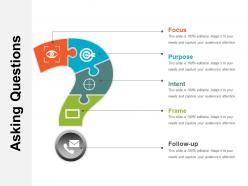
Introducing Asking Questions PowerPoint Slide Clipart which helps you to solve your issues related to a particular subject or topic. With the help of this PPT template, you can put up the queries and share them with a specific person. By using this PowerPoint presentation slides, you can outline the various aspects that we need to focus on while listing our questionnaires. This ask me anything PPT template can be used in business seminars, meetings, academic projects while writing a research paper, and many more. You can describe the various forms of queries such as descriptive, relational, navigational search, and transactional search queries with the help of our professionally designed PowerPoint presentation template. This PPT slide helps an individual to create a record of their problems and later on, they can hand it over to the senior authority or any peculiar person. Therefore, download this ready-to-use PowerPoint presentation and clear your brain from all the tangled issues.
People who downloaded this PowerPoint presentation also viewed the following :
Asking questions powerpoint slide clipart with all 5 slides:
Create a bait that attracts the best brains with our Asking Questions Powerpoint Slide Clipart. Be able to go fishing.
FAQs for Asking questions
Okay so questions are literally a game changer for presentations. People's brains check out after like 5 minutes - it's just how we're wired. But when you throw in a question, suddenly they have to actually think instead of just sitting there. You can do rhetorical ones to guide where their mind goes, or direct questions if you want real answers. I also love using quick polls to break things up when I'm going too long on one topic. The trick is spacing them out every few minutes so you're constantly pulling their attention back. Works way better than just talking at people for 20 minutes straight.
You know what's crazy? Good questions literally rewire how you think. Instead of accepting whatever someone tells you, you start digging with "why" and "how" questions. I see this all the time in meetings - everyone's just nodding along like robots. But when someone asks "what evidence do we actually have?" or "what if this totally backfires?" suddenly people wake up. Your brain gets better at catching BS and spotting holes in logic. Next time you're in a discussion, try throwing out three solid questions before anyone jumps to solutions. Works way better than you'd think.
Okay so the trick is asking "how" and "why" questions instead of stuff they can just answer with yes or no. Like "What's bugging you about this plan?" gets way better responses than "Do you like this idea?" Hypothetical scenarios are gold too - people open up more when it's not about them directly. Oh and don't rush to fill the silence after someone answers. I know it feels weird, but that's usually when they'll add the real interesting stuff. One more thing - always ask at least one follow-up to whatever they share first. That's where the good conversations actually start.
Yeah, question timing is huge for presentations. I learned this the hard way when someone hijacked my entire talk with questions about their side project - total nightmare. You've got two options really. Take questions throughout and keep people engaged, but risk going completely off track. Or save everything for the end, stay focused, but potentially lose people if they're confused early. Honestly? Do a mix. Pause at natural breaks for quick clarifying stuff, then tell people to save the bigger discussions for later. Works way better than either extreme.
Yeah, I've found open-ended questions work way better than yes/no stuff. Like instead of "Do you like this?" try "What's your biggest challenge here?" People actually have to think instead of just saying "looks good!" - which honestly is the most useless feedback ever. Follow-ups are where you get the real gold though. "Tell me more about that" or "What would make this better?" Those keep people talking. The trick is sounding like you genuinely care what they think, not just going through the motions.
Rhetorical questions are honestly one of my favorite tricks. Drop one right before your big moment - "What if I told you our sales could double?" - then hit them with the actual data. People literally can't help but engage with questions, even silent ones. I use them way too much probably, but they grab attention like nothing else. You can put them on slides by themselves or just work them into what you're saying. Just don't overdo it though - maybe 2 or 3 tops. Try one before your most important point and you'll see what I mean.
So basically closed questions give you quick yes/no stuff - "Did you finish that thing?" Open-ended ones let people actually explain themselves, like "What's your take on the new system?" I'd use closed questions when you need fast answers or want to keep things moving. They're clutch for surveys honestly. Open-ended works better for brainstorming sessions or when you're trying to figure out what's really going on with someone. Best approach? Start with the broad open questions first, then zoom in with specific closed ones once you get the general vibe.
Honestly, visuals are a game changer for making questions more engaging. People process images way faster than text, so throwing in a chart or diagram keeps them focused instead of zoning out. Complex stuff becomes so much clearer - like, a good graphic can replace paragraphs of explanation. Before/after shots work great for comparison questions. Data viz is perfect when you're asking about trends. Oh, and they create natural breaks too, which gives people a sec to actually think before jumping in with answers. Trust me, it's worth the extra effort.
Try asking open-ended questions instead of yes/no stuff - gets way better responses. The "popcorn" thing actually works great too, where people just build off each other's ideas. Give folks time to think since some people need a sec to process. Oh, and definitely celebrate whatever people say, even weird answers. I swear this makes such a difference. Once people see you're not gonna shut them down, the quiet ones start talking more. You can also throw out "what else?" or "different angle?" to push for more viewpoints.
Dude, you gotta totally switch up your approach depending who's there. With younger crowds, throw in current references and do polls or quick hand-raises to keep them engaged. Executives? Ask big strategic questions - they hate having their time wasted. Tech people want all the nitty-gritty details, but general audiences need stuff that's way more accessible. I swear, cultural context matters too - some groups want you to be super direct while others prefer a gentler touch. Oh and seriously, research your crowd beforehand. Nothing's worse than watching someone use heavy jargon with the wrong audience. Prepare like 2-3 different versions of your key questions just in case.
Ugh, the worst thing you can do is ask stuff you don't really want answered. Like when people go "Any questions?" then bolt before anyone can speak up. Also - and this drives me nuts - don't pile multiple questions together because it just confuses everyone. Keep it simple, one question at a time. Be ready for whatever comes back too, even if it's dead silence or someone disagreeing with you. Oh, and actually wait for answers! Count to five (seriously) before moving on. People need time to think.
Honestly, there's tons of ways to handle live Q&A these days. Mentimeter and Slido are solid for polls during presentations. Most video calls have chat features built right in. Slack threads work great too if your team's already on there daily. Interactive whiteboards are actually pretty fun - way better than I expected when I first tried one. AI chatbots can knock out the basic questions so you're not stuck repeating yourself. Pick whatever fits your crowd and situation. Start simple with tools you already know, then get fancy later if you need to.
Just be upfront about having a perspective, you know? Like instead of "Don't you think this is the best option?" try "What parts of this solution grab you?" Way less pushy. Honestly, we're all biased anyway - might as well own it. The goal is making people feel like they're figuring stuff out with you, not getting steamrolled toward your conclusion. I always start with "I'm curious about..." or "What's your take on..." It comes off way more collaborative. People can smell manipulation from a mile away, but genuine curiosity? That actually works.
Follow-up questions are honestly game-changers for conversations. They show you're actually listening, not just waiting for your turn to talk. You know how some conversations feel really shallow? These help you dig into what people really care about. They clear up confusion and uncover stuff your first explanation probably missed. Everyone stays more engaged because they feel heard - which is huge. Try something like "What part of this hits closest to home for you?" or "Where's the biggest roadblock?" Works way better than just moving on to the next topic.
Okay so basically questions act like natural bridges between your points. Like instead of that awkward "moving on to..." thing everyone does, you just ask "So what does this mean for our quarterly goals?" Way smoother, right? It gives people a second to mentally switch gears while building curiosity about what's next. The trick is connecting where you just were with where you're going. Honestly, those clunky transition phrases are the worst - this feels so much more natural. Write out maybe 2-3 questions beforehand and you'll see the difference. Trust me on this one.
-
Excellent design and quick turnaround.
-
Informative design.