


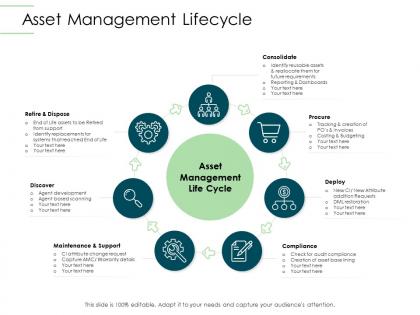
Asset management lifecycle infrastructure planning




Try Before you Buy Download Free Sample Product
 Impress Your
 Audience
 100%
100% Editable
 Save Hours
 of Time


Our Asset Management Lifecycle Infrastructure Planning are topically designed to provide an attractive backdrop to any subject. Use them to look like a presentation pro.
People who downloaded this PowerPoint presentation also viewed the following :
Asset management lifecycle infrastructure planning with all 2 slides:
Use our Asset Management Lifecycle Infrastructure Planning to effectively help you save your valuable time. They are readymade to fit into any presentation structure.
FAQs for Asset management
Effective asset management principles include lifecycle optimization, risk-based decision making, performance monitoring, strategic alignment with organizational goals, and cost-benefit analysis. These approaches enhance operational efficiency by maximizing asset value, minimizing downtime, and extending equipment lifespan, with many organizations finding that systematic asset management delivers significant cost reductions and improved service reliability.
Organizations can assess asset risk through comprehensive risk matrices, vulnerability assessments, threat modeling, impact analysis, and probabilistic risk calculations. These methodologies enable businesses to evaluate financial, operational, cyber, and regulatory risks across their asset portfolios, with many financial institutions and manufacturing companies finding that systematic risk assessment ultimately delivers better resource allocation, enhanced security protocols, and stronger competitive positioning in increasingly complex markets.
Technology serves as the backbone of modern asset management strategies, enabling real-time portfolio monitoring, automated risk assessment, predictive analytics, and algorithmic trading capabilities. Through AI-driven platforms and cloud-based systems, investment firms streamline operational efficiency, enhance client reporting transparency, and deliver personalized investment solutions, with many institutions finding that these technologies significantly reduce costs while improving decision-making accuracy.
Asset management contributes to sustainability through ESG integration, lifecycle optimization, predictive maintenance, and resource efficiency monitoring. These approaches enable organizations to reduce waste, minimize energy consumption, and extend asset lifespans, while financial institutions increasingly find that sustainable asset strategies deliver both environmental impact and competitive advantage in regulatory-conscious markets.
Common asset management frameworks include ISO 55000, ITIL for IT assets, COSO for risk management, COBIT for governance, and lifecycle management models. These frameworks streamline operations by standardizing processes, enhancing compliance, and optimizing resource allocation, with many financial institutions and manufacturing companies finding that integrated approaches ultimately deliver improved ROI and competitive advantage.
Businesses measure asset management performance through key metrics including asset utilization rates, maintenance costs, downtime frequency, return on assets, and lifecycle value optimization. These indicators enable organizations to track operational efficiency, identify underperforming equipment, and optimize resource allocation, with many companies finding that comprehensive performance monitoring ultimately delivers cost reductions and enhanced competitive advantage.
Market trends significantly influence asset management decisions by affecting portfolio allocation, risk assessment, sector rotation strategies, and investment timing considerations. Through trend analysis, asset managers can anticipate market shifts, adjust diversification approaches, and optimize performance outcomes, with many financial institutions finding that proactive trend monitoring enhances client returns while minimizing volatility exposure.
Organizations ensure regulatory compliance in asset management through comprehensive audit trails, automated reporting systems, real-time monitoring tools, and standardized documentation processes. These technologies streamline compliance by tracking asset lifecycles, generating required reports automatically, and maintaining transparent records, with many financial institutions and healthcare organizations finding that integrated compliance platforms significantly reduce regulatory risks while enhancing operational efficiency.
**INPUT**: What strategies can help improve the lifecycle management of assets? **OUTPUT**: Effective asset lifecycle management strategies include predictive maintenance scheduling, comprehensive tracking systems, performance analytics, strategic replacement planning, and automated monitoring technologies. These approaches streamline operations by reducing unexpected failures, optimizing resource allocation, and extending asset lifespan, with organizations across manufacturing, healthcare, and infrastructure finding that integrated lifecycle management ultimately delivers significant cost savings and enhanced operational efficiency. [Word count: 58 words]
Data analytics enhances asset management processes by enabling predictive maintenance, optimizing portfolio performance, and improving risk assessment through real-time data insights. Through advanced algorithms and machine learning, financial institutions and manufacturing companies can identify market trends, predict equipment failures, and automate rebalancing decisions, ultimately delivering reduced operational costs and enhanced returns.
Integrating asset management into business strategy delivers enhanced operational efficiency, improved risk management, optimized resource allocation, better regulatory compliance, and increased return on investment. This strategic combination enables organizations to streamline maintenance costs, extend asset lifecycles, and make data-driven decisions about capital expenditures, ultimately providing competitive advantage in increasingly complex markets.
Different industries approach asset management through sector-specific strategies, with manufacturing focusing on equipment lifecycle optimization, healthcare emphasizing medical device compliance and utilization, financial services prioritizing portfolio diversification and risk assessment, and utilities concentrating on infrastructure reliability and regulatory adherence. These tailored approaches enable organizations to maximize asset value while meeting industry-specific requirements, ultimately delivering enhanced operational efficiency and competitive advantage.
Asset managers face challenges including market volatility, regulatory compliance complexities, evolving client expectations, technological disruption, and increased fee pressure from passive investing alternatives. These challenges present both operational hurdles and strategic opportunities, with many firms finding that embracing digital transformation, enhancing risk management capabilities, and developing innovative investment solutions ultimately delivers competitive advantage in an increasingly dynamic environment.
Effective asset management improves customer satisfaction by ensuring optimal equipment performance, reducing service disruptions, and enabling faster response times through predictive maintenance and real-time monitoring. Organizations with streamlined asset tracking deliver more reliable services, minimize downtime-related delays, and allocate resources efficiently, ultimately enhancing customer experiences while reducing operational costs and maintaining competitive service standards.
Training and skill development are fundamental to successful asset management, encompassing technical expertise, regulatory compliance, risk assessment, financial analysis, and technology proficiency. These capabilities enable asset managers to optimize portfolio performance, navigate complex market conditions, and deliver superior client outcomes, with many financial institutions finding that continuous professional development significantly enhances investment returns and operational efficiency.
-
Design layout is very impressive.