


Asset Management Organization With Matrix Structure




Try Before you Buy Download Free Sample Product
 Impress Your
 Audience
 100%
100% Editable
 Save Hours
 of Time


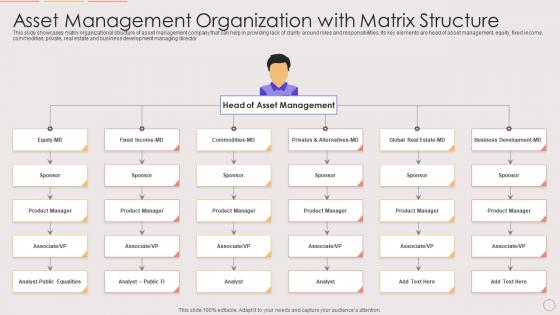
This slide showcases matrix organizational structure of asset management company that can help in providing lack of clarity around roles and responsibilities. Its key elements are head of asset management, equity, fixed income, commodities, private, real estate and business development managing director
People who downloaded this PowerPoint presentation also viewed the following :
Asset Management Organization With Matrix Structure with all 6 slides:
Use our Asset Management Organization With Matrix Structure to effectively help you save your valuable time. They are readymade to fit into any presentation structure.






FAQs for Asset Management Organization
So basically you've got four main things: asset types, how they're performing, risk levels, and where you're putting your money. Picture a spreadsheet where everything connects. Assets get grouped by what they are - equipment, infrastructure, money stuff. Then you map those against criticality scores, maintenance needs, investment priorities, all that. Way simpler than it sounds, trust me. Once you actually see one it clicks pretty fast. The whole point is visualizing where your resources go and catching any weird gaps or overlaps. Honestly? Start with maybe 3-4 basic categories first, then add more as you figure it out.
So matrix structures mean your asset managers report to two bosses - functional heads plus project/regional leaders. Sounds chaotic but hear me out. Information flows way better because you're getting input from multiple angles instead of just one department. Decision-making actually speeds up since everyone's already connected. Risk assessment gets more thorough too - you've got both operational and strategic people weighing in. The trick is nailing down who does what from day one. Otherwise you'll just end up with a hot mess where nobody knows their actual responsibilities.
So cross-functional teams are pretty much what makes matrix structures work. Different departments - operations, finance, IT, compliance - all team up on specific projects instead of staying in their lanes. Yeah, it gets confusing because people report to their regular manager AND the project manager. Honestly took me forever to figure out who was actually in charge when I first dealt with this setup. But that's kind of the point - you get all these different perspectives solving problems together instead of playing telephone between departments. Just make sure everyone knows their role upfront or it'll be a total mess.
So this matrix thing really shines in industries with tons of expensive equipment - utilities, manufacturing, oil & gas, that kind of stuff. Power plants and refineries can't just break down randomly, you know? Healthcare systems do well with it too for managing all their medical gear. The whole point is getting your technical people and operations folks actually talking to each other instead of working in silos. Oh, and real estate companies have had good luck with it. Honestly though, don't go crazy and roll it out everywhere at once - test it in one division first.
So basically the matrix thing shows you where all your money and people are going across different parts of your business. You'll spot overlaps super fast - like when you're dumping tons into one area but completely ignoring another. Makes reallocating way easier too since you can actually see the connections between everything. I'd honestly start by just mapping out what you're doing right now, even if it's messy. Then look for the obvious mismatches. Way better than trying to manage each department separately and wondering why nothing connects.
Honestly, the worst part is when nobody knows who they're actually supposed to listen to. Your team gets caught between their regular boss and the portfolio manager - super awkward. Communication becomes this nightmare web where info has to go up, down, AND sideways. Department heads start getting territorial too since they're not used to sharing control. Oh, and people stress out hardcore when decision-making gets murky. I'd probably map out who owns what decisions first, before anything else goes sideways on you.
Dude, technology basically saves you from drowning in spreadsheets. IoT sensors grab all your performance data automatically, while AI figures out when stuff needs maintenance before it breaks. Real-time dashboards show everything at once - no more hunting through different systems. Cloud platforms let your whole team see the same live data, which honestly makes meetings way less painful. I'd start with whatever eats up most of your time manually and find tools for those parts first. My buddy's company did this last year and it was a total game-changer for them.
Honestly, you need to track the hard numbers first - asset utilization, maintenance costs, downtime, ROI improvements. That stuff matters most. But don't ignore the people side either. Are teams actually collaborating better? How fast are decisions getting made now? Because if that's not improving, the whole matrix thing is kinda pointless. I'd say pick 3-4 metrics max so you don't drown in spreadsheets. Check them monthly against whatever your baseline was before the matrix. Oh, and give it at least a quarter before you panic if the numbers look weird initially.
So matrix structure is pretty solid for risk management - you get functional specialists AND project managers both keeping watch. Portfolio managers catch the big picture systemic stuff while your tech teams spot operational issues that could slip by. Honestly, it's kind of brilliant having two safety nets like that. Information flows up faster too since there are more reporting paths. But here's the thing - if your teams don't actually talk to each other, you'll just end up with people doing the same work twice and missing stuff anyway.
Honestly, you've gotta nail down who talks to who right from the start. I'd map out your communication flow this week - like literally draw it out. Regular check-ins with everyone involved are huge because people love assuming someone else has it covered (been there, nightmare fuel). Get some shared dashboard going so there's no "wait, I thought you knew" moments. Your team should feel cool escalating drama instead of letting it simmer. Oh, and write down the big decisions and blast them to everyone - verbal stuff gets forgotten so fast it's not even funny. Trust me on this one.
So with matrix structure, you can move people around fast when markets get crazy. Like if bonds suddenly need more help during rate chaos, just pull specialists from equity without reorganizing whole departments. Pretty smooth actually. Dual reporting means PMs can pivot while risk keeps doing their thing consistently. One thing though - you absolutely need clear escalation paths or everyone just freezes when shit hits the fan. Oh and get your team communication sorted beforehand, not during the crisis. Trust me on that one.
Yeah, matrix structures are kind of a pain for timelines honestly. More people means more meetings and you're constantly juggling between different managers who all think their stuff is priority
-
Informative presentations that are easily editable.
-
Easily Understandable slides.