


Car Dealership Start Up Organizational Structure For Smooth Business Operations BP SS




Try Before you Buy Download Free Sample Product
 Impress Your
 Audience
 100%
100% Editable
 Save Hours
 of Time


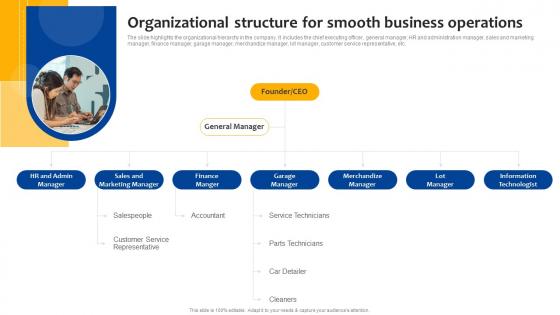
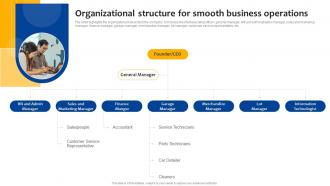
The slide highlights the organizational hierarchy in the company. It includes the chief executing officer, general manager, HR and administration manager, sales and marketing manager, finance manager, garage manager, merchandize manager, lot manager, customer service representative, etc.
People who downloaded this PowerPoint presentation also viewed the following :
Car Dealership Start Up Organizational Structure For Smooth Business Operations BP SS with all 9 slides:
Use our Car Dealership Start Up Organizational Structure For Smooth Business Operations BP SS to effectively help you save your valuable time. They are readymade to fit into any presentation structure.








FAQs for Car Dealership Start Up Organizational Structure For Smooth Business
So dealerships are pretty basic when it comes to organization. General Manager runs the show, then you've got department heads for sales, service, parts, and finance underneath. Sales reps, techs, and finance people work under those managers. Some places throw in assistant managers too - honestly depends on how big they are. My cousin worked at one and said the hierarchy was super obvious once you're there. If you need help with something, start with whoever handles that area first. Can't get anywhere? Just ask to speak with their manager. Works most of the time.
Dude, sales and service are way more connected than most people realize. Once you sell someone a car, service takes over that relationship for years - maintenance, warranties, all that stuff. Plus sales reps usually get bonuses when their customers book service appointments. Service advisors will actually send customers back to specific salespeople when they're ready for their next car. Honestly, some of the best salespeople I know are tight with the service team because that's where your repeat business comes from. Oh and referrals too - service customers are goldmines for new leads if you play it right.
So the finance dept handles all your loan processing, credit apps, payment plans - that whole side of things. You'll need a finance manager running the show, plus F&I people who work with customers on financing and push warranties. Honestly, those add-ons are where dealerships make bank. Collections is huge too for late payments, and someone's gotta maintain relationships with lenders. One thing though - your finance manager better know compliance inside and out because auto lending rules are no joke. Banks get pissy real fast if you mess that up.
Dude, franchise dealerships are way more structured - they've got corporate breathing down their necks so everything's super organized. Clear departments, managers, the whole nine yards. Independent lots? Total free-for-all. The owner might be selling you a car in the morning and doing the books at night. Honestly, I kinda respect the hustle. At franchises you get specialized roles and actual career paths, which is nice if you're planning to stick around. Independents make you do everything but hey, you learn fast. For job hunting, franchises probably give you better training programs and advancement opportunities.
KPIs totally depend on your department. Sales guys track units sold, profit per car, and closing ratios. Service departments care about labor hours sold and customer pay revenue - plus how fast they knock out warranty work. Parts is all about inventory turns and fill rates. Finance has the weirdest metrics honestly, like penetration rates for warranties and loan products. Your GM watches customer satisfaction scores since those affect the whole dealership. Oh, and repeat business rates too. Just ask your department manager what 3-4 numbers they actually care about, then focus on those.
Dude, good communication literally fixes like 80% of dealership headaches. Your sales guys need to talk to finance fast, and service has to keep everyone posted on delivery dates. Otherwise customers get totally different stories from different people - super awkward. I watched one place blow a sale because nobody mentioned the car needed repairs first. Pretty brutal. Set up quick daily check-ins between teams and get everyone using the same system to track deals. Real-time updates are clutch for inventory stuff too. Trust me, it's way easier than dealing with angry customers later.
Your inventory team is literally the hub connecting sales, service, and finance. They're tracking lot inventory, incoming shipments, and those nightmare cars that won't sell. Sales coordination happens daily - checking availability, managing commitments. Service gets looped in for trade-ins and reconditioning work. Finance needs their data for floor planning too. But here's the thing - they're not just car counters. They're optimizing cash flow and lot turnover, which honestly makes or breaks your margins. Keep them updated on any deals in real-time, because outdated info screws up everything downstream.
So there's usually a general manager handling the manufacturer stuff while parts and service managers deal with suppliers. The manufacturer relationship is critical - they control your inventory, incentives, basically everything that matters for your franchise. Parts managers stay busy working with OEM suppliers and aftermarket vendors to keep the service bays running. Most of the back-and-forth happens through manufacturer portals and those quarterly business reviews where you hash out sales targets and customer satisfaction metrics. Honestly, start building those personal connections from day one because when things get crazy with inventory shortages, that's what'll save you.
So dealership size pretty much dictates your whole org setup. Small places? Super flat structure - your GM probably does sales management too, techs juggle different jobs. Scale up and you get actual department heads, assistant managers, finance people, service advisors. Big dealerships can get crazy hierarchical with regional stuff (honestly feels like working at a bank at that point). Match your structure to your volume though - don't overcomplicate a small shop, but you need clear authority lines when you're growing. Otherwise it's chaos.
So tech basically forces your departments to actually talk to each other, which is huge. CRM systems and inventory tools give everyone the same customer info in real time - no more playing telephone between sales and service. Your team structure gets way more flexible too. Salespeople can book service appointments, service guys can sell parts, managers see everything happening. It's honestly crazy how much drama disappears when people aren't working off different spreadsheets. I'd start by figuring out which departments hate each other most, then find software that makes them share data whether they want to or not.
Honestly, start with product knowledge - your team needs to actually understand what they're selling and how financing works. Customer service training is huge too because car shopping already sucks without dealing with pushy sales people. Compliance stuff for finance regs is non-negotiable. Your service dept needs tech training since cars are basically computers now. Oh, and cross-train between departments so everyone gets the full customer experience. Leadership development for managers helps too, but that's more long-term. I'd audit your current gaps first, then map out quarterly training around the biggest holes.
So here's the thing - your customer experience strategy totally dictates how you set up your team. White-glove service? You'll need customer success people, maybe experience coordinators who guide folks through everything. Way different than the old sales floor vibe. Flattening your hierarchy helps too since decisions happen faster when customers hit problems. I've seen dealerships mess this up badly - they promise this amazing experience but their structure can't actually deliver it. Just makes everyone frustrated, honestly. The org chart has to match whatever you're telling customers they'll get.
Dude, the hardest part is keeping everything consistent while still letting each location do their own thing. Like, you want standard procedures but your downtown spot needs totally different strategies than your suburban one. Communication gets messy fast - trying to sync inventory, pricing, all that stuff across multiple sites is honestly exhausting. Training becomes weird too because you need everyone on the same page but different locations need different skills. Oh and don't even get me started on managing different personalities at each site. My take? Get your communication systems locked down first, then worry about expanding.
Split your team based on where customers actually find you. Get someone on digital - social, Google ads, web stuff - since everyone googles first anyway. Traditional media (radio, print) still works for older buyers, so cover that too. Here's what most people miss: your service department needs marketing love for keeping customers around. Someone's gotta own the CRM and follow up with leads - that's honestly where most deals happen or die. Just make sure everyone has clear numbers to hit and can work together when campaigns cross over.
Your GM's style basically sets the tone for everything. Autocratic leaders? You get rigid departments where people are scared to make calls - which honestly sucks for customers. Collaborative managers though, they let sales teams actually solve problems instead of running to ask permission every five minutes. I've noticed the service department shows this the most. Micromanaged techs work totally different than ones who can trust their judgment. It all flows down - affects retention, customer scores, the whole thing. Just watch how decisions get made around your place and you'll see exactly what kind of culture you've got.
-
Loved the templates on SlideTeam, I believe I have found the go to place for my presentation needs!
-
Visually stunning presentation, love the content.