


Auto Industry Business Plan Organizational Structure For Smooth Business Operations BP SS




Try Before you Buy Download Free Sample Product
 Impress Your
 Audience
 100%
100% Editable
 Save Hours
 of Time


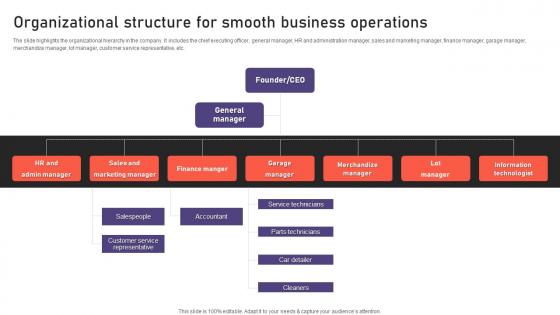
The slide highlights the organizational hierarchy in the company. It includes the chief executing officer, general manager, HR and administration manager, sales and marketing manager, finance manager, garage manager, merchandize manager, lot manager, customer service representative, etc.
People who downloaded this PowerPoint presentation also viewed the following :
Auto Industry Business Plan Organizational Structure For Smooth Business Operations BP SS with all 9 slides:
Use our Auto Industry Business Plan Organizational Structure For Smooth Business Operations BP SS to effectively help you save your valuable time. They are readymade to fit into any presentation structure.








FAQs for Auto Industry Business Plan Organizational Structure For Smooth Business
Honestly, start by nailing down three things: clean divisions between R&D, manufacturing, and sales. Then build solid project teams that cut across those divisions. R&D is make-or-break here - you're screwed without good innovation flowing. Your manufacturing needs to scale up fast but keep quality tight. Oh, and communication between engineering and production? Super critical since they're always tweaking designs. Most companies that work well use this hybrid setup - part hierarchy, part agile teams. I'd map out where things get stuck in your current process first. See where better reporting could actually fix the mess.
Look, auto companies are super hierarchical so everything takes ages to approve. Engineers pitch to department heads, who go to VPs, who sometimes loop in the C-suite - it's honestly painful when you need fast decisions. But I get why they do it - one bad call costs millions in recalls or whatever. The annoying part? Great ideas from junior people often die somewhere in the middle. My advice: make friends at different levels and always bring solid numbers showing how much money your idea makes. ROI talks, everything else walks in that world.
Dude, you literally can't innovate in auto without getting everyone on the same page early. Engineering needs to talk to manufacturing from day one - otherwise you get these amazing designs that cost a fortune to actually build. I've watched so many projects crash because teams just did their own thing in silos. The companies killing it right now? They throw engineering, design, supply chain, everyone into rooms together from the start. Makes the whole timeline smoother too. Oh and pro tip - when you kick off your next project, grab someone from each department for that first meeting. Trust me on this one.
So basically, car companies don't really operate as one big global entity like you'd think. Take VW - they've got these semi-independent divisions in Europe dealing with their crazy environmental regulations and safety standards. Toyota does something similar in Asia, almost running separate companies because consumer preferences are so different there. Manufacturing costs vary wildly too, which honestly makes sense when you think about it. What's wild is how decentralized everything gets compared to other industries. These "global" brands are really just regional specialists sharing the same logo, all adapting to local stuff like labor costs and what people actually want to buy.
So EV companies are way flatter than old-school automakers - like Tesla has way fewer management layers. Traditional car companies have these huge departments that barely talk to each other, but EV startups build mixed teams that can change direction fast. The biggest thing? EVs treat cars like computers with wheels, so their whole structure is tech-first. Tesla's more like working at Apple than Ford, honestly. If you're checking out partnerships or whatever, look at how many people have to approve decisions - that'll tell you everything about how they actually operate day-to-day.
Dude, Agile will totally change how you handle auto projects. Break those huge development cycles into 2-3 week sprints instead of waiting forever to see if stuff actually works. Your teams can catch problems early and pivot when the market shifts - which happens constantly in automotive, let's be real. The feedback loops are so much faster when you involve suppliers and customers directly. Honestly, the auto industry has been stuck doing things the same way for decades, so this feels revolutionary. Just don't go crazy at first. Pick one pilot project, get everyone used to daily check-ins and sprint reviews, then expand from there. Way less painful that way.
Oh man, the cultural piece is brutal - people hate change when they've been doing the same thing forever. Middle managers especially freak out because they think you're making them obsolete (and tbh, sometimes you kinda are). Your old systems will fight you every step of the way since they're built for those silos you're trying to break down. Communication gets messy fast when everyone's role becomes fluid. Nobody knows who's accountable for what anymore. Definitely test it out with smaller teams first - like, pick something that won't tank the company if it goes sideways while you figure out what actually works.
Most companies put supply chain as its own department under the COO or CEO - makes sense since it's pretty crucial stuff. They're juggling relationships with tons of suppliers (we're talking hundreds sometimes, which honestly sounds like a nightmare to me). The whole thing works like the company's nervous system, connecting your factories with outside partners. Manufacturing, procurement, logistics - they all have to play nice together for just-in-time delivery to actually work. If you want to figure out how yours is set up, just trace who handles supplier relationships. That'll give you the roadmap.
So basically M&As flatten everything - they cut middle management and centralize decisions to save money. Duplicate departments get merged, reporting gets streamlined. The bigger company's culture wins out most of the time (look how FCA's Italian vibe took over before Stellantis happened - that was interesting to watch). Takes about 2-3 years for things to actually settle down. Watch the executive hires and plant closures early on. Those moves tell you way more about where they're headed than any press release will.
So digital stuff is basically breaking down all those old departmental walls at auto companies. Engineering, IT, manufacturing - they're all forced to work together now because of connected cars and software updates. Total chaos initially, not gonna lie! But teams can actually make decisions faster without waiting for endless approvals. Companies are creating these weird hybrid roles where people report to like three different departments at once. Oh, and if you're thinking about restructuring anything - seriously upgrade your communication systems first. Those matrix relationships turn into a complete nightmare if people can't stay in the loop properly.
Dude, here's the thing - if your org structure doesn't match your strategy, you'll just be fighting your own company all day. Look at auto: you've got R&D, supply chains, regulations, all this crazy complexity. Say you want EV innovation but your electric and gas teams are still totally separate? That's just dumb. Tesla figured this out early, and even Ford finally got their act together by fixing their org chart first. Honestly, just map out your big strategic moves against who actually reports to who. You'll see the gaps pretty quick.
Auto companies have to build their whole structure around compliance - no joke, it's wild. Different teams handle emissions, safety, data privacy, all that stuff. Most use matrix setups where product people work with regulatory specialists constantly throughout development. Different markets have completely different rules too, which makes everything messier. The legal and compliance divisions? They actually make decisions, not just give advice like at other companies. Oh, and if you're ever mapping out an automotive org chart, figure out your regulatory bodies first - that alone shapes like half the structure. It's way more complex than it looks from the outside.
Dude, it's all about psychological safety - your team won't take risks if they're scared of getting fired for failing. Most prototypes bomb anyway, that's just how it works. Good auto leaders actually fund R&D instead of just giving lip service to innovation. They also smash those stupid silos between engineering and design teams. Honestly, the cross-functional approach is where the magic happens. My advice? Ask your people what wild ideas they've been sitting on but haven't mentioned. You'll be surprised what they're holding back.
Most auto companies set up dedicated sustainability teams or hire a Chief Sustainability Officer who reports directly to the CEO. The good ones don't just throw around fancy green buzzwords - they actually weave it into daily operations. You'll find sustainability metrics in employee reviews, massive R&D budgets going toward EVs, and procurement teams working on ethical sourcing. Here's the real test though: check their org chart. If the sustainability person reports straight to the CEO instead of being buried under some PR department, they're probably not just playing games with it.
Most auto companies do cross-functional teams and town halls to keep everyone talking - executives down to factory workers. Toyota's probably the best example with their whole continuous improvement thing where literally everyone communicates with everyone else. Engineers work straight with production teams instead of going through all the management layers. They also do these visual boards on factory floors and weekly "leadership walks" where the suits actually go see what's happening. Oh, and digital platforms obviously. Honestly, the key is building those direct channels between levels rather than having info trickle down the old-school way.
-
My team has been relying on SlideTeam’s professional PPT designs for a while now. It has greatly sped up quality work at my organization. So thanks!
-
If you are looking for satisfactory PowerPoint services, SlideTeam is your go-to place. I am fully contented with their research and development team.