

It Asset Management Process Flow




Try Before you Buy Download Free Sample Product
 Impress Your
 Audience
 100%
100% Editable
 Save Hours
 of Time


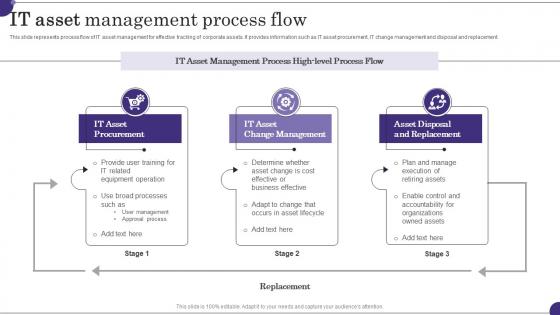
This slide represents process flow of IT asset management for effective tracking of corporate assets. It provides information such as IT asset procurement, IT change management and disposal and replacement.
People who downloaded this PowerPoint presentation also viewed the following :
It Asset Management Process Flow with all 6 slides:
Use our It Asset Management Process Flow to effectively help you save your valuable time. They are readymade to fit into any presentation structure.






FAQs for It Asset
So you'll need discovery tools to find everything on your network first - that's honestly the hardest part. Then get a central database for tracking all your hardware and software details. Lifecycle management comes next, covering procurement through disposal. Financial tracking is massive too - costs, contracts, licensing, all that fun stuff. Security integration matters because shadow IT will totally screw you over down the road. Most people jump into trying to manage everything at once and just get buried. Start with visibility into what you actually have, then build your processes around that.
Honestly, IT Asset Management is like the backbone of staying compliant and not getting screwed over in audits. You need to know what software licenses you actually own, where all your hardware lives, and how people are using everything. Otherwise you're just guessing when auditors show up. It helps with security policies too, plus managing vendor contracts and avoiding duplicate purchases - which happens way more than you'd think. My advice? Start with a decent inventory system first. Can't manage what you can't track, right?
Dude, automation will save your sanity with ITAM. Start with discovery tools that scan your network automatically - watching it populate your inventory is honestly pretty satisfying. It handles the boring stuff too: license checks, software tracking, warranty alerts. Your team won't be drowning in spreadsheets anymore. The best part? Real-time visibility without human screwups constantly messing things up. I'd say tackle discovery first, then automate whatever you're doing repeatedly. Oh, and don't go crazy trying to automate everything at once - learned that one the hard way.
Honestly, you'll want some kind of centralized tool that auto-discovers what's installed across your network - way better than trying to track everything manually. Do a baseline audit first to see what mess you're dealing with. Then set up automated scanning for new stuff. Spreadsheets for this? Total disaster waiting to happen, trust me. Track your license types, when they expire, actual usage stats - helps with renewals and keeps you compliant. Oh, and set alerts for expiring licenses. I'd do quarterly reviews too, you'll probably find tons of unused software you can ditch.
Start by grouping stuff into types - hardware, software, network gear, that kind of thing. Then rank everything by how critical it is to your business. I'd also throw in location and department info because honestly, it saves your ass when things break and you need to find someone fast. Consistent naming is huge here. Tag purchase dates, warranty stuff, who's using what. The key is keeping your classification rules documented so your whole team does it the same way - otherwise it turns into chaos pretty quick. Simple but thorough works best.
So ITAM basically gives you full visibility into what you actually own versus what you're using. You'll spot duplicate licenses and software nobody touches - that's usually where the big money waste is hiding. Hardware sitting around doing nothing? Same deal. Plus it saves you from those brutal audit penalties that come out of nowhere (seriously, those can wreck a budget). Having solid asset data means you can actually negotiate better with vendors and plan renewals instead of scrambling last minute. Start with software licenses first - that's where most companies find their biggest savings.
Honestly, data accuracy is going to drive you crazy - you'll find random printers and equipment nobody even remembered buying. Getting departments on board is tough too since they think it's just more busywork. Oh, and don't get me started on trying to integrate with whatever ancient systems you're already using. Start with just one department though, get that working smoothly first. Makes a huge difference if you can get some executive backing early on. Trust me on that one. Once you've got one team seeing the benefits, rolling it out everywhere else gets way easier.
So basically ITAM feeds all your asset info straight into ITSM workflows. Super helpful when tickets come in - warranty details, configs, who owns what, all right there. Change management gets easier too since you know what's gonna be affected upfront. Most tools integrate pretty well now, honestly better than they used to be. Your CMDB stays current with real data instead of getting stale. Techs don't have to bounce around different systems hunting for info. Definitely get those API connections working early though - trust me, you'll thank yourself later when you're not doing manual lookups all day.
Cost savings is definitely your starting point - leadership loves seeing those numbers. Track your software license compliance and asset utilization too. Security stuff is critical, especially finding unpatched systems before they become problems. Inventory accuracy should hit 95%+ if you're taking this seriously. Also watch procurement cycle times and refresh rates - trust me, that refresh tracking will save you from discovering ancient Windows 7 machines still lurking around. Pick maybe 3-4 metrics that actually matter to your business first, then build from there once you get momentum.
Honestly, start with cleaning up whatever mess you've got first - that's the hardest part but you gotta do it. Then set up automated scans pulling from network tools, endpoint agents, and your procurement system. But here's the thing - automation misses stuff constantly. Assign actual people to own different chunks and make them validate quarterly. Create some basic templates with required fields so people can't just throw random data in there. Manual checks are annoying but they catch what the automated stuff doesn't. Oh, and make sure someone's actually following up on the validation workflows you set up.
Dude, bad asset management will mess you up. Security gets sketchy when devices aren't patched or just forgotten about completely. Audits become a total nightmare. You'll buy the same software twice or pay for licenses nobody uses - such a waste of money. Hunting down equipment takes forever, and honestly, trying to figure out what you actually own is exhausting. Can't plan replacements either when you don't know what's expiring. Oh, and compliance issues are real. Start with just a basic spreadsheet if you've got nothing right now. Better than guessing constantly.
Honestly, the biggest thing is keeping your inventory records current - track all your software licenses and hardware with purchase dates, counts, where stuff's deployed, the whole deal. Don't be like half the companies I've worked with who realize their tracking spreadsheets are ancient when auditors show up. Keep receipts, contracts, and license docs somewhere you can actually find them. Run your own internal audits regularly so you catch problems first. And seriously, put someone in charge of this stuff year-round instead of panicking every audit season.
Oh man, cloud computing totally flips asset management on its head. You're not just tracking physical stuff anymore - now it's virtual machines that pop up whenever they want, storage that scales itself, licenses that multiply like rabbits. Honestly caught me off guard how chaotic it gets without proper tagging from the start. The good news? Cloud tools actually show you what you're really using and spending. Get some automated discovery running ASAP though, because trying to manually track this stuff is basically impossible. Trust me on the tagging thing - I learned that one the hard way!
Honestly, ITAM is a game changer because you finally get real data on what your stuff actually costs and how it's performing over time. No more wild guessing! Like, you'll start noticing patterns - maybe those Dell laptops always crap out after 3 years, or half your software licenses are just sitting there unused (classic waste of money). Way better than our old strategy of "eh, let's replace everything every 4 years." The real-time tracking helps you nail down better refresh cycles and budget way more accurately. Oh, and you won't get blindsided by random end-of-life surprises anymore. Just start with your top 3 asset types - you'll spot the big wins pretty fast.
Honestly, AI and machine learning are absolutely crushing it right now. They're automating discovery, predicting hardware failures, optimizing software licenses - basically handling all that tedious manual stuff. Cloud-native tools are killing it too since they actually work with hybrid setups, unlike those clunky on-premise systems. IoT integration is getting pretty cool, though most companies aren't there yet. But here's the thing - these tools finally reduce your workload in a meaningful way. Start with AI-powered discovery tools first. They'll make the biggest difference right away for what you're dealing with now.
-
Incredibly beautiful designs that will help you get noticed! These eye-catching templates are perfect for corporate presentations that can be altered to fit any occasion or taste.
-
Unique research projects to present in meeting.