


Collaborative Robots It Powerpoint Presentation Slides





Try Before you Buy Download Free Sample Product
 Impress Your
 Audience
 100%
100% Editable
 Save Hours
 of Time


Our Collaborative Robots PowerPoint presentation provides a comprehensive overview of Cobots provider Company, its services, and why businesses should invest in Collaborative Robots. The deck covers the basics of cobots, including their safety, risk factors, and benefits. It also explores the various industries and tasks where cobots can add the most value, and highlights the companys cobots application builder service and various types of cobots. The learning section includes a training program for IT teams, a comparison between classic industrial robots and cobots, and training on how to fully utilize a cobot. Additionally, the deck contains information on post installation outcomes, pricing details, a 30 60 90 days plan, a roadmap for building and installing a robot, and a dashboard to track the performance of a cobot. With this presentation, businesses can gain a comprehensive understanding of Collaborative Robots and how they can benefit their operations. Get access now and take your business to the next level with cobots.
People who downloaded this PowerPoint presentation also viewed the following :
Content of this Powerpoint Presentation
Slide 1: This slide introduces Collaborative Robots (IT). State your company name and begin.
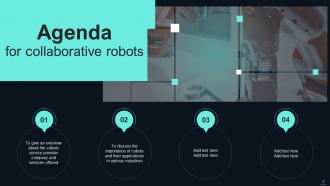
Slide 2: This slide depicts the Agenda of the presentation.
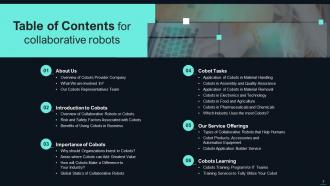
Slide 3: This slide shows Table of Content for the presentation.
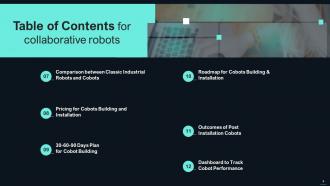
Slide 4: This is yet another slide continuing the Table of contents.
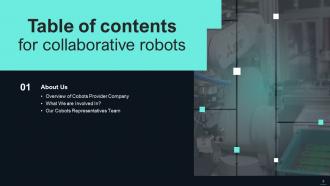
Slide 5: This slide showcases the Title for the Topics to be covered further.
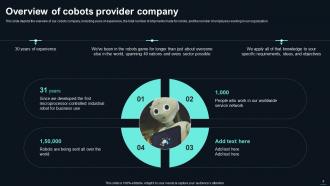
Slide 6: This slide presents an Overview of cobots provider company.
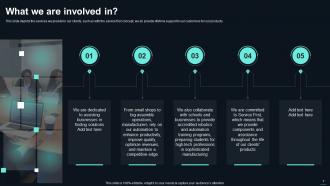
Slide 7: This slide depicts the services offered by the Company.
Slide 8: This slide depicts the organization's representatives team.
Slide 9: This slide elucidates the Heading for the Contents to be covered in the next template.
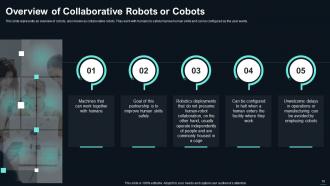
Slide 10: This slide represents an Overview of collaborative robots or cobots.
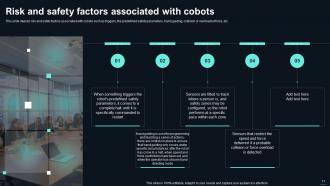
Slide 11: This slide displays risk and safety factors associated with cobots.
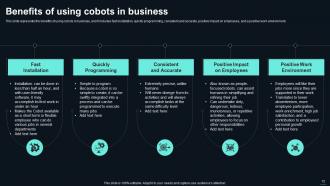
Slide 12: This slide shows the Benefits of using cobots in business.
Slide 13: This slide highlights the Title for the Contents to be discussed in the next template.
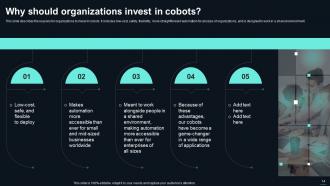
Slide 14: This slide describes the reasons for organizations to invest in cobots.
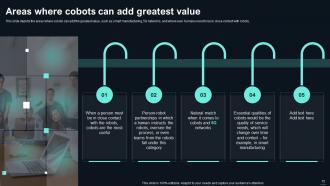
Slide 15: This slide explains the areas where cobots can add the greatest value.
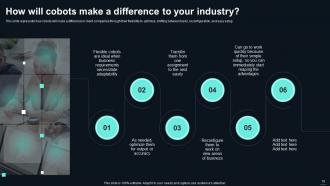
Slide 16: This slide represents how cobots will make a difference in client companies.
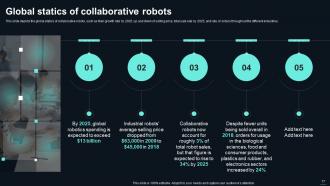
Slide 17: This slide reveals the global statics of collaborative robots.
Slide 18: This slide showcases the Heading for the Ideas to be discussed further.
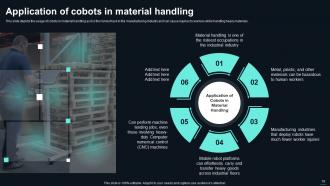
Slide 19: This slide depicts the usage of cobots in material handling as it is the riskiest task in the manufacturing industry.
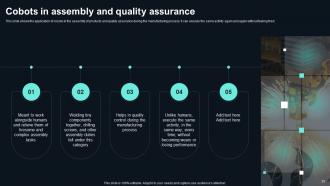
Slide 20: This slide shows the application of cobots in the assembly of products and quality assurance during the manufacturing process.
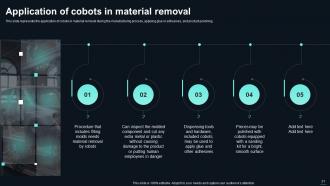
Slide 21: This slide represents the application of cobots in material removal during the manufacturing process.
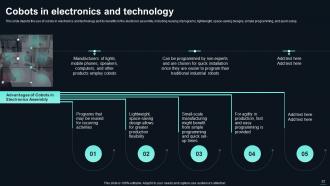
Slide 22: This slide showcases the use of cobots in electronics and technology and its benefits in the electronic assembly.
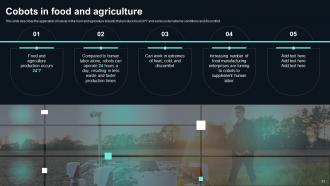
Slide 23: This slide describes the application of cobots in the food and agriculture industry.
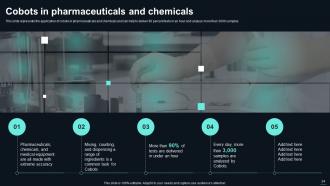
Slide 24: This slide represents the application of cobots in pharmaceuticals and chemicals.
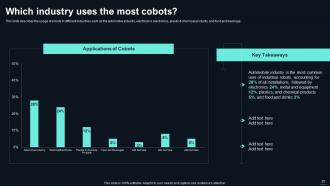
Slide 25: This slide describes the usage of cobots in different industries.
Slide 26: This slide incorporates the Heading for the Contents to be discussed further.
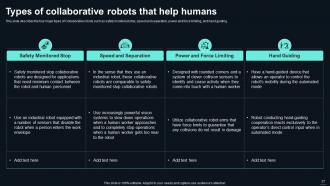
Slide 27: This slide states the four major types of Collaborative robots.
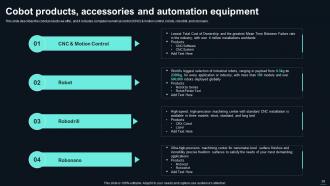
Slide 28: This slide provides information about the cobot products offered by the Company.
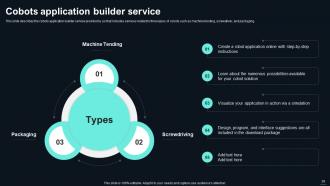
Slide 29: This slide elucidates the cobots application builder service provided by the organization.
Slide 30: This slide contains the Heading for the Topics to be discussed in the upcoming slide.
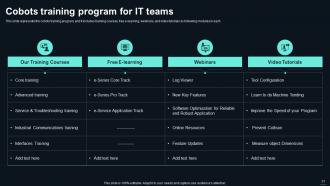
Slide 31: This slide represents the cobots training program.
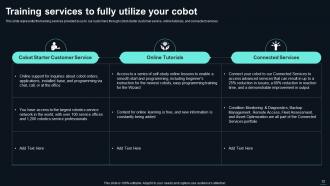
Slide 32: This slide represents the training services provided by the company to customers.
Slide 33: This slide elucidates the Title for the Ideas to be covered in the next template.
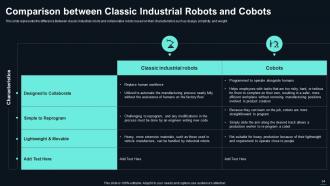
Slide 34: This slide represents the difference Between classic industrial robots and collaborative robots based on their characteristics.
Slide 35: This slide highlights the Heading for the Contents to be discussed further.
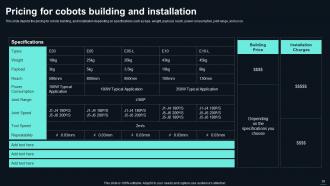
Slide 36: This slide depicts the pricing for cobots building, and installation depending on certain specifications.
Slide 37: This slide exhibits information about the Title for the Ideas to eb covered further.
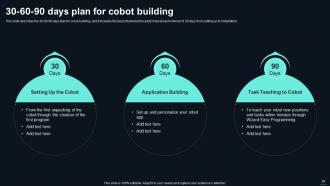
Slide 38: This slide describes the 30-60-90 days plan for cobot building.
Slide 39: This slide mentions the Title for the Topics to be covered in the forth-coming template.
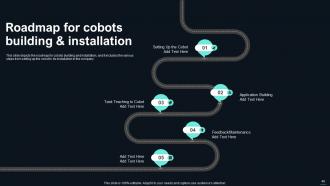
Slide 40: This slide depicts the roadmap for cobots building and installation.
Slide 41: This slide represents the Heading for the Topics to be discussed next.
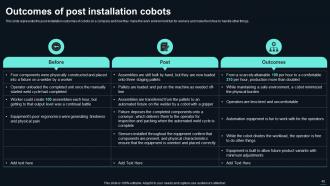
Slide 42: This slide outlines the post-installation outcomes of cobots on a company.
Slide 43: This slide covers the Title for the Ideas to be discussed in the forth-coming template.
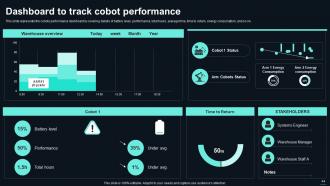
Slide 44: This slide displays the cobots performance dashboard.
Slide 45: This slide contains all the icons used in this presentation.
Slide 46: This slide is titled as Additional Slides for moving forward.
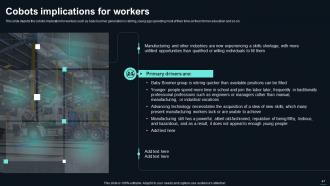
Slide 47: This slide shows Cobots implications for workers.
Slide 48: This is Our Goal slide. State your firm's goals here.
Slide 49: This slide depicts Venn diagram with text boxes.
Slide 50: This is a Timeline slide. Show data related to time intervals here.
Slide 51: This slide contains Puzzle with related icons and text.
Slide 52: This slide shows Post It Notes. Post your important notes here.
Slide 53: This slide showcases Magnifying Glass to highlight information, specifications etc
Slide 54: This is an Idea Generation slide to state a new idea or highlight information, specifications etc.
Slide 55: This is a Thank You slide with address, contact numbers and email address.
Collaborative Robots It Powerpoint Presentation Slides with all 60 slides:
Use our Collaborative Robots It Powerpoint Presentation Slides to effectively help you save your valuable time. They are readymade to fit into any presentation structure.














FAQs for Collaborative Robots It
Honestly, cobots are game-changers for productivity and safety. They'll work around the clock handling all that repetitive stuff, so your team can focus on actually solving problems. Way safer than those big industrial robots too - no need for safety cages since they're built to work right next to people. Programming them is pretty straightforward when you need to switch things up, which beats dealing with those massive fixed systems that cost crazy money to change. Oh, and definitely start with your most repetitive tasks that are hard on workers' bodies. That's where you'll see the money back fastest.
So cobots have these smart sensors that make them stop or slow down when they sense people nearby - pretty cool tech actually. They're built way differently than those massive industrial robots that need cages because they'll basically crush anything in their path. These things have rounded edges, they're lighter, and their vision systems are constantly scanning around them. Safety protocols are baked right into how they're programmed too. The whole point is boosting efficiency without creating a death trap, though you'll still want proper training for everyone first.
Oh man, manufacturing is crushing it right now - automotive and electronics especially. Amazon's warehouses are basically robot cities at this point. Food processing jumped in big time for all that boring packaging stuff. Even healthcare's getting into it with lab work and pharmacy robots, which honestly makes me a little nervous lol. But yeah, seems like every industry with repetitive work is testing the waters. The pattern I'm seeing? Companies want automation but still need humans watching over everything. I'd definitely scope out what your competitors are doing before diving in though.
Figure out what you actually need it to do first - that's the big one. Payload, reach, how precise it needs to be for your specific jobs. Safety stuff is obviously critical since people work right next to these things. Some are way easier to program than others, which honestly makes a huge difference day-to-day. Check if it'll play nice with whatever systems you've got running already. Total cost gets tricky because training and maintenance add up fast. Definitely get demos from multiple vendors though - you'll be shocked how different they feel to actually use.
Dude, cobots are so much simpler than those massive industrial robots. You literally just grab the arm and move it around to teach it - no programming nightmare. They come with these drag-and-drop interfaces that make sense, unlike traditional bots that need actual engineers to set up. Plus you don't need all those safety cages everywhere. The cool part? They'll actually slow down or stop if you get too close, so you can work right next to them. Honestly, if you're thinking about automation but don't have robotics people, cobots are your best bet to start with.
Honestly, cobots are pretty cool - they're built to work WITH you, not replace you. So while they handle the boring repetitive stuff or heavy lifting that kills your back, you get to do the actual thinking work like quality checks and problem-solving. I mean, who wants to strain their eyes doing precision assembly all day anyway? They're basically fancy tools that are safe enough to work right next to. Super useful for anything that's slowing your team down or creating safety headaches. Worth looking into if you've got tasks like that.
Dude, the AI stuff happening with cobots right now is insane. They can actually understand what you're saying and recognize people/objects instantly. Some of them even predict your next move - kinda creepy but super useful. No more giant safety cages either since the sensors got way better at keeping everyone safe. Oh, and here's the cool part: they learn from experience, so they'll actually improve at whatever task you give them. Honestly feels like sci-fi sometimes. If you're shopping around, definitely prioritize the ones with that adaptive learning feature.
Honestly, cobots are pretty awesome for warehouse stuff. They handle picking, packing, sorting - all that repetitive work that kills your back. No safety cages needed since they're built to work right next to people. Picture a super smart cart that follows workers around and can actually lift heavy boxes - that's basically what you get. My buddy's company uses them for moving inventory and palletizing, runs them 24/7 which is nice for ROI. Way fewer injuries too. I'd say start small though - find your most mind-numbing, physical task and try one cobot there first.
Most common stuff is assembly line work - door panels, mounting parts, anything that needs precision but human judgment too. Quality control is massive right now. Cobots help check welds and spot defects while workers handle the tricky calls. Material handling's everywhere - moving heavy components, loading stations. Welding and painting applications are really taking off lately, which honestly makes sense since those jobs are tough on people. Look for tasks that are super repetitive or murder on your back/shoulders. That's where you'll get the biggest win. Basically anywhere you want flexibility without completely replacing your team.
So these collaborative robots have all this sensor tech - cameras, force sensors, proximity stuff. They watch what's happening and adjust on the fly. Machine learning kicks in too, so they actually improve from doing tasks repeatedly. Honestly, it's pretty impressive how they switch between different modes automatically based on what they're sensing. You can set different parameters and they'll figure out which one to use. If you're thinking about getting some, I'd look at your most unpredictable processes first - that's where you'll really see them shine.
So you're looking at maybe $25K-100K upfront for a cobot setup, which honestly isn't terrible when you think about it. Traditional industrial robots cost way more because they need all those safety cages and complex programming - cobots don't. You'll hit ROI in 1-2 years through labor savings and productivity bumps. Main costs are the robot, integration work, training your team, plus any workspace tweaks for safety. Here's what I'd do: crunch the numbers on what you're currently spending on repetitive tasks. That's where the money is. Then you can move your people to stuff that actually requires thinking.
Look, cobots don't really steal jobs - they just change them. Your workers end up doing cooler stuff like programming robots and troubleshooting when things go sideways. Honestly, people adapt way faster than you'd think. Instead of doing the same boring task all day, they become like robot babysitters who handle the tricky decisions machines can't figure out. The trick is training your current team before you roll these things out. Find the people who actually like tech and aren't scared of learning new skills - they'll be your best bet.
Honestly, the biggest pain is gonna be your workers freaking out when the robots show up - can't really blame them though. You'll also have to reprogram all your workflows and make sure safety stuff is rock solid. Getting these cobots to actually work with your current systems is a nightmare too. Training takes forever since everyone needs to learn how to work with them. Oh and definitely start small with like one department first before going crazy company-wide. Trust me on that one - I've seen too many places try to do everything at once and it's a disaster.
So basically you want to nail three things. First, train your people properly on how the cobots work - nobody wants that awkward standoff where everyone's waiting for someone else to act. Communication is huge too - set up some kind of signal system so humans and robots both know what's next. Visual cues work great, or even just audio alerts. Oh and don't underestimate the layout piece. Your floor needs to flow right so workers can move around without getting in the robot's way or screwing up their tasks. Honestly, I'd start small with just one human-robot pair and see how it goes before you roll it out everywhere.
Dude, these cobots are getting insanely smart with AI - they'll actually learn your workflows without any reprogramming. Safety features keep improving too. The whole industry is moving toward plug-and-play setups where you can basically just show them what to do instead of needing some engineer. Prices are dropping fast, which is huge. Their sensors and grippers are way more precise now. I'd honestly start mapping out which boring, repetitive stuff your team does because pretty soon you won't need a computer science degree to set these things up.
-
Editable, diversified, compatible with MS PPT and Google Slides, and on top of that finest graphics!! I mean in the words of the famous Ross Geller, “What more do you want!”
-
My team has been relying on SlideTeam’s professional PPT designs for a while now. It has greatly sped up quality work at my organization. So thanks!