

B2b E Commerce Supply Chain Flow And Management B2b E Commerce Platform Management




Try Before you Buy Download Free Sample Product
 Impress Your
 Audience
 100%
100% Editable
 Save Hours
 of Time


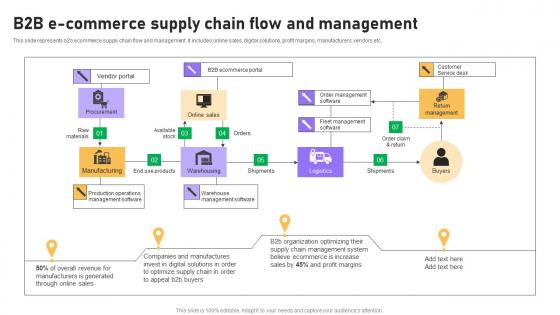
This slide represents b2b ecommerce supply chain flow and management. It includes online sales, digital solutions, profit margins, manufacturers, vendors etc.
People who downloaded this PowerPoint presentation also viewed the following :
B2b E Commerce Supply Chain Flow And Management B2b E Commerce Platform Management with all 6 slides:
Use our B2b E Commerce Supply Chain Flow And Management B2b E Commerce Platform Management to effectively help you save your valuable time. They are readymade to fit into any presentation structure.





FAQs for B2b E Commerce Supply Chain Flow And Management B2b E
Dude, B2B supply chains are a total nightmare compared to B2C. You're juggling bulk orders that take forever to process, plus like five different people need to approve every purchase. B2C is all about speed - get stuff to customers fast. But B2B? It's relationship management on steroids. These companies want custom pricing, weird delivery schedules, and they'll order massive quantities maybe twice a year. The sales cycles drag on for months (seriously, I've seen deals take a year to close). Your inventory planning gets tricky since demand is so unpredictable, and you need systems that play nice with their procurement software. Way more moving parts than regular retail.
Honestly, the visibility you get now is crazy - IoT sensors and blockchain let you track stuff in real-time from supplier to customer. Your ERP can talk to everyone through APIs, so suppliers and logistics are all synced up. No more annoying "where's my shipment" calls. AI spots problems before they blow up too, which is clutch. I'd connect your main systems first though. The fancy tracking stuff can wait until your data actually flows right - learned that the hard way at my last job.
Look, data analytics is like having x-ray vision for your supply chain. You can actually predict demand spikes and catch bottlenecks before they wreck everything. Track supplier performance, delivery times, inventory levels - the patterns that jump out are honestly mind-blowing. I nerded out hard when I first saw this stuff in action. It shows you exactly when to reorder, which suppliers suck, and where you're hemorrhaging cash. Don't overthink it though. Just pick one thing like fulfillment times and start tracking consistently. The insights will follow.
Look, B2B trust really boils down to doing what you say you'll do. Be upfront about shipping times, inventory, pricing - buyers hate surprises. Those verified reviews and case studies? They actually matter way more than most people realize. Your order fulfillment needs to be solid, customer service responsive, payments secure. The winners also give real-time tracking and dedicated account reps. Oh, and definitely audit your current touchpoints - seriously, where can you give buyers more visibility into what's happening behind the scenes?
Oh man, you're gonna hate the inventory visibility stuff - tracking products across multiple suppliers is a nightmare. Each vendor uses different EDI standards that never work together smoothly. Data formats? Forget about it, nothing matches up. Your customers will want real-time tracking while their order bounces between 3-4 warehouses, which is honestly pretty unrealistic but whatever. Lead times get weird with bulk ordering too. Start with your biggest suppliers and get them using the same data protocols. Once that's sorted, work backwards to get full visibility across the whole chain.
API connectors are your best bet for hooking up the ERP to your B2B platform. Most systems these days have them built right in, which is nice. Map your data fields carefully though - inventory, pricing, customer stuff all needs to sync right. Honestly? Getting everyone to agree on data structure is way harder than the actual tech setup. Figure out what data flows both ways vs. one direction only first. Oh, and definitely pilot with just one product category before going all-in. Saves you from discovering weird timing issues later when it's too late to fix easily.
Real-time inventory tracking is where you should start - get your systems talking to each other so stock updates automatically everywhere. B2B orders are usually bigger and way more predictable, so demand forecasting becomes super valuable. Set up automated reorder points based on your lead times and customer buying patterns. ABC analysis is a game changer for figuring out which products need tight control (seriously changed everything for us). Oh, and ditch the annual inventory counts - cycle counting is so much more accurate. Clean up your data first, automate what you can, then layer forecasting on top. Safety stock levels matter too but don't overthink it initially.
Ugh, cross-border regs are honestly such a pain. You're suddenly juggling customs paperwork, different tax rules, import licenses - the whole mess varies by country too. Shipping times get unpredictable, you can't plan inventory the same way, and don't even get me started on how duties and VAT mess with your pricing. Border delays are just a fact of life now. My advice? Build in way more buffer time than you think you'll need and find logistics partners who actually know their stuff in whatever markets you're hitting. Trust me, it's worth paying for that expertise upfront.
Honestly, cloud stuff is pretty amazing for supply chain management. You can see everything happening in real-time - inventory, shipments, the whole deal. During busy seasons, it scales up automatically so you don't have to scramble for more servers. Your team can jump in from anywhere too, which is clutch. The money part is nice - way less spent on IT infrastructure and all that maintenance headache. Oh, and it plays much better with other B2B systems than I expected. I'd say just try moving one thing first, maybe order tracking? See how it feels before going all-in.
Yeah, you can automate basically everything - order processing, inventory, shipping, invoicing, the whole thing. Purchase order automation is where most people see huge wins since it'll reorder stock automatically when you hit certain levels. EDI integrations are clutch too because your systems can talk straight to suppliers without anyone typing stuff in manually. Honestly? The time you'll save is insane. I'd also check out automated demand forecasting and warehouse management systems, though that might be overkill depending on your size. Just start with whatever's driving you crazy right now - usually inventory headaches or order processing nightmares.
Honestly, customer experience controls pretty much everything in B2B supply chains now. Your buyers want instant inventory updates and next-day delivery? Time to rebuild your whole backend. It's crazy - one "where's my shipment?" complaint can totally reshape how you run warehouses. Bad customer experience = lost contracts and relationships that take years to fix. The mess spreads to your suppliers too, which is annoying. I'd start by actually mapping out your customer journey first. Find the biggest headaches and you'll see exactly what needs fixing in your supply chain setup.
First thing - find carriers who actually get B2B shipping and won't ghost you when things get complicated. Auto-alerts are clutch so your customers aren't constantly hitting you up asking where their order is. Buffer time is everything because stuff WILL go wrong (trust me on this one). Keep backup suppliers lined up too. The communication piece honestly makes or breaks you - B2B folks lose their minds over delivery surprises. Oh and track everything obsessively. Don't pick carriers based on their fancy sales pitch - go with whoever's actually delivering on time consistently.
Track on-time delivery first - that's what customers actually see and care about. Also watch order accuracy, transportation costs, and how long it takes to turn inventory back into cash (cash-to-cash cycle). Customer satisfaction stuff matters too, like return rates and order cycle times. Honestly though? Don't go crazy with metrics - I've seen companies drown in dashboards. Pick maybe 3-4 that directly hit your customers' day-to-day operations and obsess over those instead. Lead times are huge right now with all the supply chain weirdness happening.
Honestly, green practices are becoming a huge deal in B2B sales now. Your buyers are literally choosing suppliers based on how environmentally friendly you are. So you'll want to start tracking carbon emissions, waste stuff, and where you source materials from. Most platforms actually build sustainability metrics right into their systems these days - makes life easier, I guess. Oh and your shipping partners matter too. Electric delivery trucks, better routes, less packaging waste - it all adds up to your overall score. I'd probably start by checking what your current suppliers are doing, then set some actual targets you can measure.
Honestly, AI and machine learning are huge right now - they're crushing it with demand forecasting and inventory optimization. IoT sensors track everything in real-time, which is pretty wild compared to how we used to do things manually. Blockchain's getting traction for supply chain transparency too. Oh, and robotic automation handles all that boring stuff like order processing. My advice? Pick one tech that fixes your worst headache first. Don't try to do everything at once - that's a recipe for disaster.
-
It's always a delight to see new templates from you! I am extremely pleased with the fact that they are easy to modify and fit any presentation layout in seconds!
-
The content is very helpful from business point of view.