


Benchmark Comparison Analysis Of Market Competitors




Try Before you Buy Download Free Sample Product
 Impress Your
 Audience
 100%
100% Editable
 Save Hours
 of Time


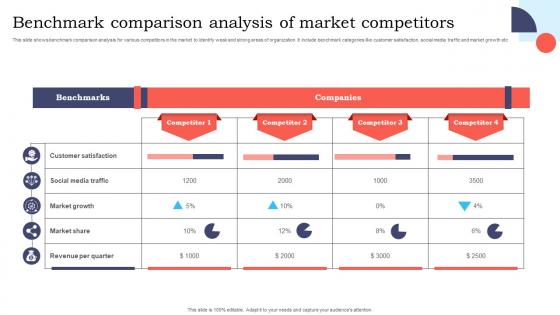
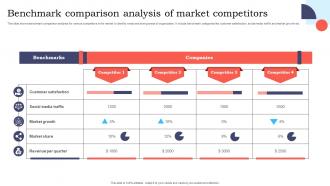
This slide shows benchmark comparison analysis for various competitors in the market to identify weak and strong areas of organization. It include benchmark categories like customer satisfaction, social media traffic and market growth etc.
People who downloaded this PowerPoint presentation also viewed the following :
Benchmark Comparison Analysis Of Market Competitors with all 7 slides:
Use our Benchmark Comparison Analysis Of Market Competitors to effectively help you save your valuable time. They are readymade to fit into any presentation structure.





FAQs for Benchmark Comparison Analysis
Focus on the big three first: revenue growth, profit margins, and customer satisfaction. Those tell you if you're actually winning. Then add operational stuff like productivity rates or market share - whatever makes sense for your industry. Quality metrics are solid too, like defect rates if you're making things. Honestly though? I've seen companies get obsessed with tracking like 20 different KPIs and it becomes a nightmare. Pick maybe 5-7 max that directly connect to your main goals. Check what your competitors probably measure, but don't copy everything blindly. Start simple and add more later if needed.
Free industry reports and government data are total goldmines that most small businesses just ignore. Government stuff can be boring to dig through, but it's worth it. Try joining industry associations or online forums where business owners actually share their real numbers - you just gotta ask nicely. Don't try benchmarking everything though. Pick 3-4 metrics that genuinely matter to your business. Honestly? Sometimes calling a friendly competitor works way better than fancy software. You're not looking for perfection here, just directional insight. This week, grab one metric and spend 30 minutes researching what good actually looks like.
Honestly, competitive analysis is what makes benchmarking actually useful. You're basically checking your performance against similar companies to see if you're doing well or... not so much. Pick competitors that match your size and market - otherwise you're comparing apples to oranges, which is pretty pointless. Without this comparison, you're just staring at your own numbers going "is this good?" The whole point is figuring out where you stand in the real world. It's like running a race but having no clue if you're winning or dead last.
Quarterly works best for most companies, but it really depends on your industry. Tech and retail move crazy fast - waiting a year puts you way behind competitors who are checking monthly. Manufacturing or utilities? Maybe twice a year is fine since things don't shift as much. Honestly though, don't make benchmarking this huge dreaded project. Set up simple tracking so you can watch key metrics ongoing. I'd start quarterly and see how that feels - you can always adjust the timing once you get into a rhythm with it.
Find companies that are close enough in size and complexity to make sense, but crushing it where you're not. Industry peers work great, though honestly some of my best insights came from totally different sectors. You'll want organizations actually willing to share real numbers - not just fluff metrics. Skip your direct competitors unless there's some formal consortium thing going on. Professional networks and industry groups are solid starting points for finding partners who'd also get value from swapping data. The key is picking someone different enough that you'll actually discover something new.
Honestly, benchmarking is like getting a cheat sheet for what's working. You see where competitors are killing it and where they're totally missing the mark. That gap analysis? Pure gold for sparking new ideas. Look beyond your obvious competitors too - I've seen retail companies steal brilliant processes from airlines. Weird but it works. The cool part is catching trends early, before everyone's doing the same thing. My advice: pick one thing you want to fix and find three companies nailing it. Then reverse-engineer what they're doing differently.
Yeah, cultural stuff really throws off benchmarking data. Some cultures are brutally honest about problems, others sugarcoat everything to avoid conflict. Performance metrics get messy too - "meeting deadlines" might be flexible in one region but absolute in another. Customer surveys? Totally skewed since some cultures never give extreme ratings or harsh feedback. I learned this the hard way at my last job actually. You've got to validate everything locally instead of assuming data means the same thing everywhere. Don't trust numbers at face value across different regions.
Okay so for benchmarking - IBISWorld and Hoovers are solid for competitor data. Your own Google Analytics gives you the digital baseline. SurveyMonkey's perfect for customer satisfaction stuff. Excel is honestly still the best for most analysis work, don't let anyone tell you otherwise. Process mapping? Lucidchart works well to spot workflow gaps. Bloomberg Terminal is amazing for financial benchmarking but costs a fortune. My take is start with the free tools first. Figure out which metrics actually matter for your situation, then maybe invest in fancier software later. No point dropping cash on tools you might not even need.
Look, benchmarking data is basically your reality check for setting goals that actually make sense. Map those results directly to what you're trying to accomplish - like if your customer satisfaction sucks compared to competitors, boom, that's priority
-
“Easy to use. I always wanted to have a quick search for products and SlideTeam has helped me have it.”
-
Thrilled to see several customizable templates catering various verticals and industries.