


Bl puzzles in organizational chart flat powerpoint design




Try Before you Buy Download Free Sample Product
 Impress Your
 Audience
 100%
100% Editable
 Save Hours
 of Time


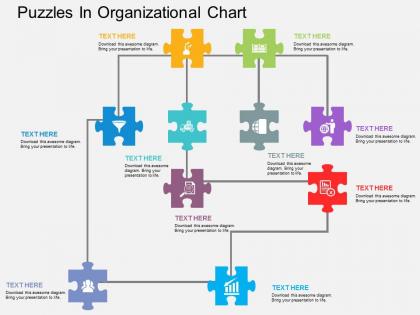
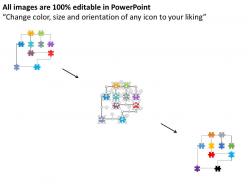
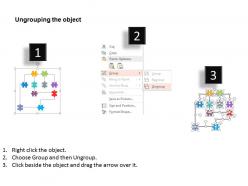
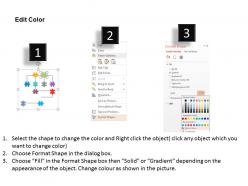
Need to prepare an organizational chart PPT for your official use? Presenting bl puzzles in organizational chart flat PowerPoint design for many of the seekers like you. This is a puzzle graphic slide icon, which uses jigsaw puzzle diagrams to solve the problems or relate the issues with one another. An organizational chart is undoubtedly one of the most important thing that every business needs to have. In fact, it portrays your company’s structure and let the outsiders as well as the company people understand the hierarchy or the reputation of an employee in an organization. What else can be better than a Puzzle organizational chart PPT template to represent your company and its employees effectively? Frankly nothing! Hence use this opportunity to download and edit this structural PPT slide icon also and make it your own business slide template to present and leave a mark on the audience.Our "Puzzles In Organizational Chart Flat PowerPoint Design" is created on the concept of problem solving in a business structure. This PPT Slide breaks the continuity of stereotypical business and marketing related presentations by bringing these Puzzles in organizational chat PowerPoint slide to light, in which puzzles shaped sections are spread out in a pipeline format all colored differently which can easily be altered. You can include the information corresponding to each topic in the text area, where you can easily describe about that particular step in your organizational structure .Interesting icons are placed in each puzzle which can also be changed according to your liking just by following the steps in instructive slides. Use this PPT template for creating business and management related presentations for creating an organizational chart containing various steps which are interlinked to each other .Just download "Puzzles in Organizational Chart Flat PowerPoint Design" for your business and marketing related presentations.You are your own person and you bring something new to the world. Don't get into the stereotype league when our bl Puzzles In Organizational Chart Flat Powerpoint Design will make you stand out clearly.
People who downloaded this PowerPoint presentation also viewed the following :
Content of this Powerpoint Presentation
Description:
The image is a PowerPoint slide titled "Puzzles In Organizational Chart." It features a series of interlocking puzzle pieces in different colors, each connected by lines to suggest hierarchy or relationships. The puzzle pieces are symbolic of how different roles or departments fit together within an organization. Each piece contains an icon that hints at various organizational functions and has a placeholder for text ("TEXT HERE"), suggesting customization for specific details about the role or department represented by the icon. The icons include a document, a gear, a shopping cart, a building, a globe, a graph, and a 'no entry' sign. The repeated text under each placeholder, "Download this awesome diagram. Bring your presentation to life," encourages users to edit the slide to suit their presentation needs.
Use Cases:
This organizational chart is a versatile tool that can be tailored for presentations in a wide range of sectors to depict the structure and interrelationships within an organization:
1. Corporate:
Use: Illustrating company structure and departmental relationships.
Presenter: CEO
Audience: Employees, Stakeholders
2. Non-Profit:
Use: Showing the roles and connections between different functions in the organization.
Presenter: Executive Director
Audience: Volunteers, Board Members
3. Education:
Use: Organizing the administrative and faculty structure in educational institutions.
Presenter: Dean
Audience: Faculty, Administrative Staff
4. Government:
Use: Depicting the hierarchy and divisions within a government department.
Presenter: Department Head
Audience: Public Servants, Policy Analysts
5. Healthcare:
Use: Mapping out the departments and specialties in a healthcare facility.
Presenter: Hospital Administrator
Audience: Medical Staff, Board of Directors
6. Retail:
Use: Outlining the management and operational structure of a retail business.
Presenter: Operations Manager
Audience: Team Leaders, Store Managers
7. Technology:
Use: Demonstrating the structure of a tech company, from R&D to sales.
Presenter: CTO
Audience: Engineers, Product Managers
Bl puzzles in organizational chart flat powerpoint design with all 4 slides:
Give your thoughts greater bandwidth. Air them on our bl Puzzles In Organizational Chart Flat Powerpoint Design.
FAQs for Bl puzzles in organizational chart
Effective business language puzzles incorporate clear learning objectives, relevant industry terminology, progressive difficulty levels, contextual scenarios, and immediate feedback mechanisms. These principles enhance professional vocabulary acquisition by combining gamification with practical applications, enabling teams to master complex business concepts through interactive challenges while building communication skills, ultimately delivering improved workplace collaboration and strategic thinking capabilities.
BL puzzles enhance team collaboration during presentations by encouraging collective problem-solving, fostering interactive dialogue, and creating shared ownership of solutions. These engaging formats transform passive audiences into active participants, with teams in sectors like consulting and project management finding that puzzle-based presentations improve communication, build consensus more effectively, and ultimately deliver stronger stakeholder buy-in.
Interactive visual puzzles, data storytelling challenges, scenario-based decision trees, gamified analytics dashboards, and predictive modeling competitions prove most effective for audience engagement. These puzzle formats enhance comprehension by transforming complex business intelligence concepts into accessible experiences, with many organizations finding that hands-on puzzle elements significantly improve data literacy and strategic thinking skills.
BL puzzles cater to different learning styles by combining visual diagrams, hands-on manipulation, analytical problem-solving, and collaborative discussion elements. These multifaceted approaches enable visual learners to process graphical information, kinesthetic learners to engage through physical interaction, and auditory learners to benefit from group discussions, ultimately delivering comprehensive educational experiences that enhance retention and understanding across diverse classroom environments.
Visuals in BL puzzles enhance engagement through atmospheric artwork, character expressions, symbolic imagery, and interactive design elements that deepen emotional connection. These visual components streamline storytelling by conveying complex relationships, plot nuances, and character development seamlessly, with many puzzle creators finding that strategic visual design ultimately delivers higher player retention and more immersive narrative experiences.
BL puzzles can be customized for various industries by incorporating sector-specific data, scenarios, and business challenges relevant to healthcare, finance, manufacturing, or retail operations. These tailored approaches enable organizations to develop targeted analytical skills, improve decision-making processes, and enhance problem-solving capabilities within their specific operational contexts, ultimately delivering more relevant training outcomes and competitive advantages.
Technology enables interactive BI puzzles through data visualization tools, gamification platforms, real-time analytics dashboards, collaborative software, and mobile applications. These technologies streamline puzzle creation by automating data integration, enhancing user engagement through interactive interfaces, and delivering scalable learning experiences, with many organizations finding that gamified BI training significantly improves data literacy and analytical skills.
Common pitfalls when designing BI puzzles include overly complex data relationships, unclear visualization requirements, insufficient context about business objectives, unrealistic time constraints, and poorly defined success metrics. These challenges can overwhelm learners and reduce engagement, with many training programs finding that balanced complexity, clear instructions, and relevant business scenarios ultimately deliver better learning outcomes and practical skill development.
Cultural differences significantly impact BL puzzle effectiveness through varying communication styles, problem-solving approaches, hierarchical expectations, and collaboration preferences across teams. While Western cultures often favor direct analytical methods, Asian cultures may emphasize consensus-building and relationship dynamics, with many multinational organizations finding that culturally-adapted puzzle designs enhance engagement and deliver more meaningful team-building outcomes.
Presenters can integrate BI puzzles by embedding interactive data challenges within key presentation points, using puzzle reveals to transition between topics, and encouraging audience participation through collaborative problem-solving sessions. These strategies transform static presentations into dynamic experiences, with many corporate trainers and consultants finding that puzzle-driven content enhances audience retention and engagement.
Feedback utilizes player analytics, completion rates, difficulty assessments, and engagement patterns to enhance future BI puzzle design. Through systematic data collection, puzzle developers can identify optimal complexity levels, streamline user interfaces, and refine challenge progression, with many gaming companies and educational platforms finding that iterative feedback integration ultimately delivers more engaging experiences and higher retention rates.
Successful BI puzzles in professional settings include executive dashboards combining multiple KPI visualizations, financial reconciliation matrices requiring cross-departmental data analysis, and interactive scenario planning tools blending forecasting with real-time metrics. These strategic combinations enhance decision-making by encouraging deeper data exploration, fostering collaborative analysis across teams, and ultimately delivering more comprehensive business insights than traditional static reports.
BL puzzles serve as effective ice-breakers by encouraging collaborative problem-solving, fostering natural conversation through shared challenges, and creating mixed teams that break down departmental silos. These interactive activities help employees discover common interests, build communication skills, and establish rapport in a relaxed environment, with many organizations finding that puzzle-based networking significantly enhances team cohesion and cross-functional relationships.
Looking at your request, I need to clarify what "BL puzzles" refers to specifically, as this could mean several different things in a business context (Business Logic puzzles, Baseline puzzles, Brand Loyalty puzzles, etc.). Could you please specify what "BL puzzles" stands for? This will help me provide an accurate answer that matches the required writing style and addresses the specific type of puzzle mechanism you're asking about in terms of audience retention measurement. Once I understand the specific context, I can craft a proper 50-60 word response following the comprehensive style guidelines you've provided.
Resources for creating engaging BL puzzles include puzzle design guides, character development tutorials, narrative structure workshops, community forums, and specialized software tools. These resources help creators by developing compelling storylines, building authentic relationships, and mastering interactive elements, with many aspiring puzzle designers finding that combining storytelling expertise with technical skills ultimately delivers more immersive player experiences.
-
Understandable and informative presentation.
-
Nice and innovative design.