

 0 Comment
 Customer Reviews

The FMEA risk assessment process identifies problems in a process, product, or system before they happen. It searches areas where things might go wrong and details just how harmful the effects could be if those failures occur. The objective is thus to rank risks by impact and likelihood so that you may take steps against them. It prevents costly mistakes from happening and improves efficiency overall.
Uncover the best practices with the top 10 FMEA templates designed to help you learn from your failures.
FMEA risk assessment enables corporations to assess potential threats and provide resolutions. The process aims to let you know how these consequences impact your business. An established company always pays attention to this as they understand how these risks can create a big problem later. Moreover, FMEA enables you to take critical measures and decisions professionally related to the business. You analyze all crucial aspects, identify the concern, and then take action steps to rectify it. In modern business, it has become more vital because of advanced technology. There is always a fear of failure at some point, and you have to better prepare for it in advance.
Enhance your risk management using the top 10 failure analysis templates. Click here and download now!
Use our FMEA Risk Assessment PowerPoint templates to clearly and effectively demonstrate any information relative to the slide topic. These presentation diagrams provide a means to present the potential risks, their causes, and the impacts they might have on your business. Use these to take necessary actions and prioritize your efforts toward high-risk severity tasks.
Template 1: Major Steps in Failure Mode and Effects Analysis Process

This PPT Slide showcases the significant steps in failure mode and the effects analysis process. It comprises a ten-step process that begins with reviewing the process and assembling a team. Analyze various failure modes and prepare a list of potential effects of failure. Assign severity, occurrence, and detection rankings. The design further shows the calculation of the risk priority numbers and develops the action plan. Finally, take the necessary actions and calculate the resulting risk priority numbers. Download now.
Template 2: Importance of Failure Mode and Effects Analysis in an Organization

This PowerPoint Presentation highlights the importance of failure mode and effects analysis in an organization. It defines FMEA and outlines situations when it can be used. The layout shows that it can be used when designing or redesigning a process, product, or service or after quality function deployment. It also outlines what to use in process restructuring before developing control plans. Download now.
Template 3: Key Responsibilities of the FMEA Team Members

This PPT Template shares the critical responsibilities of FMEA team members. It shows that each member plays a crucial role in the process. The key members include team leaders, subject matter experts, quality engineers, process engineers, and documentation specialists. The slide also enables you to define the roles and responsibilities of team members professionally. People working in different departments of an organization are accountable for one task or another. This presentation allows you to make them aware of their roles.
Template 4: Key Methods of Techniques of Failure Analysis

Use this PowerPoint Diagram to outline essential methods or techniques of failure analysis. It comprises methods like cause-consequence analysis and event tree analysis. Moreover, it also shares failure modes and effects analysis (FMEA), hazard and operability analysis, and preliminary hazard analysis. The template shows that each method allows you to identify and evaluate potential process risks. Download and use it now.
Template 5: List of Failures Along with the Potential Effect

This PPT Layout features a list of failures along with the potential effects. It begins with a production failure, where the potential impact can be an interruption in the continuity of production and achieving failed production targets. The next in the line is loss of asset availability, which can affect an increase in fixed expenses. The unavailability of equipment can disrupt production and cause system failures of interest. Apart from this, the other shortcomings shown in this PPT design are deviation from the status quo and failure to meet target expectations.
Template 6: Failure Modes and Effects Analysis (FMEA) Scoring - Severity

This PPT Image provides failure modes and effect analysis scoring and severity. It categorizes risk severity as extreme, high, moderate, low, and none. It also shows a rating from 1 to 10. Moreover, the template shares that extreme severity includes issues like lack of asset and equipment availability, whereas high severity covers disruption in production due to loss of primary function. Furthermore, it also showcases that moderate involves minor defects. Low severity encompasses minor defects, which may not have a significant impact.
Template 7: Failure Modes and Effects Analysis (FMEA) Scoring - Occurrence
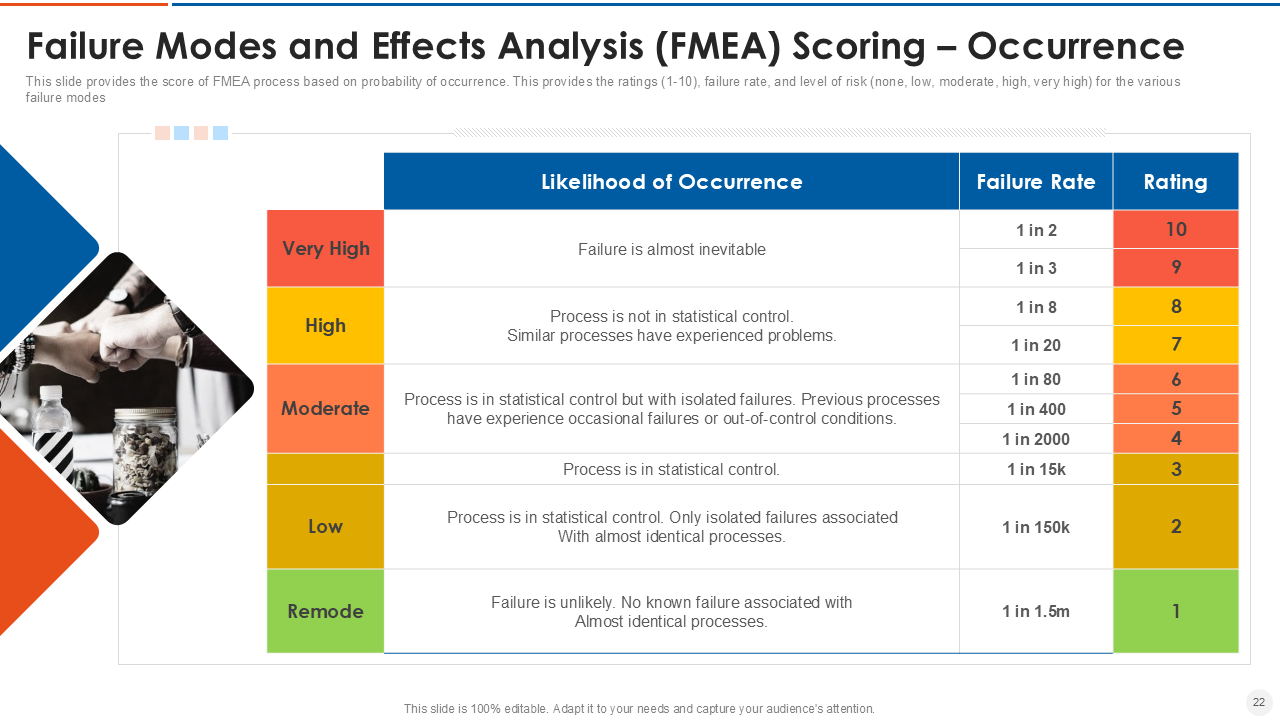
This PowerPoint Presentation demonstrates failure modes and effects analysis scoring for occurrence. It highlights the likelihood of failure occurrence and their failure rate, severity, and ratings. The slide shows that when failure is inevitable, it falls under very high severity and rating. Moreover, when the process is under no statistical control, it is highly severe. Furthermore, it is under moderate severity when the process is under statistical control but with isolated failures. The template also shows that only isolated failures associated with identical processes come under low severity when the process is under statistical control. Lastly, when there are no known failures, then it falls under remodel.
Template 8: Failure Modes and Effects Analysis (FMEA) Scoring - Detection

Download This Presentation Now
This PPT Design focuses on failure modes and effects analysis scoring for detection. It portrays that when no known controls are available to detect failure mode, it is at a very low risk. When controls have the slightest chance of detecting the failure, it comes under low risk. Further, when controls may detect the existence of a failure, then it falls under moderate. Additionally, when controls have a good chance of detecting the existence of a failure, then it is under high risk. When it automatically detects a failure, it is in a dangerous situation with a very high risk. Download now.
Template 9: Action Plan as Per the Failure Mode

This PowerPoint Visual exhibits an action plan in failure mode. It outlines that you must identify the root cause for production failure, resolve it according to the risk priority number, and then reassess targets. The template also shows that for loss of asset availability, you must identify the asset requirements and ensure assets are available at every stage of the process. Also, prioritize all plan assets by assigning each an objective and relative ranking. The other failure modes shown in this presentation design are a deviation from the status quo and not meeting target expectations.
Template 10: FMEA - Calculation of Risk Preference Number

This PPT Template highlights FMEA risk priority number calculations. Scores highlighted for failure modes A, B, and C. For failure mode A, the scores are severity 2, occurrence 4, detection 9, and an RPN 72. For failure mode B, the scores are severity 3, occurrence 7, and detection 2, with an RPN of 42. Failure mode C scores severity 8, occurrence 2, and detection 1, with an RPN of 16. Failure mode A requires immediate attention since the RPN value is highest in this mode, while failure modes B and C present minor risks. Download now.
Master FMEA for Unmatched Risk Control
Our presentation images help explain and bring impact to your risk FMEA assessment. You can clearly and professionally present your risk analysis using images, so your team or stakeholders can better understand and act on crucial insights. These PowerPoint visuals make your FMEA process engaging and easy to follow.
Utilize the top 10 product risk templates with examples and samples to effectively identify and manage potential risks in your product development process. Download them here!