


Failure Mode Effects And Criticality Analysis Fmeca Method Contd Quality Risk Management




Try Before you Buy Download Free Sample Product
 Impress Your
 Audience
 100%
100% Editable
 Save Hours
 of Time


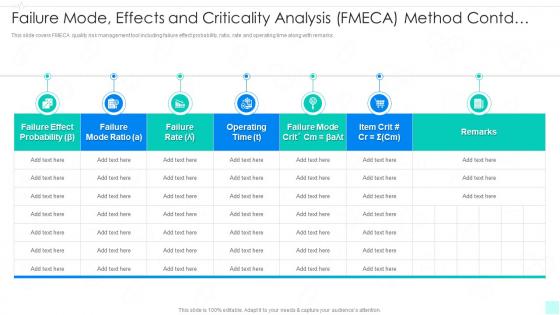
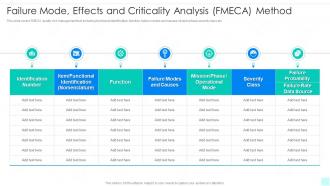
This slide covers FMECA quality risk management tool including failure effect probability, ratio, rate and operating time along with remarks.
People who downloaded this PowerPoint presentation also viewed the following :
Failure Mode Effects And Criticality Analysis Fmeca Method Contd Quality Risk Management with all 7 slides:
Use our Failure Mode Effects And Criticality Analysis Fmeca Method Contd Quality Risk Management to effectively help you save your valuable time. They are readymade to fit into any presentation structure.






FAQs for Failure Mode Effects And Criticality Analysis Fmeca Method Contd
FMECA's primary objectives include identifying potential failure modes, assessing their criticality, prioritizing risk mitigation efforts, enhancing product reliability, and reducing lifecycle costs. This systematic approach enables development teams to proactively address vulnerabilities before production, ultimately delivering more robust products with improved safety margins, while many organizations finding that early FMECA implementation significantly reduces warranty claims and enhances competitive positioning.
FMECA extends traditional FMEA by incorporating criticality analysis, which quantifies and ranks failure modes based on severity, occurrence probability, and detection likelihood through numerical scoring systems. This enhanced approach enables organizations in aerospace, automotive, and manufacturing sectors to prioritize resources more strategically, focusing maintenance efforts on the most critical failure modes while delivering improved risk management and operational efficiency across complex systems.
Key steps in conducting FMECA analysis include system definition, failure mode identification, cause analysis, effect assessment, criticality evaluation, and risk prioritization. These systematic phases enable organizations to methodically assess potential failures across manufacturing, aerospace, and automotive sectors, ultimately delivering enhanced product reliability, reduced warranty costs, and improved safety outcomes while strengthening competitive positioning.
FMECA integrates into existing risk management practices by complementing traditional risk assessments, enhancing hazard identification processes, and providing structured failure analysis frameworks. Organizations often incorporate FMECA alongside ISO 31000 standards, safety management systems, and compliance protocols, with manufacturing, aerospace, and healthcare sectors finding that this strategic combination delivers more comprehensive risk visibility, improved resource allocation, and ultimately stronger operational resilience.
Common pitfalls include inadequate team expertise, insufficient data collection, overly broad scope definition, inconsistent severity rankings, and poor documentation practices. These challenges can compromise analysis quality, with many organizations finding that establishing clear evaluation criteria, involving cross-functional teams, and maintaining detailed records throughout the process ultimately delivers more reliable risk assessments and actionable mitigation strategies.
FMECA proves most beneficial in aerospace, automotive, healthcare, nuclear power, and oil and gas industries where system failures can have catastrophic consequences. These sectors leverage FMECA's systematic approach to identify critical failure modes, assess their severity and detectability, and prioritize risk mitigation efforts, ultimately delivering enhanced safety protocols, reduced operational downtime, and significant cost savings through proactive maintenance strategies.
Software tools enhance FMECA processes by automating risk calculations, standardizing failure mode databases, and enabling real-time collaboration across engineering teams. These digital platforms streamline data collection, generate comprehensive risk matrices, and facilitate continuous monitoring, with manufacturing and aerospace companies finding that automated FMECA tools reduce analysis time while improving accuracy and regulatory compliance outcomes.
Team collaboration drives effective FMECA implementation by combining diverse expertise from engineering, operations, quality, and maintenance teams to identify comprehensive failure modes and accurate risk assessments. Cross-functional teams enhance analysis quality through shared knowledge, ensure buy-in for recommended actions, and streamline implementation of mitigation strategies, ultimately delivering more robust systems and faster resolution of critical reliability issues.
FMECA findings can be communicated effectively through visual dashboards, executive summaries with risk prioritization matrices, detailed technical reports, and interactive presentations tailored to each audience. Organizations across manufacturing, aerospace, and automotive sectors enhance stakeholder engagement by combining quantitative risk scores with clear action plans, ultimately ensuring faster decision-making and improved resource allocation for critical system improvements.
FMECA prioritizes failure modes using three primary metrics: Severity (impact of failure consequences), Occurrence (frequency of failure happening), and Detection (ability to identify failure before it reaches customers). These metrics combine to calculate Risk Priority Numbers (RPN), enabling organizations in manufacturing, aerospace, and automotive sectors to systematically address the most critical failure modes first, ultimately reducing costs and enhancing product reliability.
FMECA should be reviewed quarterly during active development phases and annually for stable operations, with additional updates triggered by design changes, process modifications, or incident discoveries. Many manufacturing and aerospace organizations find that integrating FMECA reviews with existing quality audits streamlines compliance while maintaining comprehensive risk oversight, ultimately delivering sustained operational reliability and regulatory adherence.
FMECA supports regulatory compliance by systematically identifying potential failures, assessing their impacts on safety and quality standards, and documenting risk mitigation strategies. Industries like aerospace, automotive, and pharmaceuticals leverage FMECA to meet stringent regulatory requirements, demonstrating due diligence in risk management while ultimately reducing compliance costs and accelerating product approvals.
Assigning severity, occurrence, and detection ratings in FMECA enables systematic risk prioritization by quantifying failure impact, frequency likelihood, and identification capability through standardized numerical scales. These ratings calculate Risk Priority Numbers that guide resource allocation toward critical failure modes, with manufacturing and aerospace industries finding that this structured approach streamlines maintenance planning, enhances product reliability, and ultimately delivers more efficient quality management systems.
FMECA findings drive design improvements by identifying critical failure modes, quantifying risks through criticality analysis, and prioritizing modification efforts based on severity and occurrence data. Through systematic risk assessment, engineering teams streamline design iterations, enhance component reliability, and minimize costly field failures, with many manufacturing organizations finding that proactive FMECA-driven modifications deliver significant competitive advantages.
Conducting thorough FMECA requires multidisciplinary expertise including systems engineering, reliability analysis, risk assessment methodologies, and deep domain knowledge of the specific product or process being analyzed. Teams typically combine engineers with statistical analysis skills, quality assurance professionals, and subject matter experts from relevant sectors like aerospace, automotive, or manufacturing, ultimately delivering comprehensive risk mitigation strategies through collaborative technical assessment.
-
Easy to edit slides with easy to understand instructions.
-
Amazing variety of PowerPoint slides. Really helpful in designing professional presentations.