


Failure mode and effects analysis fmea matrix chart for fmea interpretation




Try Before you Buy Download Free Sample Product
 Impress Your
 Audience
 100%
100% Editable
 Save Hours
 of Time


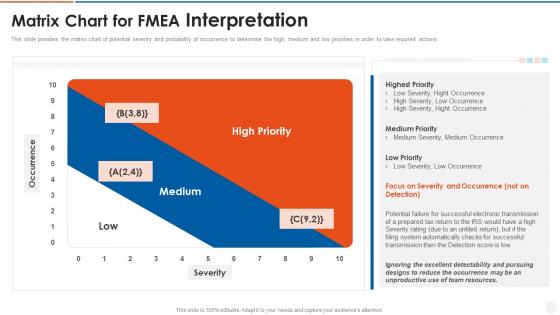
This slide provides the matrix chart of potential severity and probability of occurrence to determine the high, medium and low priorities in order to take required actions.
People who downloaded this PowerPoint presentation also viewed the following :
Failure mode and effects analysis fmea matrix chart for fmea interpretation with all 6 slides:
Use our Failure Mode And Effects Analysis FMEA Matrix Chart For FMEA Interpretation to effectively help you save your valuable time. They are readymade to fit into any presentation structure.





FAQs for Failure mode and effects analysis fmea matrix chart
FMEA is basically about figuring out what could go wrong before it actually does. Think of it like being a detective - you map out potential failures and their ripple effects. Then you assign risk numbers so you know which problems to tackle first instead of just randomly fixing stuff. Honestly, it's way more useful than it sounds on paper. Start with your most critical processes and you'll probably find failure modes nobody even considered. It's like having a crystal ball but with way more spreadsheets involved!
So basically, Design FMEA is for catching product failures while you're still developing stuff. Process FMEA looks at your manufacturing steps - like where things could go wrong on the production line. System FMEA is more big picture, checking how all your components work together. Design helps before you build anything. Process saves you from production nightmares later. System catches those annoying interface issues between parts. They actually work pretty well together if you do them right. Just start with whatever matches where you are - designing something? Go with Design FMEA first. Makes the most sense.
Get your team together first and nail down what you're actually analyzing. Next, brainstorm all the ways things could go wrong, then figure out what causes those failures and how bad they'd be. You'll assign severity, occurrence, and detection scores - honestly, this part's pretty boring but you gotta do it. Those scores give you RPNs so you know which problems to tackle first. Once you fix stuff, recalculate everything to see if it actually worked. Oh, and write it all down or you'll forget half of what you did!
Get your cross-functional teams together right from the start - engineers, quality, ops, the whole gang. Don't wait for stuff to break first. Map out what could go wrong, then rank those failure modes by how bad they'd be and how likely. Honestly, most teams I've worked with totally rush this step and regret it later. Hit the scary high-risk stuff first. Keep everything in a spreadsheet that you actually maintain (not just create once and forget). Oh, and make this part of your regular design reviews - can't be a one-time thing.
Dude, you absolutely need a cross-functional team for FMEA - like, it won't work otherwise. Get design, manufacturing, quality, and field service people together because they all spot different failure modes. Manufacturing catches assembly problems design never thinks about. Field service? They know how customers actually break stuff (and wow, some of those stories...). The whole idea is combining everyone's knowledge to find potential failures before they bite you. Just make sure you get the right people from the start - saves you so many headaches down the road. Short meetings work better too, honestly.
Use your team's 1-10 scales for both likelihood and severity. Likelihood is basically how often this failure actually happens - check your historical data, test results, field reports. Severity measures the impact if it goes wrong. Annoying glitch or total catastrophe? Here's the thing though - most FMEAs tank because people just guess at the numbers. You've gotta pull in the folks who actually touch this stuff daily. They know what really breaks and why. Their input makes the difference between useful analysis and just paperwork nobody trusts.
So for FMEA software, ReliaSoft XFMEA and IQS FMEA are pretty solid dedicated options. APIS IQ-FMEA too. Honestly though? Excel works fine if you're not dealing with huge teams - just gets messy when everyone's collaborating. Minitab Quality Companion has FMEA built in with other quality stuff, which is nice. TeamCenter does the same thing. My buddy at work swears by the free trials approach - just download 2 or 3 and see what doesn't make you want to throw your laptop. Really depends on your team size and how complex your processes are.
Don't treat FMEA like some separate thing you do once and forget about. Connect those action items straight into your corrective action system. Update your work instructions based on what you find, and make sure your control plans actually reflect the preventive stuff you identified. Honestly, the biggest mistake I see is people doing this as a checkbox exercise. Review your FMEAs during management meetings and update them when processes change. The real trick? Make those FMEA outputs visible in daily work - update procedures, training, inspection criteria. Map out where each recommendation should live in your current docs first.
Focus on RPN reduction first - compare before and after numbers. Then track defect rates, customer complaints, and warranty costs. Most teams I know also measure how many critical failure modes actually got fixed and if the fixes worked. But here's the thing - I've watched so many FMEAs become paperwork exercises that nobody follows up on. What really matters? You're catching problems during design instead of after launch. Track your detection rates there. Also measure field surprises - are you still getting blindsided by issues customers find first? Pick 2-3 metrics your boss cares about and stick with those consistently.
Honestly, update your FMEA whenever something big changes - new equipment, different processes, or after any incidents. Also do a full review once a year minimum, even when things seem stable. It's kinda like maintaining your car before it breaks down, you know? New failure modes can pop up over time, and you'll want to check if your current safeguards are actually working. The trick is building it into your regular improvement routine. Otherwise it just becomes another useless document sitting in a filing cabinet somewhere.
FMEA is honestly a lifesaver for compliance stuff. You're basically documenting all the ways things could go wrong upfront, which is exactly what regulators want to see. FDA loves this for medical devices - gives them that systematic risk management approach they're always asking for. Automotive standards like ISO/TS 16949 pretty much require this kind of failure analysis too. Here's the thing though - you've got to keep updating it as your process changes. I learned that the hard way when auditors showed up and my FMEA was like six months old. But when it's current? Makes those regulatory visits way less stressful since you can actually show you're on top of the risks.
Think of RCA as FMEA's partner in crime - FMEA predicts what might break, while RCA figures out what actually broke and why. Super useful combo, honestly. Take your RCA findings and feed them back into your FMEA updates. Real failure data beats theoretical guessing every time. You'll start seeing patterns you missed before. Short version: FMEA prevents problems, RCA learns from them. When you cycle those RCA discoveries back into your risk assessments, your predictions get way sharper. It's like having hindsight work for you instead of against you.
Scope creep will kill you - everyone wants to analyze every tiny thing and you'll get buried. Getting the right people there is a nightmare since they're all swamped. Half the team thinks it's just pointless paperwork anyway, which is frustrating. Start with a small pilot to prove it works. Be super clear about boundaries upfront. You need someone who actually knows the process running things, not just any random person. Focus on the big failure modes first instead of trying to cover everything. Oh, and do short sessions - nobody wants to sit through a 4-hour meeting.
Yeah, totally doable! Break your FMEA into sprint-sized pieces instead of trying to boil the ocean upfront. Just focus on whatever features you're actually building that iteration. I've watched teams get completely stuck doing these massive risk analyses that never end - such a waste of time. Keep the assessments simple and update them when you get real feedback from testing or users. Oh, and treat it like a living doc that grows with your product. Don't fall into that trap of thinking it's some one-time thing you check off and forget about.
Dude, you should totally bring suppliers into your FMEA sessions. They know their stuff inside and out, so they'll catch failure modes you'd never think of. I've seen this work so well - like, way better than trying to guess what could go wrong from our end. It's not just about catching problems early either. Your supplier relationships get stronger because you're actually working together on solutions instead of playing the blame game later (which, let's be honest, sucks for everyone). Plus they're way more invested in fixing issues fast when they helped identify them. Start with your most critical suppliers first.
-
Excellent products for quick understanding.
-
Best Representation of topics, really appreciable.