

Failure mode and effects analysis fmea powerpoint presentation slides





Try Before you Buy Download Free Sample Product
 Impress Your
Audience
 100%
Editable
 Save Hours
of Time


FMEA is a technique that various companies use to detect product failures or defects. It is a qualitative and highly structured process used by analysts looking to reduce the chances of faults by detecting problems and their possible repercussions. Here is a professionally designed template on Failure Modes and Effect Analysis FMEA that is useful for the corporates specifically production companies that want to identify potential risks regarding occupational and health hazards and environmental hazards. This can also be used by the companies that have just initiated a new process and want to identify the potential threats or failure in the process. The deck covered the details related to sections such as FMEA process overview, team structure and responsibilities, possible effects and cause of the failure, Severity, Occurrence, and Detection SOD ranking, risk assessment, action steps to eliminate the failure, RPN Risk priority number calculations, etc. The presentation covers critical steps involved in the process, analysis of the process, fundamental failure modes, potential effects of failure mode, FMEA scoring regarding SOD, etc. Customize this 100 percent editable template now.
People who downloaded this PowerPoint presentation also viewed the following :
Content of this Powerpoint Presentation
Slide 1: This slide displays title i.e. 'Failure Mode and Effects Analysis (FMEA)' and your Company Name.
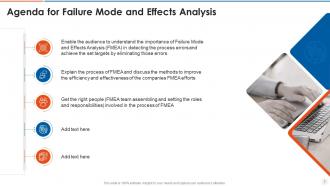
Slide 2: This slide presents agenda.
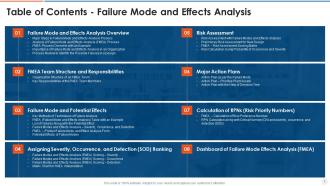
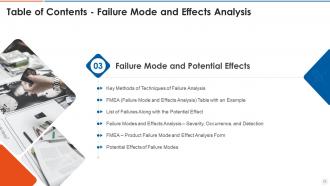
Slide 3: This slide exhibits table of contents.
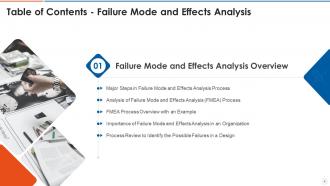
Slide 4: This slide depicts title for five topics that are to be covered next in the template.
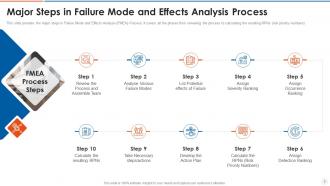
Slide 5: This slide provides the major steps in Failure Mode and Effects Analysis (FMEA) Process.
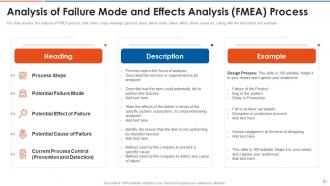
Slide 6: The slide provides the analysis of FMEA process, that covers major headings (process steps, failure mode, failure effect, failure cause etc.).
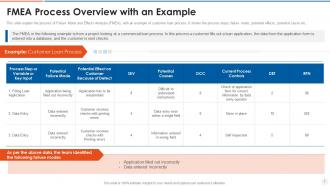
Slide 7: This slide explain the process of Failure Mode and Effects Analysis (FMEA), with an example of customer loan process.
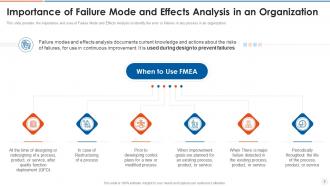
Slide 8: This slide provides the importance and uses of Failure Mode and Effects Analysis to identify the error or failures in any process in an organization.
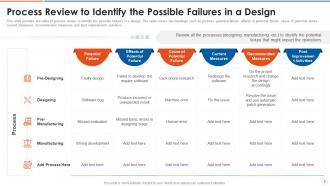
Slide 9: This slide provides the table of process review to identify the possible failures in a design.
Slide 10: This slide depicts title for two topics that are to be covered next in the template.
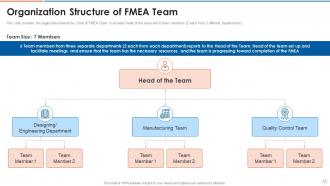
Slide 11: This slide provides the organization/hierarchy chart of FMEA Team.
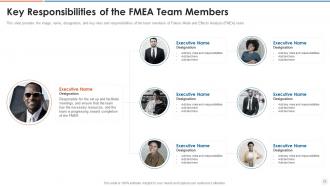
Slide 12: This slide provides the image, name, designation, and key roles and responsibilities of the team members of FMEA team.
Slide 13: This slide depicts title for six topics that are to be covered next in the template.
Slide 14: This slide provides the key details (description, reason to choose and comments) for various methods of failure analysis.
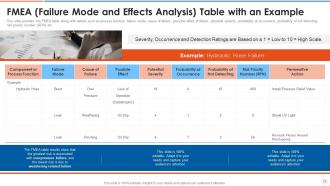
Slide 15: This slide provides the FMEA table along with details such as process function, failure mode, cause of failure, etc.
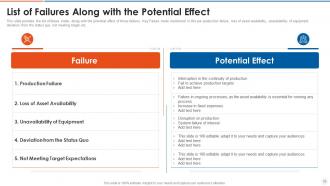
Slide 16: This slide provides the list of failure mode, along with the potential effect of those failures.
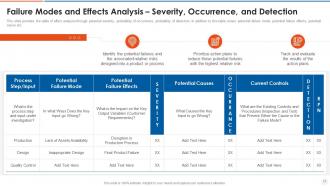
Slide 17: This slide provides the table of effect analysis through potential severity, probability of occurrence, probability of detection.
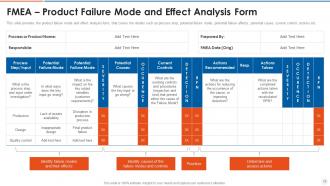
Slide 18: This slide provides the product failure mode and effect analysis form, that covers the details such as process step, potential failure mode, etc.
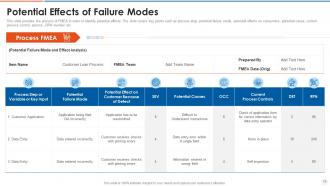
Slide 19: This slide provides the process of FMEA in order to identify potential effects.
Slide 20: This slide depicts title for four topics that are to be covered next in the template.
Slide 21: This slide provides the score of FMEA process based on potential severity.
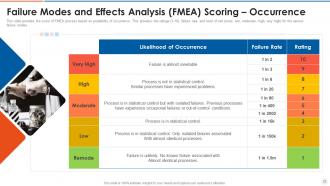
Slide 22: This slide provides the score of FMEA process based on probability of occurrence.
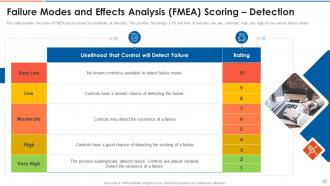
Slide 23: This slide provides the score of FMEA process based on probability of detection.
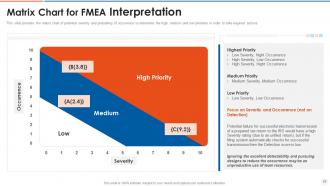
Slide 24: This slide provides the matrix chart of potential severity and probability of occurrence to determine the high, medium and low priorities.
Slide 25: This slide depicts title for four topics that are to be covered next in the template.
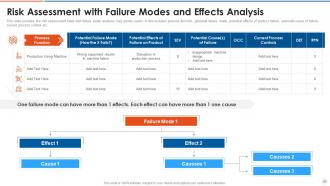
Slide 26: This slide provides the risk assessment table with failure mode analysis.
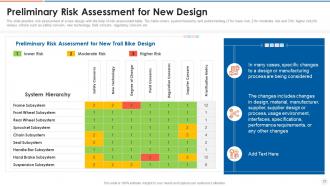
Slide 27: The slide provides risk assessment of a new design with the help of risk assessment table.
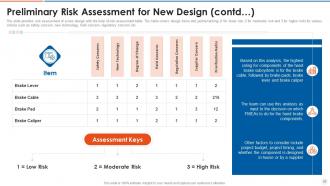
Slide 28: The slide provides risk assessment of a new design with the help of risk assessment table.
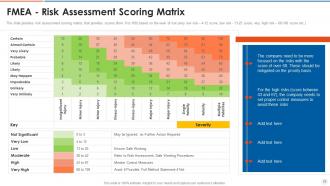
Slide 29: The slide provides risk assessment scoring matrix, that provides scores (from 0 to 100) based on the level of risk.
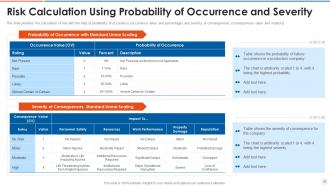
Slide 30: The slide provides the calculation of risk with the help of probability of occurrence and severity of consequences.
Slide 31: This slide depicts title for three topics that are to be covered next in the template.
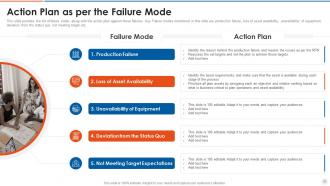
Slide 32: This slide provides the list of failure mode, along with the action plan against those failures.
Slide 33: This slide provides the organization’s action plans against asset unavailability failure.
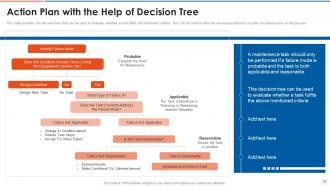
Slide 34: This slide provides the decision tree that can be used to evaluate whether a task fulfils the mentioned criteria.
Slide 35: This slide depicts title for two topics that are to be covered next in the template.
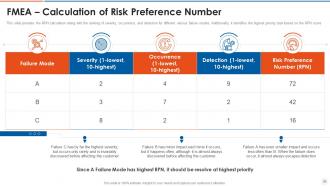
Slide 36: This slide provides the RPN calculation along with the ranking of severity, occurrence, and detection for different various failure modes.
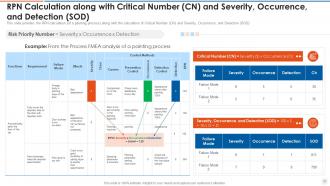
Slide 37: This slide provides the RPN calculation (of a painting process) along with the calculation of Critical Number (CN) and Severity, Occurrence, etc.
Slide 38: This slide depicts title for three topics that are to be covered next in the template.
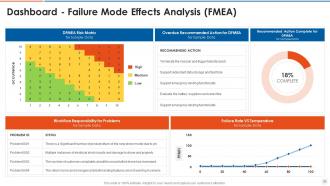
Slide 39: This slide presents Dashboard - Failure Mode Effects Analysis (FMEA).
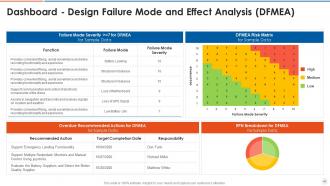
Slide 40: This slide exhibits Dashboard - Design Failure Mode and Effect Analysis (DFMEA).
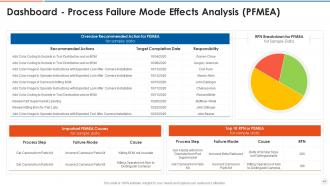
Slide 41: This slide illustrates Dashboard - Process Failure Mode Effects Analysis (PFMEA).
Slide 42: This is the icons slide.
Slide 43: This slide presents title for additional slides.
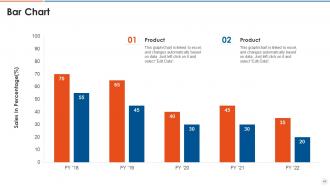
Slide 44: This slide exhibits yearly sales bar charts for different products. The charts are linked to Excel.
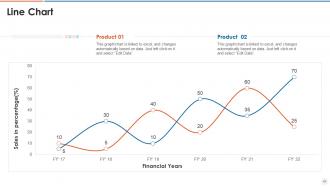
Slide 45: This slide depicts yearly sales line charts for different products. The charts are linked to Excel.
Slide 46: This slide shows about your company, target audience and its client's values.
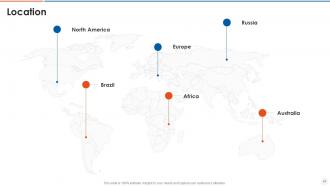
Slide 47: This slide highlights location of company in world map.
Slide 48: This slide presents your company's vision, mission and goals.
Slide 49: This slide exhibits yearly timeline.
Slide 50: This slide shows details of team members like name, designation, etc.
Slide 51: This slide displays puzzle.
Slide 52: This slide depicts 30-60-90 days plan for projects.
Slide 53: This slide depicts posts for past experiences of clients.
Slide 54: This is thank you slide & contains contact details of company like office address, phone no., etc.
Failure mode and effects analysis fmea powerpoint presentation slides with all 62 slides:
Use our Failure Mode And Effects Analysis FMEA Powerpoint Presentation Slides to effectively help you save your valuable time. They are readymade to fit into any presentation structure.













FAQs for Failure mode and effects analysis fmea
So FMEA is basically about spotting problems before they happen - way better than dealing with recalls later, trust me. You identify potential failure modes in your processes, figure out how likely they are and what damage they'd cause. Then prioritize which ones to tackle first. It's like having a crystal ball for your operation. Honestly, the prevention strategies you develop from this are gold. Detection methods too. Oh, and don't go crazy trying to analyze everything at once - start with your most critical stuff first. You'll save yourself major headaches down the road.
FMEA starts with individual parts failing and works up to see system-wide effects. Fault Tree Analysis does the opposite - begins with a major failure then digs down to find what caused it. HAZOP is different, focusing on process deviations and "what if" situations. I really like FMEA's systematic approach since it gives you those risk priority numbers to prioritize fixes. FTA works better for investigating failures that already happened. HAZOP's great during design reviews though - catches stuff you might miss otherwise. Go with FMEA if you need thorough failure documentation for your project.
Okay so FMEA has five basic steps. Start by defining your scope and getting a good cross-functional team together. Identify every possible failure mode for each component - this part can actually be pretty interesting once you get into it. Rate each failure on severity, how likely it is to happen, and whether you'd even catch it. Calculate your RPNs (risk priority numbers) to figure out what needs fixing first. Then tackle action plans for the worst stuff. Honestly, don't jump into anything too complex right away - pick something simple for your first go so everyone gets the hang of it.
So there's basically three types you'll run into: Design FMEA (DFMEA), Process FMEA (PFMEA), and System FMEA. DFMEA's what you want when developing new products or tweaking existing designs - catches failures before they're baked in. For manufacturing and assembly processes, go with PFMEA, especially on new production lines. System FMEA is honestly the trickiest one since it looks at how subsystems interact, but you can't skip it for safety-critical stuff like medical devices. My advice? Just match whatever project phase you're in right now - still designing something? Start with DFMEA.
So for FMEA risk, you'll want to calculate the Risk Priority Number (RPN). It's pretty simple math - just multiply Severity × Occurrence × Detection, each rated 1-10. Severity is how bad the failure would be, occurrence is how often it might happen, and detection measures if you can catch it before customers do. Honestly, anything over 100 should grab your attention right away. The highest RPNs are where you'll get the most impact from fixing things. I usually tell people to tackle those first since your time's limited anyway. Makes the whole process way more manageable.
You definitely need a team for FMEA - trying to do it solo is basically asking to miss half the problems. Get people from different areas: design, manufacturing, quality, maybe even suppliers if it makes sense. The best stuff happens when everyone's arguing (productively) about what could go wrong. Nobody has all the answers alone, which is honestly the whole point. Set clear roles from the start so meetings don't turn into chaos. Use structured brainstorming sessions and don't let that one person who loves to talk monopolize everything. Oh, and write down your reasoning as you go - trust me, you'll forget why you made certain decisions when review time comes around.
Update your FMEA during design reviews, before production ramp-up, and whenever you change designs or processes. Annual reviews are bare minimum - more often if your industry moves fast. Customer complaints or field failures? Time to pull it out again. New regulations too, obviously. Honestly, I'd set calendar reminders right now because these things are so easy to forget when you're buried in day-to-day chaos. Had a coworker who swore he'd remember, then went two years without touching theirs. The whole point is keeping it current with your product, not letting it collect dust on some server.
Be super specific when documenting failure modes - write "pump bearing seizure from poor lubrication" instead of just "pump fails." Include your severity/occurrence/detection ratings but explain why you picked those numbers. I've seen way too many FMEAs that are basically meaningless spreadsheets. Assign clear owners for each action item with actual deadlines. The real test? Someone should be able to grab your FMEA months later and immediately get what you were thinking and what still needs doing. Context is everything - don't make people guess your logic.
Honestly, digital FMEA tools are a lifesaver. No more giant Excel spreadsheets that crash your computer! The software handles RPN calculations automatically and tracks all your changes between versions. Real-time collaboration is huge too - everyone can jump in and work together instead of emailing files back and forth like it's 2005. Most tools come with failure mode libraries built in, which saves tons of time since you're not reinventing the wheel. Just make sure whatever you pick plays nice with your current quality system so you don't end up with data scattered everywhere.
Honestly, the biggest pain is teams thinking it's just more BS paperwork to deal with. Training everyone properly is a nightmare too. I've watched so many people rush through it or make everything way too vague - basically just checking boxes for compliance. Start with small pilot projects first. Show them it actually works. Get your leadership on board early or you're screwed. Invest in decent training for whoever's running these sessions. Here's the key though - you gotta actually use what comes out of it. Don't just file it away somewhere. Once people see FMEA catching real problems before they happen, they'll stop complaining about it.
So your FMEA scope depends on whatever regulations you're dealing with. Medical device stuff? FDA wants ISO 14971 compliance, which means way more detail than regular consumer products. Automotive has their AIAG standards, aerospace follows AS9100 - honestly, pharma is probably the worst for paperwork requirements. Each industry has its own templates and severity ratings you've got to stick to. Here's the thing though - figure out your regulatory framework before you start building anything. I learned this the hard way, but trying to retrofit compliance later is absolutely miserable. Trust me on that one.
FMEA helps you spot weak points before they bite you. Cross-functional teams work together on this stuff, which honestly makes it way better since everyone sees different failure modes. The risk scores are clutch - they show you exactly where to focus your improvement work instead of just guessing. Yeah, it feels like a pain initially, but once you get going it becomes this living document full of lessons learned. I'd update existing FMEAs every quarter or so. You'll catch things you totally missed before. It's basically future-proofing your processes with data you already have access to.
Honestly, start with your RPNs - if they're not dropping after you fix stuff, something's wrong. Track defect rates and customer complaints in whatever areas you analyzed. I'm big on measuring how many high-priority failures you actually tackled vs just identified, because let's be real, identifying problems is the easy part. Cost savings from prevented failures is solid too, though sometimes hard to calculate. Pick maybe 2-3 metrics that actually matter for your specific process. Check them quarterly - you'll start seeing patterns pretty quick if the FMEA is doing its job.
Just rank them by RPN - multiply severity, occurrence, and detection scores (usually 1-10). Higher numbers = bigger problems to tackle first. Don't try fixing everything at once though, you'll go crazy. Pick a cutoff like RPN > 100 and start there. I've watched teams burn out trying to address every single issue simultaneously - terrible idea. Focus your budget and time on the worst offenders first. Document action plans for the high-priority stuff and get someone to own each one right away. Work your way down the list as resources allow.
Oh man, cross-functional teams are a game-changer for FMEA. You really need those different viewpoints - like, manufacturing people will spot assembly nightmares that design folks would never think of. Quality catches stuff field service sees, and vice versa. Working in silos is honestly just asking to miss obvious problems. I've seen it happen so many times. Each person brings their real-world experience with the product, not just theory. You'll get way more failure modes identified and better risk assessments. Just make sure you don't stock the team with managers - grab people who actually touch the product daily.
-
Qualitative and comprehensive slides.
-
Great experience, I would definitely use your services further.