


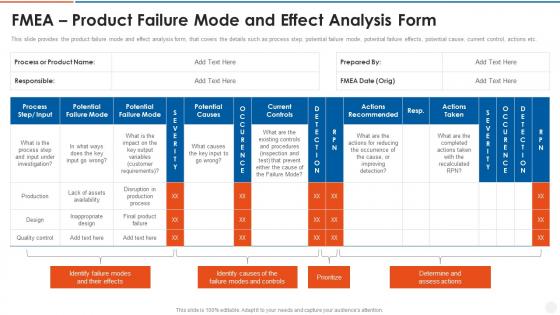
Fmea product failure mode and effect analysis form




Try Before you Buy Download Free Sample Product
 Impress Your
 Audience
 100%
100% Editable
 Save Hours
 of Time


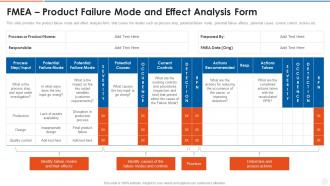
This slide provides the product failure mode and effect analysis form, that covers the details such as process step, potential failure mode, potential failure effects, potential cause, current control, actions etc.
People who downloaded this PowerPoint presentation also viewed the following :
Fmea product failure mode and effect analysis form with all 6 slides:
Use our FMEA Product Failure Mode And Effect Analysis Form to effectively help you save your valuable time. They are readymade to fit into any presentation structure.





FAQs for Fmea product failure mode and
FMEA is basically about catching problems before they bite you in the ass. You go through each part of your product or process and ask "what could break here?" Then figure out what happens if it does break. Think of it as productive paranoia - you're hunting for trouble while it's still cheap to fix. Way better than dealing with angry customers later. The trick is prioritizing based on how bad the failure would be, how likely it is, and whether you'd even catch it. Focus on the scary stuff first. I've seen teams waste weeks on minor issues while missing the big obvious disasters. Don't be those guys.
So FMEA is basically professional paranoia - you go through each part of your system and ask "what could go wrong here?" Then you figure out how likely each failure is and how bad it'd be if it happened. Honestly, it's one of those things that feels tedious until it saves your butt. The whole point is catching problems when they're still cheap to fix, not when you're already in production and everything's on fire. I'd start with whatever components scare you the most. You'll end up with a ranked list of risks so you're not just throwing resources at random problems.
So basically, Design FMEA happens when you're developing the product - you're asking "what could break or fail in this thing?" Component issues, material problems, that stuff. Process FMEA comes later when you're figuring out manufacturing. Now you're worried about equipment breaking down, workers making mistakes, weird environmental factors messing with production. I always think of it like this: Design FMEA stops you from shipping junk. Process FMEA stops you from screwing up good designs during manufacturing. You'd normally do Design first, then let that guide your Process FMEA when setting up the production line. Makes way more sense that way.
Set up 1-10 scales for each factor - just make sure your whole team agrees on what the numbers mean upfront. Severity is pretty straightforward: how screwed are you if this actually happens? Think safety issues, downtime, angry regulators. Occurrence gets weird since you're basically guessing how often something will break, but use whatever data you have or just go with your gut as a team. Detection is about whether your current checks will actually catch the problem before customers see it. Honestly, the hardest part isn't the math - it's getting everyone to rate things the same way consistently.
FMEA really needs cross-functional teams - they're what makes the whole thing work. Different departments catch different problems, you know? Manufacturing spots production issues designers would never think of. Design folks see potential failures that manufacturing might miss. Quality brings their own angle too. Having that mix means you'll find way more failure modes and actually understand the real risks. Oh, and the solutions end up being way more practical when everyone's involved from the start. Don't try doing this with just one department - you'll miss so much stuff it's not even funny.
So FMEA basically shows you where things are most likely to go wrong before they actually do. Those RPN numbers? They're your priority list - start with the highest scores since those are your biggest headaches waiting to happen. I love that it makes you actually think through failure scenarios instead of just winging it. Maybe you'll add extra checks to your process, redesign a weak component, or build in some backup systems. The key is don't ignore those high-risk items once you've identified them - that's like doing all this work for nothing.
Don't rush it - that's the biggest mistake I see. Get the right people in there, like actual experts who do the work daily, not just their managers who *think* they know what's happening. Be super specific about failure modes too. "Machine breaks" is useless - you need to know exactly how and why it fails. Honestly, treating it like a one-and-done thing is pretty pointless. You'll need to update it whenever processes change. I'd start small with one area first so you can figure out your approach before going company-wide.
Honestly, FMEA software is a game changer. No more wrestling with Excel formulas for RPN calculations - the tools handle all that automatically. Your whole team can jump in and update stuff in real-time, which beats emailing spreadsheets back and forth. The traceability features are clutch too since you can link failure modes directly to design changes. Documentation looks way more polished. I tried doing it manually for way too long before switching. Short version: get dedicated FMEA software instead of cobbling something together yourself.
So the easiest way is watching your Risk Priority Numbers drop after you put fixes in place. Customer complaints and warranty costs should go down too in those areas. I also track how fast we catch issues now versus before - that's usually pretty telling. Oh, and count how many of your predicted failures actually happened compared to surprises that blindsided you. The real test though? Way fewer panicked "all hands" meetings. Trust me on that one. Just pick 3-4 of these metrics, throw them on a simple dashboard, and review quarterly. Don't overcomplicate it.
Honestly, treat your FMEA like it's alive - update it at design reviews, prototype testing, production launch, whenever you make big changes. Don't just file it away after the first pass (I've watched way too many teams do that). New failure modes pop up during testing, customer complaints roll in, suppliers switch things up - all reasons to revisit it. Even do a yearly review if nothing major happened. You'll catch stuff you missed before, trust me. Oh, and actually put reminders in your calendar or you'll totally forget.
Yeah, FMEA actually has some solid wins you can look at. Toyota's probably the biggest example - they built it right into their whole production thing, which is honestly why their cars don't break down every five minutes. Boeing does the same for planes (thank god), and NASA started using it way more after Challenger happened. Medical stuff too - pacemakers, surgical tools, basically anything where if it fails someone's having a really bad day. Oh, and here's the thing - don't try to do everything at once. Pick your most critical processes first, then just build from there.
FMEA works great with Six Sigma's DMAIC process. Use it in the Analyze phase to spot potential failures, then bring it back during Improve to check your solutions. Honestly, I think it's one of the more flexible tools out there - you can pair it with control charts to track the critical stuff you found, or run it alongside DOE when testing fixes. The RPN scores are clutch here because they tell you exactly where to focus your Six Sigma work. I'd start with an FMEA on whatever process you're dealing with, then let those risk numbers guide where you put your energy. Way more efficient than just guessing.
Look, you want people who actually know your product inside and out - design engineers, quality techs, manufacturing guys, the whole crew. Cross-functional is huge here. But honestly? The magic happens when you get folks who'll push back and ask the tough "what if" questions instead of just nodding along. Everyone needs basic FMEA training first though, otherwise you'll waste half the meeting explaining what severity ratings mean. Oh, and don't forget the subject matter experts - they're the ones who'll catch stuff others miss. Get your core team trained up, then pull in the right technical people for each specific analysis you're doing.
FMEA's pretty much required by most regulators now - FDA, ISO 13485, automotive stuff like ISO/TS 16949. They all want to see systematic risk analysis, and honestly FMEA is perfect for that. It's one of those tools that actually works on multiple levels. You get your documentation requirements covered while fixing real process issues. Quick tip though - definitely check what standards hit your industry first. They usually lay out exactly where FMEA should fit in your quality system, which saves you from guessing. Way better than trying to retrofit it later.
So once you've got your failure modes mapped out, rate each one on severity, occurrence, and detection using a 1-10 scale. Multiply those three numbers together - that's your RPN. Higher numbers = bigger problems that need attention first. I'd tackle the top 3-5 RPNs and create action plans for those. Document it all so you can track what's working (and what isn't). The math part's pretty straightforward, but honestly the hardest thing is getting your team to actually follow through on the fixes. Don't spread yourself too thin trying to address everything at once.
-
Editable templates with innovative design and color combination.
-
Great quality product.