


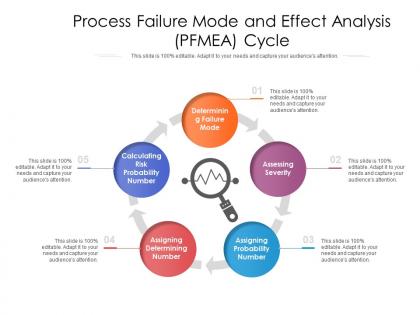
Process failure mode and effect analysis pfmea cycle




Try Before you Buy Download Free Sample Product
 Impress Your
 Audience
 100%
100% Editable
 Save Hours
 of Time


Our Process Failure Mode And Effect Analysis PFMEA Cycle are explicit and effective. They combine clarity and concise expression.
People who downloaded this PowerPoint presentation also viewed the following :
Process failure mode and effect analysis pfmea cycle with all 2 slides:
Give your audience a fulfilling experience. They will find our Process Failure Mode And Effect Analysis PFMEA Cycle elevating.

FAQs for Process failure mode and effect
So you'll need your process steps mapped out first - grab that flow diagram if you have one. Then work through potential failure modes for each step, plus what happens when things go wrong and what causes them. Don't forget your current controls too. The RPN calculation is where it gets interesting - you rate severity, occurrence, and detection, then multiply those numbers together. Higher scores = bigger problems to tackle first. Honestly, the math part is pretty straightforward once you get the hang of it. Document who's gonna fix what, and you're golden. It's basically your roadmap for keeping processes from completely falling apart.
PFMEA is basically your early warning system for catching manufacturing screwups before they cost you serious money. Go through each process step and figure out what could go wrong, then rank those failures by how bad they'd be and how likely they are to happen. Build in safeguards to either prevent the issues or spot them fast. Honestly, it's way better than constantly putting out fires after things break. The cool part? Keep updating it as your processes evolve - that's where you really start seeing your quality numbers improve. Start with whatever processes scare you most.
First thing - get the right people in the room. Engineers, operators, quality team, whoever actually touches this process day-to-day. Map out each step, then brainstorm what could fail at every stage. You'll rate severity, occurrence, and detection to get your RPN scores. Fair warning though - these sessions drag on forever sometimes, but that's honestly where you find the good stuff. Make sure someone's taking notes (not just on a laptop where it disappears into the void). Assign owners for the big issues. Most important part? Actually follow up afterward, or you've just wasted everyone's time.
So basically you go through each process step and ask "what could possibly go wrong here?" I always start with the process flow diagram and just brainstorm everything - equipment breaking down, people screwing up, bad materials, weird environmental stuff. The operators are honestly your best resource since they deal with the actual headaches every day. Don't just write "pump failure" though - be specific like "pump can't maintain pressure." Also, tackle your most critical steps first since that's where you'll get the biggest bang for your buck. It's kind of like being a professional pessimist, but in a useful way.
So RPN is how you figure out what to tackle first in your PFMEA. Multiply severity, occurrence, and detection scores - gives you 1 to 1000. Higher numbers = bigger problems that need fixing ASAP. Pretty straightforward math, honestly. But here's the thing - don't follow it blindly. Sometimes you'll get a lower RPN on something that could kill someone, just because it rarely happens. That still deserves attention. Start with your highest RPNs and work down, but use your brain too. It's more of a ranking tool than gospel.
Honestly, cross-functional teams are a game changer for PFMEA. You'll catch way more failure modes when you've got manufacturing, quality, design, and ops all sitting together. Each person sees risks others would miss based on what they deal with daily. Your severity and occurrence ratings get way more accurate too - no more engineering tunnel vision screwing things up. The best part? People actually follow through on action plans when they helped create them. Oh, and grab at least one person from each department that's affected. Trust me on this one.
Don't just copy templates - every process is different, so you need actual risks, not textbook ones. The biggest mistake? Being too generic with failure modes. Get your operators and maintenance people involved early since they know where stuff really breaks down. Rushing through severity ratings is tempting (honestly, I've done it), but it'll bite you later. Look at how the process actually runs, not the fantasy version on paper. Also, if you don't update it regularly, it's just another useless document collecting dust. Your operators will thank you for involving them from the start.
So basically, DFMEA is all about the design - like "what if we screwed up the actual product specs?" PFMEA hits later when you're dealing with the manufacturing side. What could break during assembly, that kind of thing. You'll want to tackle DFMEA first while you're still messing around with the design. Then PFMEA comes in once you know how you're actually gonna build it - tooling, processes, all that jazz. Honestly, I always think of them as covering your ass twice. Different problems, different stages. Both pretty necessary though, especially if you don't want production headaches later.
Honestly, start simple with a decent template - even Visio works better than you'd think if budget's tight. ReliaSoft XFMEA and APIS IQ-FMEA are solid dedicated options that'll handle the math automatically. For bigger operations, something like MasterControl gives you PFMEA plus other quality tools in one place. But here's the thing - don't get caught up chasing the fanciest software right away. Figure out your actual process first, then upgrade once you know what features you'll actually use. I've seen too many teams blow money on overcomplicated systems they barely touch.
You can actually fold PFMEA into your current QMS without much hassle. Map your PFMEA outputs straight to control plans and work instructions - ISO 9001 already wants risk-based thinking anyway, so you're not doubling up on work. The trick is making sure PFMEA findings automatically update your quality procedures and training stuff. Honestly, I'd get one person to champion this whole thing at first. Otherwise it'll just sit there like every other "great process improvement" that never gets used. Oh, and make sure it feeds directly into your inspection criteria - that's where you'll see the real value.
AIAG-VDA FMEA is definitely what you want - it's the gold standard since they combined the American and German methods. Pretty solid stuff. For automotive, there's ISO/TS 16949, and aerospace folks use AS9100. But honestly? Most places I've seen just go with AIAG-VDA because it works across industries. IEC 60812 pops up sometimes for general failure analysis too. Start with the AIAG-VDA handbook though - walks you through their seven-step process and has all the templates. Way easier than trying to figure it out from scratch.
Don't let your PFMEA become another dead document collecting dust. Get your operators involved - they spot stuff you'll never see sitting at a desk. I'd start with quarterly reviews for most processes, but honestly, update it whenever you change something or find new failure modes. Monthly reviews work better for your riskiest processes until it becomes second nature. Oh, and here's something most people skip: track your actual failures against what you predicted. That's gold for making your risk assessments way more accurate. Pick one high-risk process first and commit to it.
Look, PFMEA is basically your best friend for regulatory compliance. You're systematically documenting all the ways things could go wrong and how you'll prevent it. For pharma stuff, it maps straight to FDA requirements like 21 CFR Part 820. Automotive? IATF 16949 standards. Regulators eat this up because you're being proactive about risk - honestly, they love when you do their job for them. The whole documentation trail helps with validation and audits too. Just figure out which specific regs you need to hit first, then build your analysis around those requirements from the start.
Start with the RPN - multiply your severity, occurrence, and detection ratings. Highest numbers get priority, but honestly? Sometimes you've gotta ignore the math a bit. A high-severity safety issue might need fixing even if the RPN isn't the absolute highest. Look for patterns too - if several failure modes stem from the same root cause, tackle that. My old boss used to say focus on what'll hurt people first, then work down from there. Grab the quick wins while you're planning the bigger fixes. Don't get too caught up in perfect prioritization - just start somewhere logical.
Yeah, PFMEA totally works for service stuff! Just treat your service like any other process. Map out every customer touchpoint, then figure out what could blow up at each step - late responses, mixed messages, tech crashes, whatever. Banks and hospitals do this constantly. The key is getting super specific about failure modes instead of staying vague. Honestly, I'd start with your biggest customer-facing processes first since those hurt the most when they break. Work backwards from there and you'll catch way more issues before they happen.
No Reviews