

Blue Ocean Strategy Framework For The Organization Ppt Professional Show




Try Before you Buy Download Free Sample Product
 Impress Your
 Audience
 100%
100% Editable
 Save Hours
 of Time


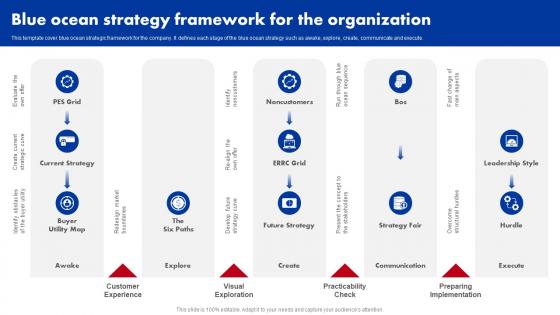
This template cover blue ocean strategic framework for the company. It defines each stage of the blue ocean strategy such as awake, explore, create, communicate and execute.
People who downloaded this PowerPoint presentation also viewed the following :
Blue Ocean Strategy Framework For The Organization Ppt Professional Show with all 6 slides:
Use our Blue Ocean Strategy Framework For The Organization Ppt Professional Show to effectively help you save your valuable time. They are readymade to fit into any presentation structure.





FAQs for Blue Ocean Strategy Framework For The Organization
Blue Ocean Strategy’s key principles include value innovation, focusing on non-customers, and reaching beyond existing demand, alongside sequencing strategic moves and overcoming organizational hurdles. These approaches streamline resource allocation by creating uncontested market space, enabling organizations—like retailers and hospitals—to achieve both differentiation and low cost, ultimately delivering enhanced profitability and sustained competitive advantage.
Companies effectively identify and create untapped market spaces by analyzing non-customer behavior, exploring complementary product/service offerings, and challenging industry assumptions, ultimately revealing blue oceans of opportunity. These strategies enable organizations to move beyond competitive rivalry, with many institutions finding that focusing on value innovation—simultaneously pursuing differentiation and low cost—delivers sustainable growth and enhanced profitability.
Innovation is central to a Blue Ocean Strategy, enabling organizations to simultaneously pursue differentiation and low cost through entirely new value propositions. These approaches redefine industry boundaries by creating uncontested market space, rather than competing within existing ones, with many healthcare and retail firms finding success through novel service delivery. Ultimately delivering enhanced customer experiences and significant competitive advantage, innovation streamlines resource allocation and fosters sustainable growth in an increasingly competitive landscape.
Blue Ocean Strategy diverges from traditional approaches by focusing on creating uncontested market space, rather than competing in existing ones, presenting both challenges and opportunities. While conventional strategies prioritize beating rivals within defined industry boundaries, this innovative approach emphasizes value innovation through simultaneously pursuing differentiation and low cost. With many organizations finding that proactively shaping demand delivers substantial growth, it enables enhanced profitability and ultimately secures a lasting competitive advantage in an increasingly dynamic landscape.
Blue Ocean Strategy case studies include Cirque du Soleil, Nintendo Wii, Southwest Airlines, Dyson, and Yellow Tail Wines. These organizations achieved success by redefining market boundaries through differentiation and low cost, ultimately delivering increased profitability and market share. With many finding that focusing on non-customers unlocks untapped demand and sustainable growth, these examples demonstrate a shift from competing within existing industries to creating uncontested market space.
Organizations measure Blue Ocean Strategy success by tracking value innovation, assessing the creation of new demand, and monitoring competitive irrelevance. These metrics reveal if initiatives deliver both differentiation and low cost, impacting market share across industries like retail and healthcare. Ultimately delivering sustainable growth and enhanced profitability, with many institutions finding that a shift in strategic focus yields significant competitive advantage.
Blue Ocean Strategy utilizes tools like the Strategy Canvas, Four Actions Framework, and the Six Paths Framework, enabling organizations to visualize competitive landscapes and identify untapped market spaces. These technologies streamline innovation by encouraging companies to raise, reduce, eliminate, and create value propositions, ultimately delivering competitive advantage and enhanced profitability with many institutions finding that a shift in focus unlocks substantial growth.
Companies transition from Red to Blue Oceans by focusing on value innovation, simultaneously pursuing differentiation and low cost, rather than competing within existing industry boundaries. These strategies involve reconstructing buyer value elements, eliminating and reducing some, raising and creating others, with many institutions finding that this unlocks new demand. Ultimately delivering significant competitive advantage and sustained growth in previously uncontested market space.
Blue Ocean Strategy presents both challenges and opportunities, often requiring organizations to overcome deeply ingrained assumptions about industry boundaries and competitive landscapes. While identifying and creating uncontested market space helps achieve high growth, it also demands significant investment in market research, value innovation, and a willingness to disrupt existing business models. With many institutions finding that successful implementation necessitates strong leadership, cross-functional collaboration, and ultimately delivering substantial competitive advantage and enhanced profitability.
Customer feedback is vitally important when developing a Blue Ocean Strategy, informing value innovation through understanding unmet needs, pain points, and aspirations. While traditional market research focuses on existing competition, Blue Ocean Strategy leverages insights from non-customers and adjacent industries, enabling organizations to identify opportunities for differentiation. With many institutions finding that actively soliciting diverse perspectives streamlines product development and ultimately delivers competitive advantage and enhanced customer experiences.
Businesses can leverage technology to discover Blue Ocean opportunities through data analytics, AI-powered market research, and social listening tools, ultimately identifying unmet customer needs and non-consumption patterns. These technologies streamline the process by revealing previously unseen market segments, enabling strategic combination of value innovation and differentiation, with many retail and financial services firms finding that predictive analytics pinpoint emerging trends.
Blue Ocean Strategy finds fertile ground in healthcare, retail, financial services, and even education, where competition is often fierce. These industries benefit from value innovation by simultaneously pursuing differentiation and low cost, creating uncontested market space. With many organizations finding that redefining industry boundaries enables significant growth, ultimately delivering enhanced customer experiences and competitive advantage.
Blue Ocean Strategy integrates into a business model by redefining value propositions, streamlining operations, and focusing on non-customers, ultimately creating uncontested market space. While requiring significant market research and potentially disrupting existing norms, it also enables organizations to enhance brand loyalty, accelerate growth, and minimize competitive pressures. With many financial services and healthcare institutions finding that this approach delivers both cost advantages and revenue opportunities, ultimately fostering sustainable competitive advantage and long-term profitability.
Blue Ocean Strategy misconceptions include believing it’s solely about technology, ignoring existing industry boundaries, or assuming it guarantees instant success, and that it’s easy to implement. These approaches often stumble because successful strategies require thorough market analysis, value innovation across multiple levers, and sustained commitment. With many organizations finding that diligent execution, coupled with a customer-centric approach, ultimately delivers competitive advantage and long-term profitability.
Cultural factors significantly influence Blue Ocean Strategy adoption through varying risk tolerances, innovation acceptance, and collaborative norms. While Western cultures often embrace disruptive change, others prioritize incremental improvements, presenting both challenges and opportunities. With many Asian and Latin American institutions finding that collective decision-making streamlines implementation, ultimately delivering enhanced market penetration and competitive advantage.
-
Best Representation of topics, really appreciable.
-
Thanks to SlideTeam, we have an ideal template to present all the info we need to cover. Their slides give our numbers and projections a more clear and enchanting look.