


Blue Ocean Strategy CD




Try Before you Buy Download Free Sample Product
 Impress Your
 Audience
 100%
100% Editable
 Save Hours
 of Time


Blue ocean is a business strategy that helps organizations create new market spaces blue oceans instead of competing in existing red oceans. Grab our insightfully crafted Blue Ocean Strategy template. It is based on value innovation principles, which focus on creating unique value propositions. It does so by combining and maximizing the factors of value and differentiation. Our Blue Ocean Shift tool and framework deck help organizations understand and navigate the shift from red to blue oceans. The strategy canvas and PMS map visualize and analyze an organizations current strategy. The Buyer Utility Map and Four Action Framework help identify areas for value innovation. The ERRC grid and Value Proposition Canvas aid firms in understanding and articulating their unique value proposition. Our Blue Ocean template further consists of the Sequence of Creation, which outlines the steps involved in creating a blue ocean. It additionally showcases the Strategy Fair and allows for collaboration and experimentation. Additionally, Our Blue ocean leadership styles module incorporates the Mind Map techniques for successful implementation. Finally, the Blue Ocean SWOT and Blue Ocean Balanced Scorecard comprehensively evaluate a companys blue ocean strategy. Get access right away.
People who downloaded this PowerPoint presentation also viewed the following :
Content of this Powerpoint Presentation
Slide 1: This slide introduces Blue Ocean Strategy. Commence by stating Your Company Name.
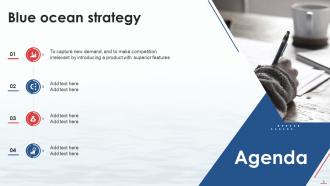
Slide 2: This slide depicts the Agenda of the presentation.
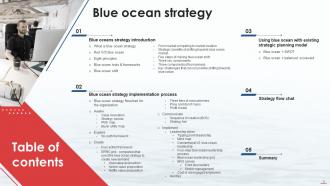
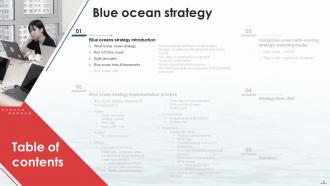
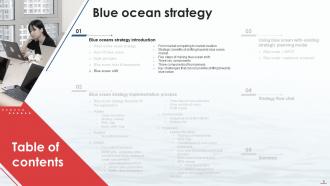
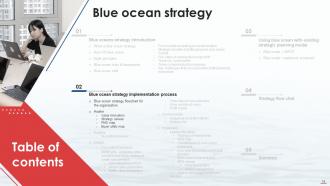
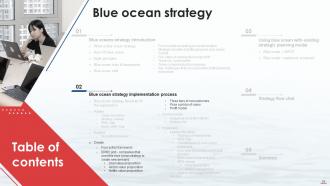
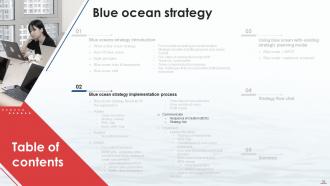
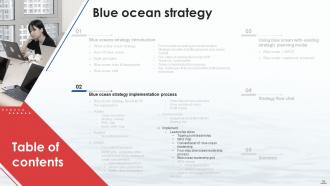
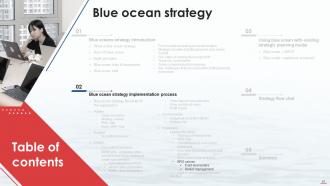
Slide 3: This slide elucidates the Table of contents.
Slide 4: This slide highlights the Title for the Topics to be covered further.
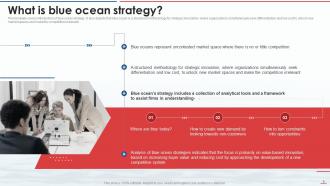
Slide 5: This template covers introduction of blue ocean strategy.
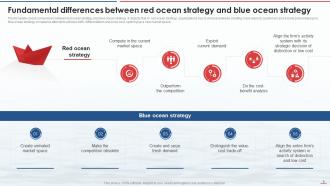
Slide 6: This template showcases the comparison between red ocean strategy and blue ocean strategy.
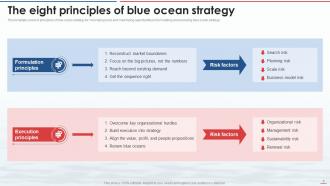
Slide 7: This template covers 8 principles of blue ocean strategy for minimizing risks and maximizing opportunities.
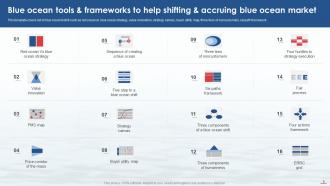
Slide 8: This template contains a list of blue ocean toolkit such as red ocean vs blue ocean strategy, value innovation, strategy canvas, etc.
Slide 9: This slide presents the Heading for the Contents to be discussed next.
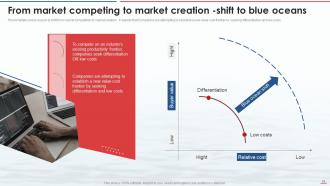
Slide 10: This template reveals the reason to shift from market competition to market creation.
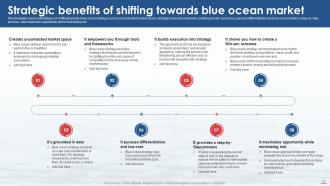
Slide 11: This slide delas with the Strategic benefits of shifting towards blue ocean market.
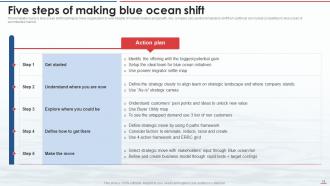
Slide 12: This slide lists the Five steps of making blue ocean shift.
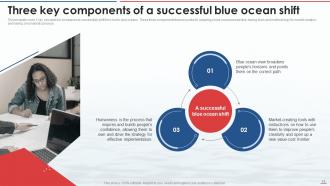
Slide 13: This slide highlights the Three key components of a successful blue ocean shift.
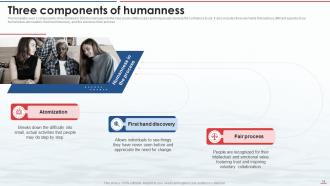
Slide 14: This slide mentions the Three components of humanness.
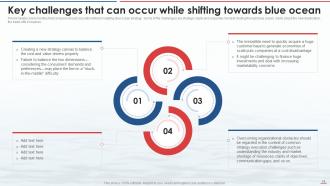
Slide 15: This slide focuses on the Key challenges that can occur while shifting towards blue ocean.
Slide 16: This slide represents the Title for the Ideas to be covered in the upcoming template.
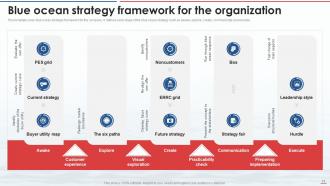
Slide 17: This template covers the blue ocean strategic framework for the company.
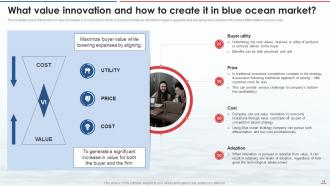
Slide 18: This slide Underlines the core values, features or utility of products or services deliver to the buyer.
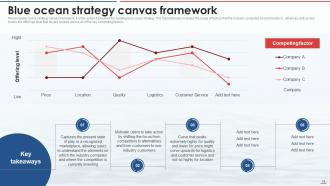
Slide 19: This template exhibits the strategy canvas framework.
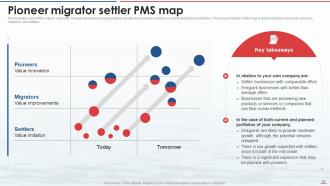
Slide 20: This template illustrates the PMS map for corporate management team pursuing profitable growth and to plot the company’s current and planned portfolios.
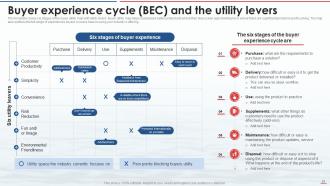
Slide 21: This template incorporates the six stages of the buyer utility map with utility levers.
Slide 22: This slide reveals the Heading for the Ideas to be discussed next.
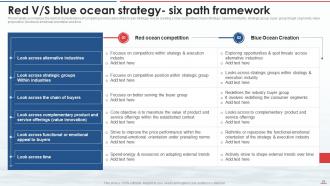
Slide 23: This template summarizes the distinct characteristics of competing in red oceans (Red Ocean Strategy) versus creating a blue ocean (Blue Ocean Strategy) based on industry, strategic group, buyer group/ target segments, etc.
Slide 24: This slide highlights the Title for the Components to be discussed next.
Slide 25: This template illustrates the ERRC grid framework.
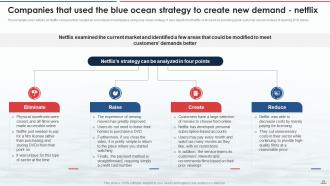
Slide 26: This template shows details on Netflix company that created an uncontested marketplace using blue ocean strategy.
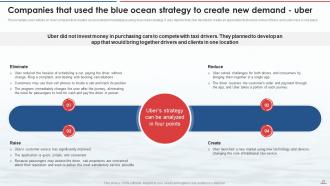
Slide 27: This template details on Uber company that created an uncontested marketplace using blue ocean strategy.
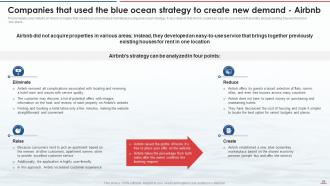
Slide 28: This template covers details on Airbnb company that created an uncontested marketplace using blue ocean strategy.
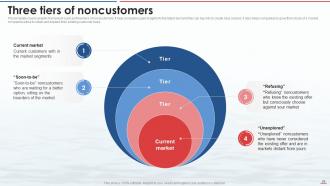
Slide 29: This template presents analytic framework such as three tiers of noncustomers.
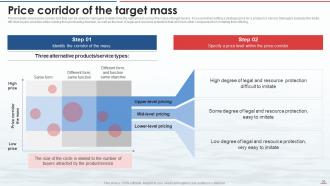
Slide 30: This template focuses on the price corridor tool that can be used by managers to determine the right price to unlock the mass of target buyers.
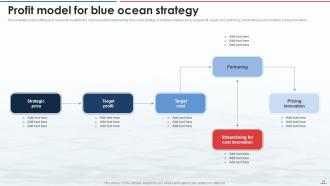
Slide 31: This template displays the Profit model for blue ocean strategy.
Slide 32: This slide incorporates the Heading for the Topics to be discussed next.
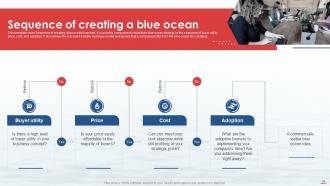
Slide 33: This template states the Sequence of creating blue ocean flowchart.
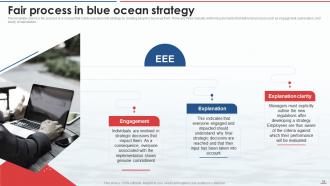
Slide 34: This template indicates E’s fair process is a concept that builds execution into strategy by creating people’s buy-in up front.
Slide 35: This slide shows the Title for the Topics to be covered further.
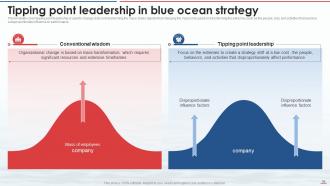
Slide 36: This template deals with the Tipping point leadership in blue ocean strategy.
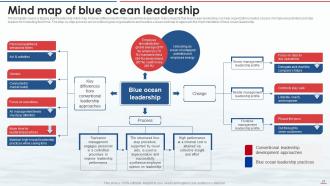
Slide 37: This template covers a tipping point leadership mind map.
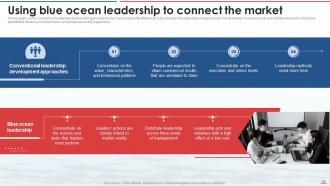
Slide 38: This slide focuses on Using blue ocean leadership to connect the market.
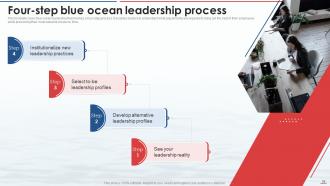
Slide 39: This template incorporates blue ocean leadership that involves a four-step process.
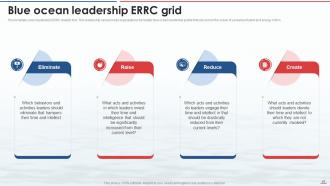
Slide 40: This template shows the leadership ERRC analytic tool.
Slide 41: This slide elucidates the Heading for the Components to be covered in the following template.
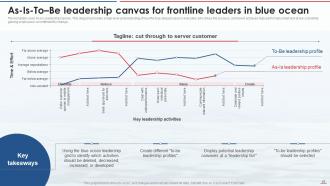
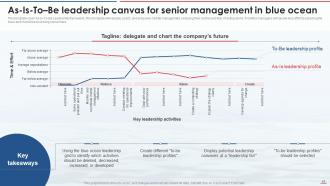
Slide 42: This template contains the As-Is Leadership Canvas.
Slide 43: This slidee illustrates the As-Is-To-Be Leadership framework.
Slide 44: This slide exhibits the Title for the Topics to be discussed next.
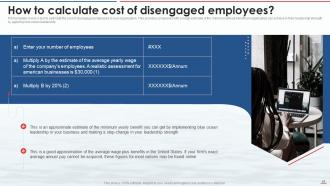
Slide 45: This template elucidates a tool to estimate the cost of disengaged employees in your organization.
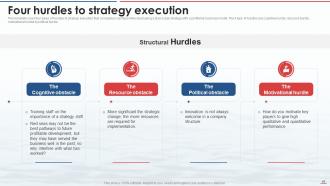
Slide 46: This slide focuses on the Four hurdles to strategy execution.
Slide 47: This slide highlights the Heading for the Ideas to be covered in the forth-coming template.
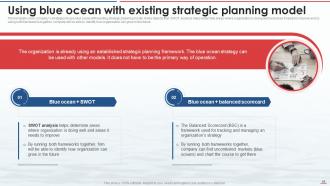
Slide 48: This slide deals with Using blue ocean with existing strategic planning model.
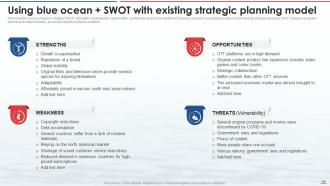
Slide 49: This template covers company’s strategic SWOT (strengths, weaknesses, opportunities, and threats) analysis to identify and analyze company's competitive position and to develop strategic planning.
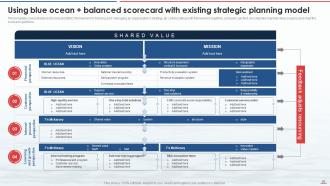
Slide 50: This slide provides information on Using blue ocean + balanced scorecard with existing strategic planning model.
Slide 51: This slide contains the Title for the Ideas to be discussed further.
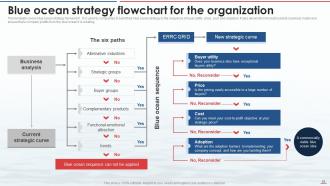
Slide 52: This slide illustrates the Blue ocean strategy flowchart for the organization.
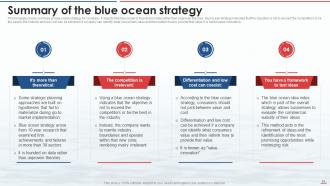
Slide 53: This template covers summary of blue ocean strategy for company.
Slide 54: This is the Icons slide containing all the Icons used in the plan.
Slide 55: The purpose of this slide is to depict some Additional information.
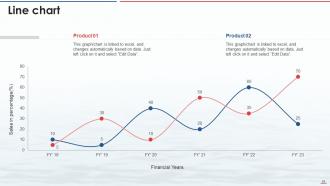
Slide 56: This slide presents the Line chart.
Slide 57: This template highlights the mission, vision, and goals of the company.
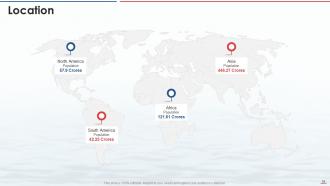
Slide 58: This slide represents the Organization's Location in terms of global presence.
Slide 59: This slide portrays the Company Targets.
Slide 60: This is the Puzzle slide with related imagery.
Slide 61: This slide elucidates the Organization Timeline.
Slide 62: This is the Idea generation slide for encouraging fresh ideas.
Slide 63: This slide contains the Post it notes for reminders and deadlines.
Slide 64: This is the Circular diagram with related imagery.
Slide 65: This is the Thank you slide for acknowledgement.
Blue Ocean Strategy CD with all 70 slides:
Use our Blue Ocean Strategy CD to effectively help you save your valuable time. They are readymade to fit into any presentation structure.







FAQs for Blue
So basically you stop fighting over the same customers and make competition irrelevant instead. Way less stressful tbh. Look at what everyone in your industry does exactly the same - that's probably where your opportunity is hiding. Netflix nailed this by ditching late fees and stores while creating the whole binge-watching thing we're all addicted to now. You eliminate the stuff that doesn't add value, cut costs on features nobody cares about, then boost quality where it actually matters. Oh and create something totally new that people didn't know they wanted. Start by listing those assumptions everyone takes for granted - then break them.
Okay so Blue Ocean Strategy is basically about doing both things at once - being different AND cheap. Most companies think they have to pick one, but value innovation throws that out the window. You find ways to give customers new value while cutting stuff they don't actually want (which saves you money). Instead of fighting over the same customers as everyone else, you're creating totally new demand. Honestly, it's way smarter than getting stuck in those brutal pricing wars. Next time that happens, just think: what can I eliminate, reduce, raise, or create instead?
Here's the thing about segmentation - it shows you where everyone's thinking is stuck in these weird boxes. Don't just target existing segments better. Look for customer groups getting totally ignored across different industries. Why do only fancy hotels have concierge services when every stressed professional could use that help? I always think the best opportunities are in those gaps competitors write off as "not our customer." Find unmet needs that cross multiple segments, or go after the underserved groups others dismiss. Your segmentation data should make you question what the whole industry assumes is normal.
Look, map out everything your industry does as "standard practice" first. Then ask yourself - what if we just ditched this entirely? Most of that stuff is honestly legacy bullshit that customers don't even want anymore. Challenge every single feature and service everyone offers. Which ones do people actually care about vs. what's just tradition? Cut the factors that cost money but add zero value. Dial back anything that's way over-engineered for what most customers need. This frees up resources to pour into areas where you can create real breakthrough value - that's your blue ocean right there.
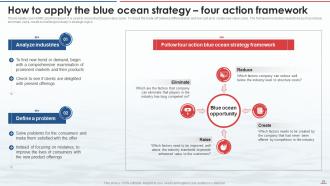
Start with the Strategy Canvas - it's super visual and you'll get that lightbulb moment about where opportunities are hiding. You'll also want the Four Actions Framework, which basically asks what to eliminate, reduce, raise, and create in your offering. Both are pretty much the backbone of Blue Ocean Strategy. The Six Paths Framework helps find new market spaces (heads up though, it's kinda overwhelming at first). There's the Buyer Experience Cycle too for spotting customer pain points. Honestly, just dive into the Strategy Canvas first since it maps out how you stack up against competitors across different factors.
Oh totally! Cirque du Soleil is like the perfect example - they mixed circus with theater instead of fighting regular circuses for customers. Netflix pulled the same move going from DVDs to streaming while Blockbuster was still obsessed with stores. Southwest found their thing with budget flights while big airlines battled over business travelers. Nintendo's Wii was genius too, honestly - they targeted families and casual players instead of the hardcore gamers. The whole trick is avoiding that direct competition by finding completely different audiences.
So basically, blue ocean strategy is about ditching that whole "fight over the same customers" thing. You know how every industry has companies just beating each other up on price? Super exhausting. Instead, you create totally new market space where you don't even have competitors yet. The trick is doing both - being different AND keeping costs low (which sounds impossible but isn't). Look at what everyone in your field assumes customers want. Then eliminate some stuff, create new things, raise or lower others. I actually think most companies overthink this part. Just map out what you're competing on now and shake it up.
Track the obvious stuff first - revenue growth and market share. But here's what really matters: are you actually pulling customers from totally new segments? That's the whole blue ocean thing, right? Watch your time-to-profitability too since you're not burning cash on competitive wars. Brand differentiation scores are solid metrics, plus honestly? Count how often competitors start copying you - that's validation right there. The big one though is your "value innovation gap" - basically how much more value you're delivering vs competitors at the same price point. That gap tells the real story.
Totally! Small businesses can crush bigger competitors with Blue Ocean Strategy - you just create new market spaces instead of going head-to-head. Big companies are slow and miss stuff that's right in front of them. You're nimble though, so find those underserved customer segments or pain points they ignore with their generic approach. While they're busy optimizing old processes, you can literally change the rules. I mean, they're kinda trapped by their own size. Map out what your industry fights over versus what customers actually want - there's usually a huge gap there. Build everything around filling that gap first.
Look, the hardest part is breaking your competitive habits - you're wired to crush competitors, so creating uncontested markets feels totally backwards. Your team will fight you on dropping existing customers and processes, even the crappy ones. Resource allocation becomes a nightmare because blue ocean strategies need upfront cash with zero guarantees. Honestly, most companies suck at the market research needed to spot these hidden opportunities anyway. Oh, and internal resistance is brutal. Start small with pilot programs first - builds confidence and shows it actually works before you go all-in.
Honestly, you've gotta make your team feel safe throwing out the weirdest ideas first - that's where the magic happens. Get people from different departments in the same room brainstorming together. Those "what if we totally ignored how this industry works" conversations? Pure gold. I'd probably dedicate like 20% of your regular meetings to just exploring completely new territory instead of waiting for some big quarterly strategy session. Oh, and make those assumption-challenging exercises a regular thing - you know, where you question everything you think you know about your market. It becomes addictive once people get into it.
So here's the thing - you really need to get into what customers are actually struggling with that nobody's fixing yet. Dig into their complaints and see what weird workarounds they're creating. That's pure gold right there. Market research isn't about crushing your competitors (though that's fun too). Focus on finding those gaps where people want something but can't get it anywhere. Map out all the annoying parts of the customer journey that everyone just accepts as "how it is." Look for underserved segments too. Sometimes the best opportunities are hiding with people the industry basically ignores.
Here's what I'd tell you - new tech is honestly your best shot at finding those untapped markets. Look at Uber, right? They used apps to completely avoid the whole taxi licensing nightmare. Pretty genius move. You want to find tech that solves the stuff customers hate most about your industry. The sweet spot is when you can slash costs AND offer something totally different - usually industries force you to pick one or the other. I'd start by listing your industry's biggest headaches, then see what emerging tech could eliminate them entirely. That's where the magic happens.
Honestly, the worst mistake is jumping into some "blue ocean" without checking if anyone actually wants what you're selling. I've watched so many startups build incredible products that just sat there. Don't get so caught up in being innovative that you forget your core strengths either. Also - and this might be obvious but whatever - competitors will follow you if you find something good. Test small first. Make sure there's real demand before going all in. You can't just assume people will want your new thing because it sounds cool to you.
Don't let competitors just waltz in and steal your thunder. Build stuff that's actually hard to copy - weird partnerships, processes only you know how to do. Never stop improving either, because the second you get comfortable, someone's gonna eat your lunch. Watch your customers like a hawk for new problems popping up. Honestly, most companies screw this up by thinking they're done once they find their sweet spot. Set up monthly check-ins or whatever to catch when things start getting crowded again. That way you can jump to the next big thing before everyone else piles in.
-
I am not the best at presentations but using SlideTeam’s PPT template made it easier for me. Thank you SlideTeam!
-
The pricing page of this website is very sorted. I felt no pain while buying the PPTs.