


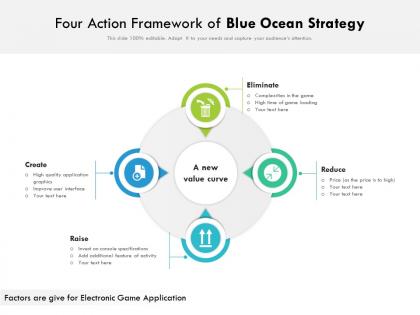
Four action framework of blue ocean strategy




Try Before you Buy Download Free Sample Product
 Impress Your
 Audience
 100%
100% Editable
 Save Hours
 of Time


Our Four Action Framework Of Blue Ocean Strategy are topically designed to provide an attractive backdrop to any subject. Use them to look like a presentation pro.
People who downloaded this PowerPoint presentation also viewed the following :
Four action framework of blue ocean strategy with all 2 slides:
Use our Four Action Framework Of Blue Ocean Strategy to effectively help you save your valuable time. They are readymade to fit into any presentation structure.
FAQs for Four action framework of
So the Four Actions Framework breaks down like this: eliminate stuff your industry just assumes it needs, reduce some factors way below what everyone else does, raise others way above standard, and create totally new things nobody's even thought of yet. Honestly, it sounds simple but questioning what everyone takes for granted is weirdly difficult when you're in the thick of it. You map out what your whole industry competes on right now, then run each thing through those four filters. That's where you'll spot the blue ocean opportunities - though I always forget which action to try first when I'm actually doing this myself.
So the Four Actions Framework is pretty straightforward - you ask four questions about your product. What can you completely eliminate? Like those fancy features nobody actually wants. Reduce stuff that's overcomplicated or costs too much. Then raise the bar on things your competitors suck at (this is where you can really shine). Create something totally new that doesn't exist yet. Honestly, the "create" part is my favorite because that's where the magic happens. Don't just copy what everyone else does - rebuild your whole value proposition from the ground up. Sketch it all out first, then focus on changes that'll make you stand out most.
Dude, this framework works everywhere - Southwest Airlines, Cirque du Soleil, Nintendo's Wii, Tesla. I've honestly seen it crush in healthcare, retail, even boring B2B stuff. What makes it so good? It forces you to question all the stupid assumptions your industry clings to. Works for tiny startups or massive companies equally well. My advice - start by listing everything your industry thinks is "just how things are done." That's where you'll find gold. Oh, and don't overthink it at first, just get the obvious stuff down on paper.
So basically you're doing surgery on your whole industry's playbook. Eliminate stuff competitors obsess over but customers don't actually care about. Reduce things that drain resources without adding real value. Then raise factors that matter more than anyone realizes, and create completely new things nobody's doing yet. The trick is doing all four moves at once - not just picking one. Most companies get stuck tweaking around the edges instead of questioning everything. Like, why does everyone compete on X when customers probably want Y? Start by listing what your whole industry fights over, then challenge each thing ruthlessly. That's where you'll find your opening.
Oh for sure! The Four Actions Framework works great for nonprofits. You'd cut wasteful programs and bureaucratic nonsense, dial back overhead costs and volunteer burnout, boost funding and community engagement, then build fresh partnerships or try new ways to deliver services. Honestly, I love when nonprofits actually ask themselves "does this stuff even help our mission?" Map out what you're currently doing vs. real results - might be eye-opening how much energy gets scattered around. It's all about focusing resources where they'll actually make a difference.
Look, most companies just tick boxes instead of actually questioning what their whole industry does wrong. They'll cut some tiny feature or shave costs a bit, but won't dare create something totally different. Honestly, it's like everyone's terrified of rocking the boat! You've got to question EVERYTHING your industry assumes is normal. Oh and here's the thing - teams rush through the "raise" and "create" parts without figuring out what actually bugs customers about current solutions. Start there. What makes your customers want to throw their laptop out the window?
Track metrics for each part - cost savings for what you eliminate/reduce, then customer satisfaction and new revenue for the stuff you raise/create. The hardest bit is measuring things you've never done before, but honestly that's where you'll see the biggest wins. Run some A/B tests or small pilots to see how people react to your new features. I'd set up a simple scorecard covering both the money you're saving and the value you're adding. Check it monthly - any longer and you'll miss important shifts in the data.
Honestly, customer feedback is everything with the Four Actions Framework. Without it, you're just making stuff up. Map their complaints to what you should eliminate, their "this is too much" comments to what needs reducing. Look for what they love but want more of - that's your "raise" category. The "create" part comes from those gaps they keep mentioning but nobody's addressed yet. I watched a whole team spend months on changes that customers didn't even care about because they never actually asked. Pretty painful to watch, tbh. Get their input before you make big moves, not after.
Work through one quadrant at a time with your team - jumping around kills momentum. Start with Eliminate: what's eating up resources for zero payoff? Then Reduce covers stuff that's way too complicated or overdone. Create is honestly the fun part - brainstorm what's missing that could actually change things. Raise means spotting what you're already good at but could dial up. Spend maybe 15-20 minutes on each section. Sticky notes work great since everyone can throw ideas up simultaneously. Don't filter anything at first - that weird idea might actually be brilliant. You can clean it up later anyway.
So the Four Actions Framework is basically how you actually DO Blue Ocean Strategy - like, it's the practical part. You've got four moves: eliminate, reduce, raise, create. Run your industry's key factors through each one. What can you cut completely to save costs? What should you dial down? Then figure out what to pump up or invent from scratch to give customers more value. I swear it sounds more complicated than it is. Just map out what everyone competes on first, then put each thing through those four filters. That's literally how you break away from your competition.
Honestly, the Four Actions Framework is a game-changer for getting your team on the same page. You map out what to eliminate, reduce, raise, and create - suddenly everyone's looking at the same picture instead of talking in circles. No more "let's do everything" meetings that go nowhere. The cool thing is it forces real trade-offs. Can't just pile on new stuff without deciding what you're ditching first. I've seen teams argue for hours until someone pulls this out, then boom - decisions start happening. Worth trying in your next strategy session, just don't expect miracles if people are being stubborn about their pet projects.
Yeah, it totally works with other frameworks! I usually run SWOT first, then use the Four Actions to dig into what weaknesses need eliminating. Customer journey mapping + Four Actions is honestly such a good combo - probably my favorite. You can also pair it with Porter's Five Forces when you're trying to create new value props. The thing is, having that strategic context beforehand makes your eliminate/reduce/raise/create decisions way smarter. Don't start with Four Actions cold - build it on top of whatever planning you're already doing.
Look at Netflix - they ditched late fees and physical stores, then cranked up convenience and content options. Cirque du Soleil? Got rid of animals and big-name performers but went all-in on artistic storytelling. Southwest basically wrote the playbook for budget airlines by cutting meals and assigned seats while boosting flight frequency and keeping prices low. Yellow Tail made wine less intimidating by dropping all that pretentious jargon and created something people actually wanted to drink (revolutionary, I know). My advice? Write down everything your industry thinks is "just how things work" and start questioning it all.
Always run your Four Actions stuff past your mission statement first - think of it as your compass. Does cutting this thing actually help our main goal? What about adding that new feature? I've watched teams get totally pumped about some cool innovation and then realize months later they're nowhere near where they started. Honestly happens way more than it should. Set up check-ins where you literally ask "does this support what we're trying to do?" If the answer's fuzzy, either fix it or ditch it. Oh, and put your mission statement somewhere everyone can see it during meetings.
Honestly, the hardest part is dealing with your own team fighting you on changes. People get weirdly attached to features that don't even matter anymore - they'll resist the "eliminate" stuff like crazy. Then when you try to "raise" or "create" new things, you realize you don't have the tech or skills for it. It gets messy fast! Oh, and measuring success becomes a nightmare since you're comparing totally different value propositions. My advice? Start with small pilots first. Test out those four actions on something low-stakes before you go big. Trust me on this one.
-
Visually stunning presentation, love the content.
-
Unique and attractive product design.
-
Nice and innovative design.
-
Understandable and informative presentation.
-
Content of slide is easy to understand and edit.
-
Excellent work done on template design and graphics.