


Netflix Blue Ocean Strategy Using Blue Ocean Plus Balanced Scorecard With Existing Strategic




Try Before you Buy Download Free Sample Product
 Impress Your
 Audience
 100%
100% Editable
 Save Hours
 of Time


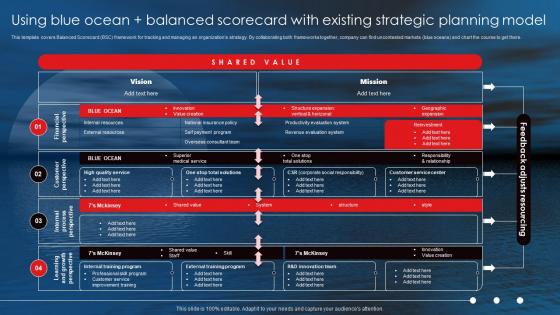
This template covers Balanced Scorecard BSC framework for tracking and managing an organizations strategy. By collaborating both frameworks together, company can find uncontested markets blue oceans and chart the course to get there.
People who downloaded this PowerPoint presentation also viewed the following :
Netflix Blue Ocean Strategy Using Blue Ocean Plus Balanced Scorecard With Existing Strategic with all 6 slides:
Use our Netflix Blue Ocean Strategy Using Blue Ocean Plus Balanced Scorecard With Existing Strategic to effectively help you save your valuable time. They are readymade to fit into any presentation structure.





FAQs for Netflix Blue Ocean Strategy Using Blue Ocean Plus Balanced Scorecard
Netflix’s Blue Ocean Strategy centered on disrupting traditional media by offering convenient, subscription-based streaming, eliminating late fees, and providing a vast library of content, while traditional companies focused on ownership and limited access. These technologies revolutionized home entertainment by streamlining content delivery, enhancing customer experiences, and ultimately delivering competitive advantage and significant market share, with many entertainment institutions finding that convenience trumps ownership.
Netflix created uncontested market space by prioritizing subscription-based streaming, eliminating late fees, and offering a vast content library, while traditional players focused on rentals and ownership. These technologies revolutionized home entertainment by delivering convenience, personalization, and on-demand access, with many media companies finding that adapting to streaming is crucial for sustained competitive advantage.
Netflix’s original content strategy contributed to its Blue Ocean approach by disrupting traditional television, offering exclusive series like *Stranger Things* and *The Crown*, and minimizing reliance on licensed programming. While content creation presents both challenges and opportunities, it enables Netflix to attract and retain subscribers, fostering brand loyalty across diverse demographics. These technologies streamline customer acquisition by delivering unique entertainment and ultimately establishing a competitive advantage in an increasingly crowded streaming landscape.
Netflix’s data-driven decisions align with Blue Ocean Strategy by focusing on non-consumers and creating uncontested market space through personalized recommendations, original content investments, and optimized streaming quality. While competitors focused on blockbusters and theatrical releases, Netflix leveraged viewing data to understand underserved niches, ultimately delivering enhanced customer experiences and significant subscription growth with many finding that this approach fosters lasting competitive advantage.
Customer experience is central to Netflix’s Blue Ocean Strategy, encompassing convenience, personalization, and binge-watching capabilities, while simultaneously minimizing friction through subscription models and broad device compatibility. These technologies streamline content access by eliminating late fees, store visits, and rigid schedules, with many entertainment institutions finding that prioritizing user-friendliness delivers significant customer loyalty and sustained competitive advantage.
Netflix has lowered competition risks while expanding globally by pioneering subscription-based streaming, creating original content, and leveraging data analytics for personalized recommendations. While traditional media focused on content ownership, Netflix prioritized accessibility and user experience, enabling rapid international growth in an increasingly competitive landscape. With many markets finding that localized content and strategic partnerships further minimize risk and ultimately deliver sustained subscriber acquisition and enhanced brand loyalty.
Netflix’s subscription model exemplifies Blue Ocean Strategy by eliminating traditional video rental costs—late fees, inventory, and brick-and-mortar stores—while enhancing convenience, selection, and personalization. While competitors focused on maximizing rental revenue per transaction, Netflix created value by offering unlimited access, attracting a broader audience, and ultimately delivering sustained growth and competitive advantage with many finding that this approach revolutionized home entertainment.
Netflix’s approach to market segmentation delivers valuable lessons, focusing on viewer preferences, content consumption habits, and personalized recommendations rather than traditional demographics. While initially disrupting video rental, it also pioneered subscription models and original content creation, enabling scalable growth across diverse audiences. With many streaming services finding that hyper-personalization enhances customer experiences and fosters loyalty, ultimately delivering increased revenue and competitive advantage.
Netflix’s focus on niche genres creates new demand by catering to underserved audiences, offering hyper-specific content, and leveraging data analytics for targeted recommendations. While traditional studios prioritize broad appeal, Netflix enhances subscriber engagement through diverse offerings like K-dramas, true crime, and international films, with many finding that this strategy fosters loyalty and attracts viewers beyond mainstream preferences, ultimately delivering increased subscriptions and competitive advantage.
Netflix disrupted traditional television networks through a Blue Ocean Strategy by prioritizing streaming convenience, personalized recommendations, and original content creation. While cable TV focused on scheduled programming and broad appeal, Netflix enabled on-demand viewing, data-driven content suggestions, and binge-worthy series like *Stranger Things*, with many media companies finding that subscription models deliver sustained revenue and enhanced customer loyalty.
Netflix’s value innovation manifests by simultaneously pursuing differentiation and low cost, offering a vast library of on-demand content at a competitive subscription price. While traditional cable focused on premium channels and high fees, Netflix streamlined distribution, eliminating late fees and providing personalized recommendations. These technologies enhance customer experiences by offering convenience, choice, and affordability, ultimately delivering increased market share and disrupting the entertainment landscape with many finding that accessibility drives sustained growth.
Netflix’s Blue Ocean Strategy significantly reshaped the media landscape by pioneering subscription-based streaming, circumventing traditional cable and DVD rental models, and investing heavily in original content. While disrupting established players like Blockbuster and cable companies, it also fostered innovation, with many media institutions now launching their own streaming services. These technologies enhance content accessibility, personalize viewing experiences, and ultimately deliver increased consumer choice and a competitive environment, increasingly impacting production and distribution methods.
Netflix’s adaptation of user preferences supports its Blue Ocean positioning by leveraging data analytics, personalized recommendations, and original content creation. While competitors focused on content acquisition, Netflix streamlined viewing experiences, enhancing customer engagement and minimizing churn, with many streaming services finding that tailored content drives subscriber loyalty. This ultimately delivers increased market share and sustained competitive advantage in an increasingly crowded landscape.
Netflix’s continued Blue Ocean Strategy faces challenges including increasing competition from Disney+, HBO Max, and Amazon, presenting both opportunities and threats. While subscriber growth remains strong, it also encounters content costs rising, alongside the need for constant innovation to retain viewership. These technologies require strategic combination of original content, data analytics, and international expansion, ultimately delivering sustained competitive advantage and market leadership with many streaming services finding that differentiation is key.
Technological innovation underpins Netflix’s Blue Ocean Strategy by enabling personalized recommendations, scalable streaming infrastructure, and data-driven content creation. While competitors focused on distribution methods, Netflix revolutionized viewing experiences, with many entertainment institutions finding that algorithmic curation drives subscriber engagement and retention. These advancements ultimately deliver enhanced customer experiences and a significant competitive advantage in an increasingly crowded media landscape.
-
Slideteam offers pocket-friendly products. As a college student this is a really necessary thing to look at while paying for something.
-
Enough space for editing and adding your own content.