


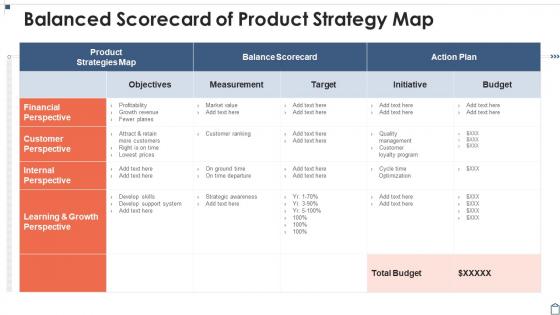
Balanced Scorecard Of Product Strategy Map




Try Before you Buy Download Free Sample Product
 Impress Your
 Audience
 100%
100% Editable
 Save Hours
 of Time


Our Balanced Scorecard Of Product Strategy Map are topically designed to provide an attractive backdrop to any subject. Use them to look like a presentation pro.
People who downloaded this PowerPoint presentation also viewed the following :
Balanced Scorecard Of Product Strategy Map with all 6 slides:
Use our Balanced Scorecard Of Product Strategy Map to effectively help you save your valuable time. They are readymade to fit into any presentation structure.





FAQs for Balanced Scorecard Of
So the Balanced Scorecard breaks down into four main areas you'll want to track. Financial stuff is the obvious one - revenue, profits, whatever. Then there's Customer perspective which looks at satisfaction and whether people stick around. Internal Process is about how efficiently you're actually running things (probably more important than most companies think). Learning & Growth covers employee development and building up your capabilities. Honestly beats just staring at financial reports all day. The whole point is using all four together instead of just obsessing over the money side of things.
So basically, a Balanced Scorecard takes your big strategy and breaks it down into actual measurable stuff across four areas - money, customers, processes, and learning/growth. What's cool is it shows everyone how their job connects to the main goals. Without it, you've got marketing going one way while ops goes another (been there!). The key is rolling these scorecards down through each team so they all have targets that feed into the bigger picture. I'd start by looking at your current metrics and seeing if they actually support what you're trying to achieve. Most don't, honestly.
Okay so three things you absolutely can't mess up: Leadership has to actually *use* the thing, not just build it to say they did. Pick metrics that actually connect to your strategy - I swear, half the scorecards I've seen are just random KPI dumps with like 35 measures nobody cares about. Keep it around 15-20 max across the four areas. Oh, and build regular review cycles into your meetings. Monthly check-ins, quarterly deep dives. Don't try to make it perfect right away - honestly that's where most people get stuck. Start basic and improve as you go.
So traditional methods just look at the money stuff - revenue, profit, costs. Balanced Scorecard is way different though. It covers four areas: financial, customer satisfaction, internal processes, and learning & growth. Instead of only "did we make money?" you're asking if customers are happy, processes running smooth, people developing their skills. Honestly it's more work at first (won't lie about that), but you actually see what's going on across your whole organization. My advice? Don't go crazy measuring everything right away. Pick a few key things in each area and build from there.
Look, stakeholder feedback is huge for making your Balanced Scorecard actually work. You've got to hear from customers, employees, shareholders - basically anyone who matters to your business. They'll tell you if your four perspectives are on track or total garbage. I've seen too many companies just make up metrics without asking anyone what they actually care about. Get input regularly so you can tweak your KPIs and catch stuff you missed. Oh, and figure out your top 5 stakeholder groups first - makes the whole process way less overwhelming.
Check your Balanced Scorecard quarterly - seriously, put it in your calendar right now or you'll forget. Things change fast and what mattered last year might be completely useless today. Get people from different departments involved in these reviews too. They usually catch problems way before the executives do. Your metrics should actually drive the behaviors you want, not just look pretty on a dashboard. If they're not doing that anymore, swap them out. I learned this the hard way when we kept tracking stuff that made zero sense for our current goals. Market shifts happen, customer needs evolve - your scorecard needs to keep up.
So for financial stuff, you're gonna want to track revenue growth, profit margins, ROI - the usual suspects. Cash flow is probably the most important one honestly, because who cares about profit on paper if you can't pay bills? Most companies also look at things like revenue per customer and cost reduction percentages. Oh, and return on equity if your executives are into that. Pick maybe 3-5 metrics max that your leadership actually cares about. Don't overcomplicate it - just figure out what gets talked about in those boring board meetings and start there.
So basically flip the whole Balanced Scorecard thing - mission and social impact go at the top, not financial stuff. Your "customers" are really your beneficiaries, donors, and community. Money becomes about being a good steward and staying sustainable instead of making profit. Staff development and systems still matter just as much. But wow, managing stakeholders gets messy fast - you've got board members, volunteers, grant makers all wanting different things. Don't just track activities. Actually measure if you're making a real difference in people's lives. Oh, and map out your theory of change first before you do anything else.
Honestly, the worst thing you can do is treat it like a checkbox exercise and then forget about it. I've watched companies create these monsters with like 50+ metrics that nobody can even remember, let alone use. Don't overcomplicate it - stick to maybe 5-10 metrics that actually matter for your strategy. Also, it can't just live at the executive level. You've got to break it down so different teams understand how they contribute. The scorecards that actually work? They're simple, updated regularly, and people reference them in meetings instead of letting them collect dust in some shared drive folder.
Dashboard tools like Tableau or Power BI are lifesavers for this. They connect straight to your CRM, ERP, whatever systems you're already using - no more manual spreadsheet hell. ClearPoint Strategy is solid if you want something built specifically for scorecards. Real-time visuals for all four BSC perspectives, automatic KPI calculations, the works. You can even set alerts when numbers go weird. Honestly, picking the right tool is half the battle - just make sure it plays nice with your current setup first. Map out your data sources before you commit to anything.
Look, strategic objectives are what make your Balanced Scorecard actually work. They turn fuzzy goals into real targets you can measure across financial, customer, internal process, and learning perspectives. Without them? You're basically just throwing darts at random numbers. Here's the thing - good objectives connect in a cause-and-effect chain. Better employee training leads to smoother processes, which makes customers happier, which boosts your bottom line. That's where it gets interesting. I'd start with 3-4 objectives per perspective. Make sure they tell one clear story about how you'll succeed, not four separate mini-strategies.
Okay so the Balanced Scorecard basically gives you four buckets - financial, customer, internal processes, and learning & growth. Instead of marketing babbling about brand awareness while finance only cares about margins, everyone's finally speaking the same language. Map out how each department connects to the big picture. Like, IT can see how their system fixes actually improve customer satisfaction and boost profits. Those visual strategy maps are clutch for this - suddenly your quarterly meetings don't suck because people get how their daily grind matters. Way better than the usual departmental drama, honestly.
Yeah, so Mobil (now ExxonMobil) is probably the biggest success story - they completely transformed how they managed performance back in the 90s using BSC. UPS did something similar to get their global operations in sync. Hilton used it across all their hotels to boost both customer happiness and profits. Even nonprofits like the Red Cross have made it work, which is pretty cool. But here's the thing - none of these companies just treated it like another boring report. They actually built it into how they make decisions at every level.
So the Balanced Scorecard is basically your business health check - tracks both the stuff that predicts future wins (like how happy your customers are) and the actual results (revenue, obviously). What I love about it is you're not just staring at money numbers all day. You get early warning signs before things go sideways. Think of it like... I don't know, checking your oil AND your gas, not just whether the engine's running. The real magic happens when you start connecting what you're fixing to actual outcomes. Just review it regularly with your team so you can pivot when needed.
Dude, your Balanced Scorecard is only as good as the people actually using it. Without engagement, you're basically pushing a rope uphill. People need to see how their daily work connects to those bigger goals - financial stuff, customer metrics, all of it. Engaged teams naturally spot problems faster and come up with better solutions. They actually care about hitting those targets instead of just going through the motions. Honestly, I've seen amazing scorecards fail because nobody explained why Janet in accounting should care about customer retention rates. Communication is huge here - show each person how they fit into the bigger picture.
-
Topic best represented with attractive design.
-
Informative presentations that are easily editable.