


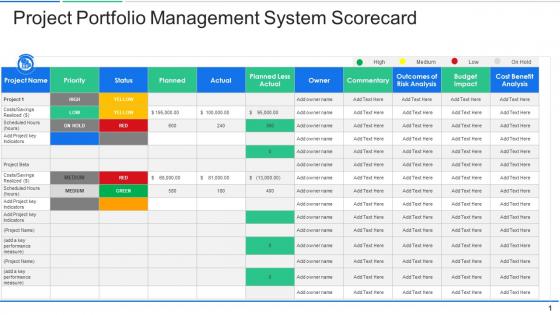
Project portfolio management system scorecard




Try Before you Buy Download Free Sample Product
 Impress Your
 Audience
 100%
100% Editable
 Save Hours
 of Time


Our Project Portfolio Management System Scorecard are topically designed to provide an attractive backdrop to any subject. Use them to look like a presentation pro.
People who downloaded this PowerPoint presentation also viewed the following :
Project portfolio management system scorecard with all 6 slides:
Use our Project Portfolio Management System Scorecard to effectively help you save your valuable time. They are readymade to fit into any presentation structure.





FAQs for Project portfolio
Look, you need four main things for a scorecard that won't drive you crazy. Strategic alignment stuff - does this project actually help the business? Financial metrics like ROI and budget tracking. Then operational basics: timelines, quality, risk management (the fun stuff that makes you panic at 2am). Don't forget stakeholder satisfaction - office politics are annoying but real. Honestly, stick to 5-7 metrics tops or you'll waste more time updating spreadsheets than doing actual work. Start simple, tweak it every few months. Trust me on this one.
Honestly, a scorecard just makes you track stuff that actually connects to your big goals. So instead of approving random projects that "seem cool," you're measuring everything against the same criteria that matter to your strategy. Pretty quickly you'll spot which projects are worth it and which are just eating up budget for no real reason. I love how visual it gets - misalignment jumps out immediately. Start simple though. Pick your top 3-4 priorities, then build scoring around those. Way easier than trying to track everything at once.
Definitely focus on the money stuff first - ROI, budget variance, how you're using resources. Schedule and milestone tracking is obvious but super important. Then add strategic alignment metrics to see if projects actually support business goals, plus customer satisfaction scores. Team productivity and risk management are worth watching too. Here's the thing though - I learned this the hard way - don't track more than 6-8 metrics or you'll get overwhelmed by all the numbers. Start with what your stakeholders care about most. You can always tweak things quarterly based on what's actually helping you make better decisions.
Honestly, the scorecard changed everything for me - I used to just wing it with project decisions. Now I can actually see which ones are making money vs. the ones bleeding cash. ROI, performance metrics, risk stuff - it's all right there. Makes those "should we kill this project?" conversations way less awkward when you've got real data backing you up. What I do now is set up monthly reviews where we look at the scores and move people off the losers onto the winning projects. Sounds obvious but you'd be surprised how many teams skip this step and wonder why nothing improves.
Honestly, stakeholder feedback is your best friend when tweaking scorecard metrics. Without it, you're just guessing what actually matters to people. I've watched so many teams build these gorgeous dashboards that nobody ends up caring about - total waste of time. Get feedback regularly to spot your blind spots and figure out if you're even measuring the right stuff. Sometimes you'll discover your whole approach is off. The weighting might be wrong, or worse, you're tracking metrics that don't drive the behaviors you want. Set up quarterly check-ins with key people and actually listen to what they tell you.
Don't try to force every project into the same scorecard - that's a recipe for disaster. IT stuff needs heavy focus on technical risks and integration headaches. Marketing campaigns? ROI and brand impact are what matter. Infrastructure projects are honestly the worst for timelines, so weight safety and compliance way higher there. Build separate templates for different project types. A compliance project might make regulatory stuff worth 40% of your score, but innovation work should prioritize getting to market fast. I'd start with maybe 3-4 main categories in your portfolio and just build custom scorecards for each one.
Honestly, getting everyone to measure stuff the same way is going to be your biggest headache. Each team thinks their way is obviously the best. Then there's the whole adoption thing - make it too fancy and people just won't bother opening it. I swear, some of the prettiest dashboards are the most useless ones sitting there collecting digital dust. Manual updates are a pain too, so that'll bite you later. My advice? Pick like 3 metrics everyone already gets and start there. Build up slowly once people actually start using the thing.
Look, nobody wants to stare at endless rows of numbers trying to figure out what's actually happening. That's where good visuals save your sanity. Color-coded dashboards, progress bars, heat maps - they let you spot problems instantly instead of playing detective with spreadsheets. Your stakeholders will thank you because they can see which projects are crushing it and which ones are total disasters without squinting at data. Just don't go crazy with pie charts everywhere (seriously, they're overused). Match your KPIs to charts that actually make sense. The goal is telling the story in one quick glance.
Honestly, I'd aim for monthly updates at minimum, but quarterly deep-dives tend to work way better for most teams. Block out time on your calendar now - seriously, protect that time like your life depends on it because everything else will try to take priority. When you're actually reviewing, look at trends instead of just current numbers. Are projects always missing deadlines or was last month just weird? Also grab input from your PMs beforehand so you're not sitting there like "uh, why did this happen again?" Pick one day each month and stick to it religiously. Consistency beats perfection every time.
So basically, you can connect your portfolio management software to whatever tools you're already using - Jira, Asana, MS Project, whatever. It'll automatically pull all your KPIs instead of you hunting around for updates like some kind of data detective. Real-time dashboards are where it gets good though. Your reports just update themselves when project data changes. I'm talking hours saved every week, no joke. Plus you get those visual heat maps that actually make sense to stakeholders. My advice? Don't go crazy at first. Pick one data source, get that working smoothly, then add more. Way less headache that way.
Honestly, the scorecard is a game-changer because you can see everything at once instead of juggling each project separately. Red flags pop up way earlier - like when budgets start creeping up or timelines get wonky. It's basically your bird's-eye view of the whole mess. The visual layout makes patterns super obvious that you'd totally miss otherwise. Over time, you'll spot which projects are chronic troublemakers (there's always that one, right?). Then you can actually make smart calls about where to focus your energy instead of just putting out fires constantly.
Dude, scorecards are seriously underrated. Instead of letting the loudest person in the room win (you know how that goes), you get actual criteria to judge projects against. Pick like 4-5 things that matter - ROI, resources needed, how risky it is, whether it fits your goals. Then just stick to those same metrics every time. No more pet projects sneaking through because someone's passionate about them. The best part? You'll have real conversations about trade-offs instead of arguing in circles. Trust me, once you start ranking everything the same way, decisions get way clearer.
Honestly, scorecards are pretty clutch for figuring out what's actually working. You can compare stuff like how fast teams deliver, whether they stick to budgets, quality metrics - all that good stuff. Makes it way easier to spot which teams are killing it versus which ones are struggling (and might need some backup). The cool part is you get to see patterns over time too. Like, is Team A consistently getting better or do they keep hitting the same walls? I'd probably start with just 3 or 4 metrics that actually matter to you guys - don't go crazy with too many right off the bat.
Honestly, project scorecards are game-changers for figuring out what's actually working. You'll start seeing patterns you never noticed before - like how your IT stuff always goes over budget but marketing hits deadlines every time. Wild how clear it becomes once you map it out. The whole point isn't just tracking numbers though. Use that data to fix your processes and pick better projects next time. I'd say start small - maybe 3-5 metrics that actually matter to your team. Don't go crazy with tracking everything under the sun right away.
Honestly, tons of big companies crush it with portfolio scorecards. Microsoft tracks their projects using balanced scorecards - they look at strategic alignment, financial returns, resource stuff. IBM's results were wild - they cut project failures by 40% after implementing theirs. Toyota does something similar for product development, and Siemens uses scorecards to figure out where to put their R&D money. The trick is they don't just copy-paste some template. Each company tweaks the metrics to match what actually matters for their business. My take? Start small with maybe 4-5 metrics that really matter to you guys.
-
Awesome presentation, really professional and easy to edit.
-
Excellent design and quick turnaround.