


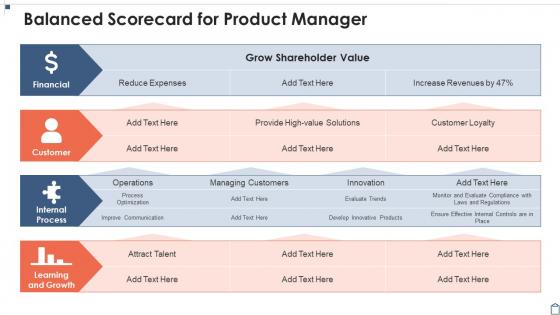
Balanced Scorecard For Product Manager




Try Before you Buy Download Free Sample Product
 Impress Your
 Audience
 100%
100% Editable
 Save Hours
 of Time


Our Balanced Scorecard For Product Manager are topically designed to provide an attractive backdrop to any subject. Use them to look like a presentation pro.
People who downloaded this PowerPoint presentation also viewed the following :
Balanced Scorecard For Product Manager with all 6 slides:
Use our Balanced Scorecard For Product Manager to effectively help you save your valuable time. They are readymade to fit into any presentation structure.





FAQs for Balanced Scorecard
So the four are Financial, Customer, Internal Process, and Learning & Growth. Financial is your usual stuff - revenue, profit margins, the numbers that keep the C-suite happy. Customer perspective tracks satisfaction and retention from their angle. Then you've got Internal Process, which is about nailing the operational stuff that actually delivers value. Learning & Growth covers your people and systems - honestly the most overlooked one in my opinion. They're all connected though. You can't just chase revenue without investing in the other areas. I'd start by seeing what you're already measuring and figure out which buckets they fall into.
So basically you'll want to map your strategy across those four BSC areas - financial, customer, internal processes, and learning/growth. Take your main strategy and break it into specific goals for each section. The trick is connecting them all together. Like, better employee training improves your processes, which makes customers happier, which boosts revenue. It's all cause-and-effect stuff. Honestly, don't get too caught up in perfection right away - just write down your objectives and start tracking the metrics that actually matter for your strategy. You can tweak things as you go.
Honestly, the Balanced Scorecard is pretty smart because it doesn't just obsess over money stuff. You get four angles - financials, customers, internal processes, and learning/growth. Way easier to catch issues early when you're looking at the whole picture, you know? Plus everyone actually understands how their job connects to the big strategy. The cool part is seeing how these four areas influence each other - like better training leading to happier customers leading to more profit. Pick 3-4 metrics for each category that actually mean something to your goals. Don't just measure what's convenient to track.
Yeah, so customer satisfaction is basically one of the four main pillars in Balanced Scorecard. You'd track stuff like retention rates, satisfaction scores, market share - the usual suspects. But here's what's cool about it: it's not just about keeping people happy (though that matters obviously). The whole point is connecting those customer metrics to your internal processes and financial performance. Like, if satisfaction drops, what process broke down? I always tell people to make sure their customer metrics actually tie back to specific things they can fix and measure, otherwise you're just collecting data for no reason.
Pick maybe 3-4 key metrics and call it good - don't try tracking everything under the sun. Honestly, a basic spreadsheet works fine for most small businesses. You don't need some expensive dashboard. Focus on stuff you can actually control that ties to your goals. I've watched too many small teams burn out copying what massive companies do (spoiler: it doesn't work). Meet once a month to look at your numbers and tweak things. The real magic? It's not the data itself but the discussions that happen when you're all looking at the same scorecard together.
Honestly, getting leadership to actually care is the hardest part. Most places just slap together random KPIs and wonder why nothing changes. You'll spend forever trying to balance metrics across all four perspectives - and seriously, finance teams will still obsess over revenue numbers like it's 2005. Data becomes a total mess when you're pulling from different systems everywhere. Oh, and good luck keeping everything updated regularly. My advice? Start with one department first as a test run. Work out all the weird issues there, then expand. Trust me on this one.
So the Balanced Scorecard takes those fuzzy strategic goals and turns them into actual numbers you can track. You look at four areas: financial stuff, customer satisfaction, internal processes, and learning/growth. Think of it like a car dashboard - instead of guessing how fast you're going, you can see exactly what's happening. Honestly, most companies are terrible at connecting daily work to the big picture, but this makes it obvious. When you map your goals using these four categories, suddenly everyone gets what they're supposed to be doing. It's way better than those generic mission statements nobody reads.
So Balanced Scorecard breaks down into four areas. Financial stuff is obvious - revenue growth, profit margins, ROI. Customer side covers satisfaction scores, retention, market share. Internal processes look at things like cycle times and quality rates. Then learning/growth tracks employee happiness, training hours, innovation metrics. Honestly, the tricky part isn't knowing the categories - it's picking the right ones. You want maybe 3-5 per area that actually connect to your strategy. I'd start with defining what "winning" looks like in each bucket, then figure out how to measure it. Don't just throw random KPIs at the wall.
So the Balanced Scorecard is pretty smart - it makes you turn your big change vision into actual numbers you can track. You're looking at four areas: financial stuff, customer impact, internal processes, and whether your team's learning what they need to know. Way better than just hoping things work out, right? Pick 2-3 metrics for each area that actually matter. The cool part is when people see how their daily tasks connect to the bigger goals, they stop rolling their eyes at "transformation initiatives" (ugh, I hate that phrase). Map your change goals to each perspective first, then you'll know what to measure.
Don't let your Balanced Scorecard collect dust - seriously, I've seen too many companies create these things and forget about them. Check it quarterly if you're moving fast, annually at minimum. Your metrics should reflect what matters now, not whatever you cared about when you first built it. Different departments will catch problems you miss, so loop them in. Oh, and schedule those "scorecard health checks" with your team - sounds corporate but it works. The whole point is making sure you're still tracking stuff that drives the right behaviors. Otherwise you're just measuring random things that don't move the needle anymore.
So most companies just stare at their financial numbers all day - revenue, profit, costs, whatever. Super limiting honestly. Balanced Scorecard switches it up by tracking four areas: financial stuff, customers, internal processes, plus learning & growth. You're not just looking backwards at old financial data anymore. Instead you get indicators that actually predict what's coming next, which is way more useful. It ties your strategy to real metrics across your whole business. Honestly, just try sorting your current KPIs into those four buckets - bet you'll spot some obvious holes.
Honestly, tech transforms Balanced Scorecards from a total pain into something actually useful. Instead of those soul-crushing monthly Excel updates, you can pull data automatically from your current systems. Real-time dashboards show your KPIs instantly, plus you'll get alerts when things go sideways. The visual tools are great for catching trends you'd miss in boring static reports. Cloud platforms make sharing across teams dead simple too - though good luck getting everyone to actually check them regularly. My advice? Figure out which data sources you can automate first. That step alone saves hours.
Honestly, Balanced Scorecards are pretty solid for quick strategic calls. You're tracking four areas - financial stuff, customers, internal ops, and team development. Here's the thing though: most people obsess over financial numbers that already happened. Instead, focus on leading indicators that actually show you what's coming. When markets get weird (and they always do), you'll spot problems early and shift resources fast. The whole point is connecting different parts of your business so you're not making blind decisions. I'd set up monthly dashboards instead of waiting for quarterly reviews - that's way too slow these days.
Dude, your scorecard is dead in the water without employee buy-in. I've watched so many companies build these gorgeous dashboards that nobody actually uses because leadership just pushed them down from above. Get your team involved in picking the metrics - that's where the real value is. When people understand how their daily work connects to those four perspectives, they start making smarter decisions automatically. Plus, you gotta keep sharing the progress regularly or people forget it exists. Honestly, the best scorecards I've seen feel more like team conversations than corporate reports. Don't make it fancy - make it meaningful.
Yeah totally! Balanced Scorecard plays nice with most other frameworks. I've seen it work great with lean, Six Sigma, OKRs - the usual suspects. Your four perspectives become like the foundation, then you stack whatever else on top. Agile integration can get weird though, just warning you. Companies try it but sometimes the timelines don't match up well. The main thing is keeping your metrics aligned across everything - otherwise you'll have teams pulling in different directions which sucks. Honestly? Start with just one other framework first. Don't go crazy trying to combine everything at once.
-
Topic best represented with attractive design.
-
Excellent products for quick understanding.