

 0 Comment
 Customer Reviews

Many organizations' IT departments struggle to define success. Different metrics and parameters can be used to demonstrate it. For example, some focus on cost and deadlines and others on deliverables. This variation and lack of common metrics cause confusion that can invite some gaps in project timelines, team clashes, and inefficient workflows.
The result? A cycle of inefficiency. Teams work hard, but with no shared metrics, they’re flying blind. Projects often miss their targets because of a lack of structure.
Teams often bear the brunt of the blame game for the inefficiency. But sometimes, the team's efficiency might not be the only issue. The teams take on projects with unclear direction and resource allocation. This results in wasted hours, missed goals, and teams that burn out without knowing where they stand.
A lot of IT projects either exceeded budget or failed to deliver expected results. Poor alignment between the project needs, resource allocation, and outcomes.
Without a shared system for measuring what matters, even the most skilled teams get stuck in reactive loops: firefighting issues, chasing feature requests, and watching scope creep eat into delivery schedules.
What's the Solution?
A balanced IT resource scorecard with a project delivery index can be a perfect solution for this problem. Organizations using such scorecards bring clarity to business operations. And third, the leaders get a clear idea of how their resources are being utilized.
With a proper IT resource balance scorecard, IT leaders can have a clear view of the following:
- What the team must accomplish (objectives)
- How to measure progress (KPIs)
- What targets matter (metrics)
- Which actions actually drive performance
The resource scorecard does one simple thing. It splits focus across four fronts: financial outcomes, internal processes, customer value, and team growth. So, instead of chasing individual metrics, leaders understand what's working for them.
Now, the question is, how to create such IT resource scorecards? Well, our team has done all the heavy lifting for you! We have created 10 IT resource scorecard templates that can help you out in this situation.
Let’s check them out one by one.
Template 1: IT Resource Balanced Scorecard PPT PowerPoint
IT teams chase performance without knowing what actually drives results. However, this scorecard fixes that by breaking down resource use across four exact focus areas. These key areas are metrics, project priority, business impact, and ongoing improvement. The template includes defined IT KPIs, process clarity, service benchmarks, budget comparisons, and a customer satisfaction lens.. You track what's working, broken, and where to redirect effort fast. This tool gives you a full picture of your financial, operational, and service-based aspects of your entire process in a single go. IT heads, department leads, and strategic planners can use it to move from isolated reports to decisive action in weekly or quarterly reviews.
[product_image id=1427825]
Template 2: Key Metrics for IT Resource Performance
Teams often miss critical red flags because they don't track the right IT performance metrics in real-time. But not anymore! This technology dashboard displays four high-impact indicators: uptime, cost, user load, and satisfaction. It gives decision-makers a simple, live snapshot of IT resource performance without sifting through bulky reports. You know instantly where service stability slips, where expenses spike, or where user experience drops. No more guessing where the problem is emerging from. You can plug in your own numbers and monitor shifts week to week. This tool works best for IT managers, service leads, and DevOps heads who need quick proof of progress.

Template 3: Internal Processes Perspective in IT
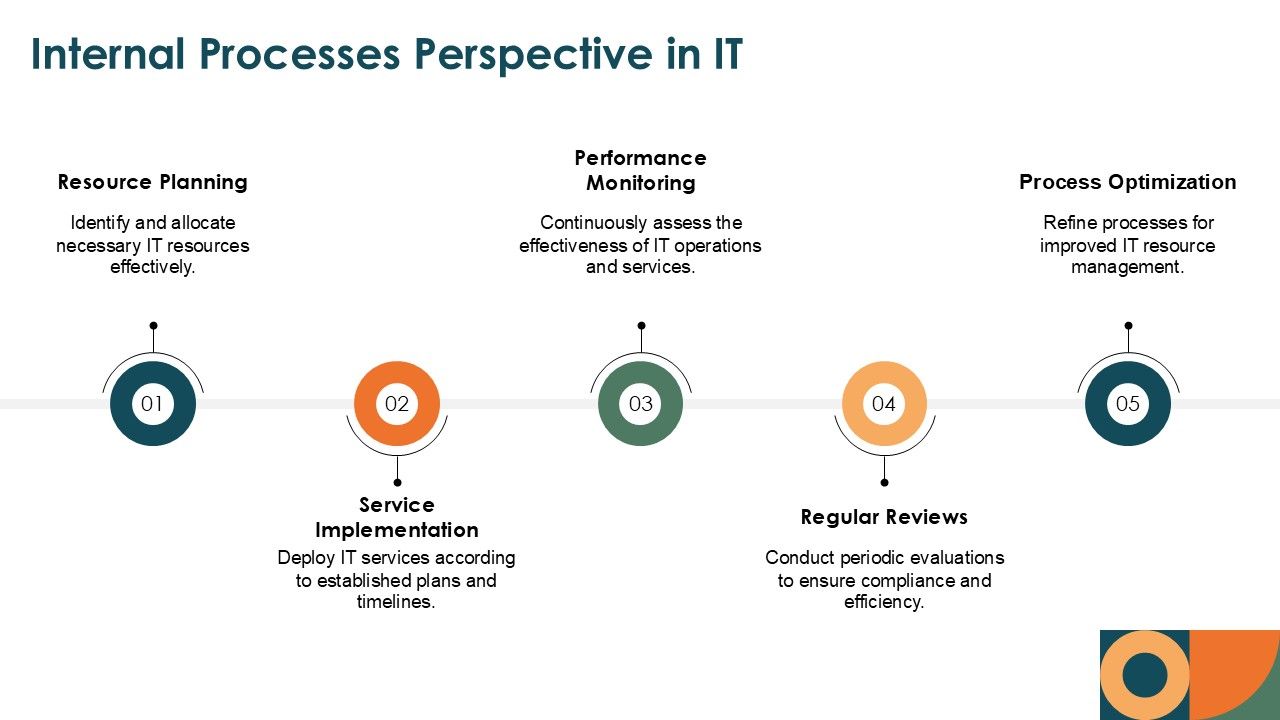
Fixing delivery gaps is one of the biggest challenges for IT firms. This generally occurs due to poor planning, rushed execution, and zero follow-up. This framework solves that by breaking internal IT processes into five exact checkpoints: resource planning, service rollout, performance checks, review cycles, and refinement. It gives you a straight-line process that tracks service quality, resource efficiency, and timing. You don't let projects spiral or die mid-sprint. You monitor what's been deployed, what's working, and what needs course correction. This template works for IT operations managers, project heads, and infrastructure leads who want to clean up internal workflows. It can also help with capacity utilization, speed up decisions, and reduce rework without reinventing the entire process model.
Template 4: Gap Analysis in IT Resource Management
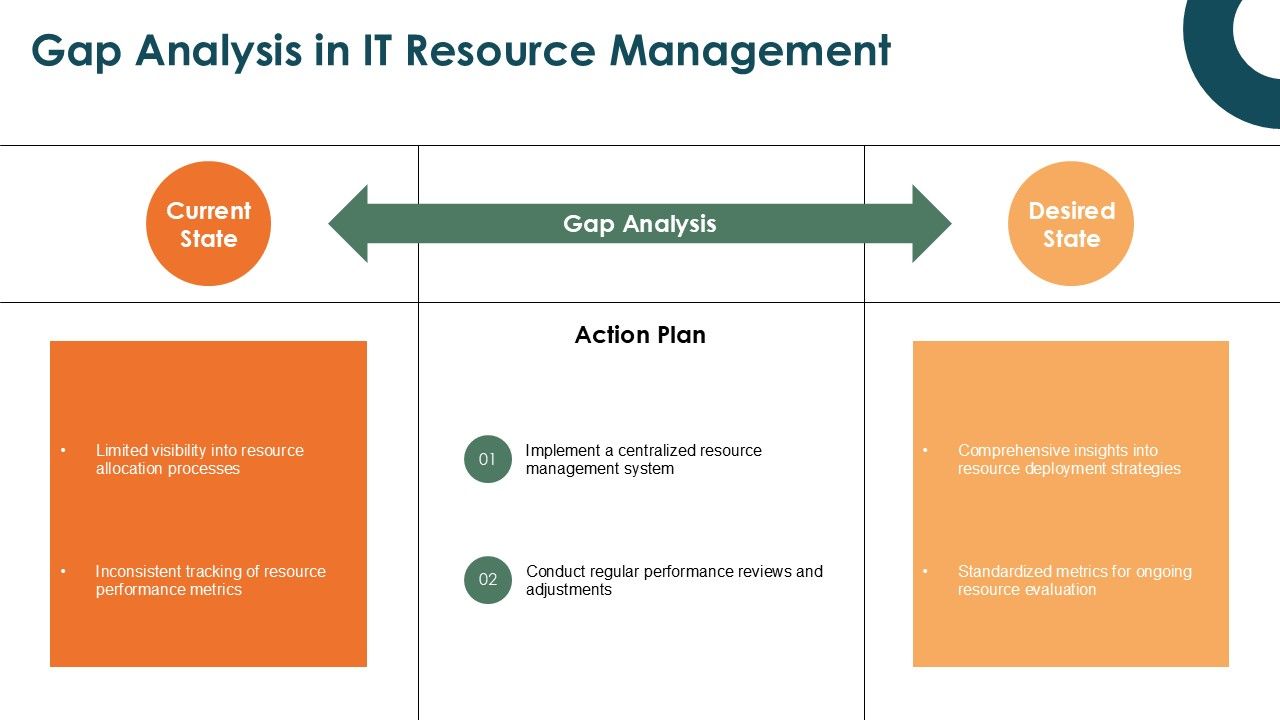
Most IT teams operate with partial visibility into how resources move across projects.This template fixes that by exposing the gaps between current performance and desired outcomes. It outlines the exact weaknesses, like poor tracking or unclear deployment, and then delivers a focused action plan to close them fast. You see what's missing, document the fix, and track the result in one clean flow. It brings structure to review meetings and removes guesswork from improvement plans. Anyone running IT audits, PMO reviews, or infrastructure upgrades can use it to build a solid case for change and back every shift with data. Result? Improved IT cost efficiency.
Template 5: Analysis of IT Performance Metrics
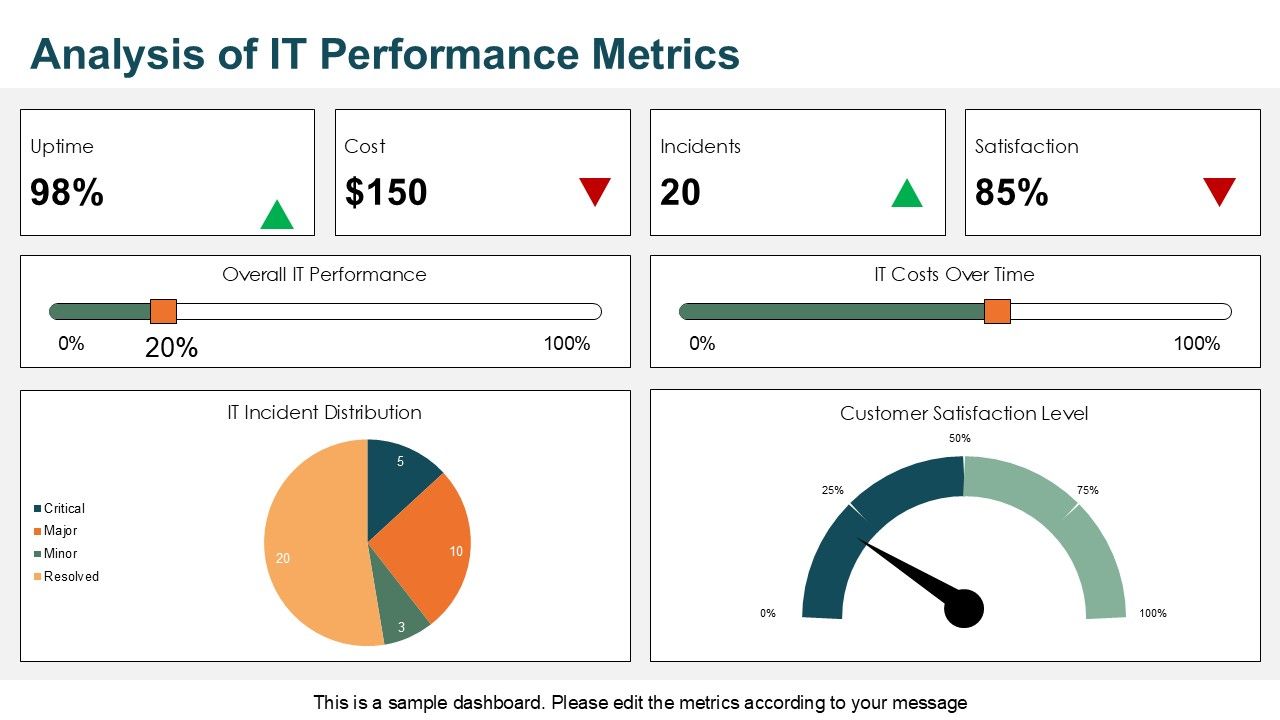
IT departments often report success based on uptime alone, while deeper issues go unnoticed. If you, too, are facing this issue, this template is here to rescue you! It breaks down performance into real, quantifiable data like system uptime, cost, user incidents, satisfaction, and severity breakdowns. With this template, you know how well, how efficiently, and how users feel about it. The visual format surfaces pain points instantly, whether it's rising incidents or customer dissatisfaction. This template gives operations managers, CIOs, and service heads a real-time grip on service delivery, financial exposure, and improves incident response time. The best part? You won't have to wait for end-of-month reports or vague stakeholder feedback when you are using this customer service level indicator.
Template 6: Integrating Feedback into IT Strategies
Most IT strategies fall flat because they ignore what users actually need. This framework fixes that by giving teams a closed loop. It collects real feedback, breaks it down into patterns, and makes clear adjustments. This template allows you to extract insight from direct user input and translate it into decisions that reflect demands. This cycle keeps your planning grounded and your delivery sharp. It works best for IT leaders, product owners, and digital transformation heads who want to cut wasted cycles and build systems that respond fast to changing expectations across internal and external users.

Template 7: Organizational Roles in IT Strategy
When IT strategy stalls, it's usually because nobody knows who owns what, and not because of a lack of innovation score. Here is a slide that shows exactly how executive roles, tech leads, and analysts connect inside the decision chain—from CEO to CIO, CTO, and CFO, down to operations and finance roles. You can use this template, comprising IT governance metrics, to build clarity in org-wide IT reviews, governance meetings, and roadmap planning. It's ideal for CIOs, transformation heads, and consulting teams who need to explain authority lines or improve employee involvement.

Template 8: IT Resources Balanced Scorecard Template
Most IT strategies collapse when teams fail to connect their actions to measurable goals. This scorecard solves that by organizing every resource into four direct performance streams: financial returns, customer results, system efficiency, and workforce development. The framework also links daily execution with big-picture goals using clear objectives, tangible targets, and lead/lag indicators. You can plug in your own data and watch strategy translate into measurable change. It's built for IT directors, PMOs, and enterprise architects who need to build clarity, scale performance, and defend ROI across teams and timeframes.
[product_image id=460948]
Template 9: IT Resource Balanced Scorecard with Strategic Objectives
What happens if an IT department pushes strategy without looking at how different roles see its value? Absolute chaos, right? This template maps four exact lenses around it. These are user perception, financial impact, future readiness, and operational quality. It shows how each direction drives a separate outcome while staying tied to one mission. You can track how users view the service, how management sees investment returns, and how prepared your team is to handle what's next. CIOs, strategy consultants, and digital transformation leads can use this to shape conversations and drive unified action across functions.

Template 10: IT Resource Balanced Scorecard with Targets and Action Plan
When IT initiatives lack focus, progress drifts, and targets keep shifting. This scorecard removes that drift by locking every goal to a category and tying it to an actionable plan. It draws a straight line from vision to outcome without letting teams get lost. You define what matters, set real metrics, and document how to get there. You can use it to guide annual planning, executive updates, or performance reviews. It's built for CIOs, delivery heads, and enterprise PMOs. They can use this to track where money flows, what customers expect, and change management effectiveness.

Wrapping Up
IT organizations need a reliable system to ensure their resources are allocated to the right teams in the right quantity. And that's where these IT balance scorecard templates can come in handy. If you, too, are leading an IT team or are in a leadership position, you can use these templates to enhance your team's overall performance.
All these templates are 100% content-ready and editable. So you can tweak them according to your brand's identity and use them.
FAQs on IT Balanced Scorecard :
1. What is the IT balanced scorecard perspective?
The IT balanced scorecard perspective measures IT performance across strategic, financial, process, and customer views.
2. What is the IT governance balanced scorecard?
IT governance balanced scorecard tracks how well IT decisions, risks, and compliance align with business goals.
3. What is the standard IT balanced scorecard?
Standard IT balanced scorecard includes metrics for cost, service quality, innovation, and internal efficiency.