


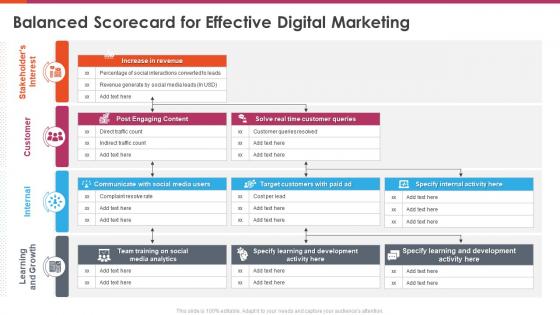
Marketing balanced scorecard balanced scorecard for effective digital marketing




Try Before you Buy Download Free Sample Product
 Impress Your
 Audience
 100%
100% Editable
 Save Hours
 of Time


Our Marketing Balanced Scorecard Balanced Scorecard For Effective Digital Marketing are topically designed to provide an attractive backdrop to any subject. Use them to look like a presentation pro.
People who downloaded this PowerPoint presentation also viewed the following :
Marketing balanced scorecard balanced scorecard for effective digital marketing with all 6 slides:
Use our Marketing Balanced Scorecard Balanced Scorecard For Effective Digital Marketing to effectively help you save your valuable time. They are readymade to fit into any presentation structure.






FAQs for Marketing balanced scorecard balanced scorecard for
So there are four parts: Financial, Customer, Internal Process, and Learning & Growth. Think of it like dominoes - you invest in employee skills and systems first (Learning & Growth), that makes your processes smoother, customers get happier, then boom - better financials. Pretty logical when you think about it, though real life obviously gets way more complicated than this clean little chain. The whole point is you can't just stare at profit numbers anymore. You need those other three perspectives to actually predict where your money's headed. Honestly saves you from chasing short-term wins that'll bite you later.
Start with mapping your strategic objectives across the four BSC perspectives - financial, customer, internal processes, and learning & growth. Then create those cause-and-effect links between them. That's where the real value is. Every KPI should connect to at least one strategic objective, otherwise you're just collecting data for no reason (and trust me, I've seen too many dashboards that are basically data graveyards). Be ruthless about cutting measures that don't tie back to strategy. I'd go with 3-4 objectives per perspective to start - keeps things manageable while you build out the framework.
So the Balanced Scorecard is basically your strategy translator - takes those big picture goals and breaks them into actual measurable stuff. You've got four areas: financial, customer, internal processes, and learning/growth. Honestly, it's like having a dashboard for your strategy instead of just crossing your fingers and hoping things work out. The cool part is connecting the dots between these areas - like how better training (learning) leads to smoother processes, which makes customers happier, which boosts revenue. Just pick 3-4 key metrics for each area that actually tie back to what you're trying to achieve.
Honestly, the Balanced Scorecard isn't as complicated as it sounds. Pick 2-3 goals in four areas: money stuff (revenue, profits), customer happiness (reviews, repeat business), how smoothly things run internally, and whether your team's actually growing their skills. What's cool is watching the connections - better training leads to happier customers, which obviously means more cash. I'd make a simple visual dashboard you can check monthly. Don't go crazy with fancy metrics or you'll just stop using it after two weeks. The whole point is seeing how everything connects to drive growth, not drowning in spreadsheets.
Honestly, the biggest mistake is thinking you can just set it up once and forget about it. I've watched so many companies create these beautiful scorecards that end up gathering digital dust. Don't cram in every metric you can think of - keep it focused or people get overwhelmed. Middle managers need to be on board too since they're the ones actually looking at this stuff daily. Oh, and resist picking metrics just because they're simple to track. Does it actually tie back to what you're trying to accomplish? Start with maybe 4-5 measures per area and grow from there.
Dude, you'll save SO much time automating that data collection instead of wrestling with Excel every month. Connect your CRM, HR system, and financial stuff directly to BSC software - it feeds everything automatically. Real-time dashboards are honestly amazing once you see them in action. You get alerts when metrics go wonky, plus charts that don't make people's eyes glaze over in meetings. I'd start by figuring out which manual tasks currently make you want to cry, then find software that plugs into those systems. The setup's a bit of work upfront but totally worth it.
So for nonprofits, flip the whole thing - mission comes before money, obviously. Start with **Mission perspective** instead of financial stuff. Track your actual impact: who you're helping, program outcomes, that kind of thing. **Stakeholder perspective** is your donors, volunteers, community - are they sticking around and happy? **Internal Process** covers how well you deliver programs, raise funds, stay compliant (ugh, but necessary). **Learning & Growth** is staff training, tech upgrades, building capacity. Honestly, the key is picking metrics that actually show if you're making a difference, not just surviving. Don't go crazy - maybe 3-4 per section to start.
So basically the Balanced Scorecard gets everyone speaking the same language about success. You know how finance obsesses over revenue while operations only cares about efficiency? This thing fixes that by giving you four clear perspectives to look at - financial, customer, internal processes, and learning stuff. Think of it as a dashboard that actually makes sense to everyone, not just the executives. What's cool is it turns your big-picture strategy into real metrics people can connect to their daily work. Team meetings get way more productive because you're all tracking the same things. Plus it naturally makes people more accountable - honestly, it's one of those tools that just works.
Honestly? Your Balanced Scorecard needs to be a living thing, not something you create once and forget about. I'd do quarterly check-ins to see if your metrics still make sense with what you're actually trying to accomplish. Get people from different departments involved - they'll catch stuff you totally missed. When market conditions change or you launch new projects, update those KPIs. I've watched so many companies let their scorecards just sit there collecting dust because nobody touched them after year one. Stay flexible with it. If something isn't pushing the right behaviors anymore, ditch it for something better.
So here's what I'd track - first, are your strategic goals actually getting hit? Check if departments are working together better and if decisions happen faster. The biggest win is when people actually use the scorecard data instead of letting it collect dust (which happens way too often, trust me). Monthly surveys with managers work great - just ask if the BSC helps them decide stuff. But honestly? The real magic happens when your leading indicators start flagging problems before they mess with your bottom line. That's when you know it's working.
So basically, old-school approaches just track the money stuff - profit, revenue, costs, whatever. Balanced Scorecard is way more comprehensive though. It adds customer satisfaction, internal processes, and learning/growth on top of financials. You're not just asking "did we make money?" anymore. Now it's like - are customers actually happy? Running things efficiently? Growing our people and innovating? Honestly makes so much sense because those other factors drive your financial results anyway. My old boss was obsessed with this framework. If you're gonna try it, pick 3-4 key metrics per category that actually align with what you're trying to accomplish.
So the Scorecard works by creating this feedback loop - you're tracking metrics across four areas and constantly seeing where you're falling short of your goals. Think of it like a strategy dashboard. When numbers start going south, it triggers discussions about what's actually causing the problems. Makes improvement way more systematic instead of just throwing darts at a wall, you know? The quarterly reviews are where the magic happens - that's when you identify the specific moves that'll actually shift your key metrics. Honestly, most companies wing it with improvement efforts, but this approach keeps you focused on what matters.
For Balanced Scorecard stuff, go with dashboard-style visuals. Traffic light indicators are perfect - red/yellow/green makes status checks super quick. Gauge charts work great for performance metrics too. I'd also throw in some trend lines to show progress over time. Heat maps are clutch when you need to display multiple KPIs at once (though honestly, they can get overwhelming if you're not careful). Keep things organized by those four perspectives - financial, customer, internal process, and learning & growth. That way stakeholders can quickly spot how each area's doing. Simple beats fancy here since execs want the big picture fast, not a data dump.
Yeah definitely! Those four standard perspectives are just a starting point. Map out what actually matters to your stakeholders first - that's where the magic happens. Healthcare companies might need "regulatory compliance" instead of one of the usual ones. Tech companies? They're always adding "innovation perspective" because honestly, traditional financial metrics don't capture half of what they do. Environmental companies swap in sustainability angles. The whole point is finding what drives success in YOUR world, then build your KPIs around that. Don't get stuck with cookie-cutter frameworks that miss your actual value drivers.
Look, your employees are doing this stuff every day - they'll spot what actually matters vs. what looks good on paper. Survey them about bottlenecks and pain points first. Anonymous feedback works best, honestly. I've watched so many companies create these gorgeous scorecards that measure completely irrelevant things because leadership never asked the front lines what success actually looks like. Focus groups help too when you're picking KPIs. They can flag weird consequences you'd never think of - like how measuring call volume might tank service quality. Start by asking what winning means from their view.
-
Really like the color and design of the presentation.