


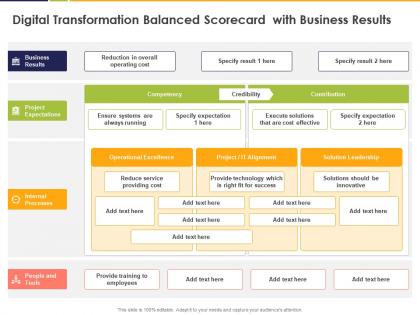
Digital transformation balanced scorecard with business results operating ppt powerpoint presentation diagram




Try Before you Buy Download Free Sample Product
 Impress Your
 Audience
 100%
100% Editable
 Save Hours
 of Time


Our Digital Transformation Balanced Scorecard With Business Results Operating Ppt Powerpoint Presentation Diagram are topically designed to provide an attractive backdrop to any subject. Use them to look like a presentation pro.
People who downloaded this PowerPoint presentation also viewed the following :
Digital transformation balanced scorecard with business results operating ppt powerpoint presentation diagram with all 2 slides:
Use our Digital Transformation Balanced Scorecard With Business Results Operating Ppt Powerpoint Presentation Diagram to effectively help you save your valuable time. They are readymade to fit into any presentation structure.
FAQs for Digital transformation balanced scorecard with business results operating ppt
So it's still the same four buckets from the original framework, just tweaked for digital stuff. Financial perspective tracks ROI on tech investments and automation savings. Customer side looks at digital experience metrics and online satisfaction. Internal processes focus on workflow efficiency and how well systems actually talk to each other (which honestly can be a nightmare). Then learning & growth covers digital skills training and adoption rates. The trick is picking KPIs that match what you're actually trying to do - cloud migration needs different metrics than improving customer experience. Figure out what outcomes your stakeholders care about most, then build your scorecard around those priorities.
So map your digital stuff across all four BSC perspectives to make sure it actually supports your strategy. Financial goals first - cost cuts, new revenue from digital products, whatever. Then figure out what customer outcomes you need. Internal processes come next (honestly, this is where most of the real work happens). Don't forget the learning piece - what capabilities do your people need? Each digital project should tie back to at least one strategic objective. Run your current initiatives through this framework and you'll probably find some gaps or realize certain projects aren't really helping your strategy at all.
Honestly, analytics is what makes those digital transformation scorecards actually useful instead of just pretty PowerPoint slides. You'll want to track the big four areas - financial returns, customer satisfaction, how smooth your internal processes are running, and whether your team is actually picking up new digital skills. Most companies just wing it without good data, which is why half these initiatives fail spectacularly. Set up some automated dashboards that grab real-time info from your systems - trust me, you'll catch problems way earlier. Pick maybe 3-4 solid metrics for each area and start there. Don't overthink it.
Look, you gotta spread your digital stuff across all four BSC areas with solid metrics. Financial side? ROI on tech spending plus whatever you're saving from automation. Track digital engagement and customer satisfaction scores too. Internal processes are about uptime, efficiency gains, cycle times - the usual suspects. But here's where everyone screws up: they totally ignore the learning piece. You need data on how fast people are picking up new digital skills and actually using the tech you're rolling out. Set up dashboards that refresh automatically so you're not flying blind when things go sideways.
Honestly, the worst part is dealing with people who hate change - and trust me, traditional companies are the absolute worst for this. Getting executives to care about digital metrics instead of just the usual financial stuff? Good luck with that. Legacy systems are another headache since they basically hate talking to modern analytics tools. But here's the thing - the culture problem is way harder than the tech stuff. I'd start with just one team, get some quick wins to show it actually works, then slowly spread from there. Don't go crazy trying to transform everything at once.
Get your stakeholders to actually build the thing with you instead of just looking at it later. Run workshops where each department defines what digital success means to them - finance wants ROI numbers, operations cares about efficiency, customers want better experiences. Honestly feels like herding cats half the time but it works. Speak their language and connect digital metrics to stuff they already track. Oh, and give each group ownership of at least one metric or section. People will actually fight for something they helped create. Way better than trying to sell them on your version after the fact.
Your tech stack basically decides what you can track - stuff like cloud adoption rates, API speeds, automation percentages. Real-time dashboards are honestly pretty sweet for monitoring customer engagement and how employees are adapting to new tools. You'll get whole new metric categories too: cybersecurity scores, data quality measures, digital satisfaction ratings. AI tools can spot patterns you'd miss (sometimes they find metrics you hadn't even thought about). Oh, and definitely start by seeing what your current systems can actually measure first. Then build your scorecard around those capabilities instead of the other way around.
So customer experience is basically the core of your customer perspective stuff in that balanced scorecard thing. Track metrics like digital satisfaction scores and how people rate your omnichannel experience. Self-service adoption too - though honestly that one can be tricky to interpret sometimes. Happy customers obviously mean more money, so these metrics connect straight to your financial results. You want KPIs that show both how easy your digital stuff is to use AND whether it's actually building loyalty. I'd start with maybe 3-4 solid customer experience metrics that align with whatever your transformation goals are.
Don't just tack employee engagement onto your scorecard as an afterthought - build it right into the learning and growth section. Track digital skills adoption rates and how people feel about new tech rollouts through pulse surveys. Honestly, I've seen too many transformations fail because leadership ignored the human side. Measure participation in training programs and cross-functional collaboration since digital stuff usually breaks down those annoying silos. The key is tracking both engagement scores AND actual behavior changes - like how fast teams actually start using new tools instead of avoiding them.
Think of it like a report card for your company's digital stuff. You map out where you are now vs where you should be across four areas - money, customers, internal processes, and team skills. Super helpful for spotting gaps. Like maybe your customer apps are decent but your back-office systems are ancient (honestly happens way more than you'd think). Instead of just guessing what's broken, you get actual numbers showing which areas suck. The key is figuring out your end goals first for each section. Then you'll know what to prioritize.
Microsoft did this when they shifted to cloud - tracking revenue plus how fast employees adopted digital tools. GE tried it too during their "digital industrial" thing, measuring IoT rollouts and customer experience stuff. Walmart's been using digital scorecards to balance online growth with keeping operations smooth (honestly didn't expect them to be so on top of it). They all take those four perspectives - financial, customer, process, learning - and tweak them for their digital goals. You should check out their public case studies. Shows you exactly how they set up their KPIs.
So basically, forget about just looking at last quarter's numbers. Digital transformation is all about measuring what you're building for tomorrow - stuff like customer lifetime value and recurring revenue. Traditional profit margins? Still matter, but they don't tell the whole story anymore. You gotta track weird things now too - data quality, how well your platform scales, digital engagement rates. I know it sounds fluffy, but these investments might tank your short-term profits while setting you up to crush competitors later. Honestly, the whole "what did we make vs what are we building" shift is kinda mind-bending at first. Start small - pick one forward-looking metric to track alongside your usual ones.
Your scorecard dies without continuous innovation - it's that simple. Don't just measure last year's digital stuff. Experiment constantly with new tech, processes, customer experiences. Like your phone updates, right? You can't set it once and ignore it forever. Innovation metrics belong in ALL four scorecard areas, not just learning. Track time-to-market for digital features, revenue from recent innovations (maybe 18-month window?), employee improvement ideas. Honestly, most companies mess this up by siloing innovation. Add at least one innovation KPI per quadrant and you'll be golden.
Ditch the annual BSC reviews - quarterly is where it's at now. Your metrics need to capture digital stuff like engagement rates, how fast people adopt new tech, automation percentages across all four perspectives. Leading indicators beat lagging ones every time since they actually predict what's coming. Get your frontline digital people involved too - they spot trends way before management does. Honestly, the "set and forget" mentality is dead when everything shifts this quickly. Start small though. Pick maybe 2-3 digital KPIs to test this quarter, see what works, then build from there.
You've got a few different routes here. Tableau, Power BI, or Qlik are solid for dashboards and visualizing your metrics. There are also specialized BSC tools - ClearPoint Strategy and Spider Impact handle the cause-and-effect mapping really well, though they're pricier. Honestly? Excel works fine if budget's an issue and you're just getting started. The trick is picking whatever your team will actually stick with. I've seen too many fancy tools get abandoned after a month. Maybe try ClearPoint or Power BI trials first - see what your stakeholders respond to best.
No Reviews